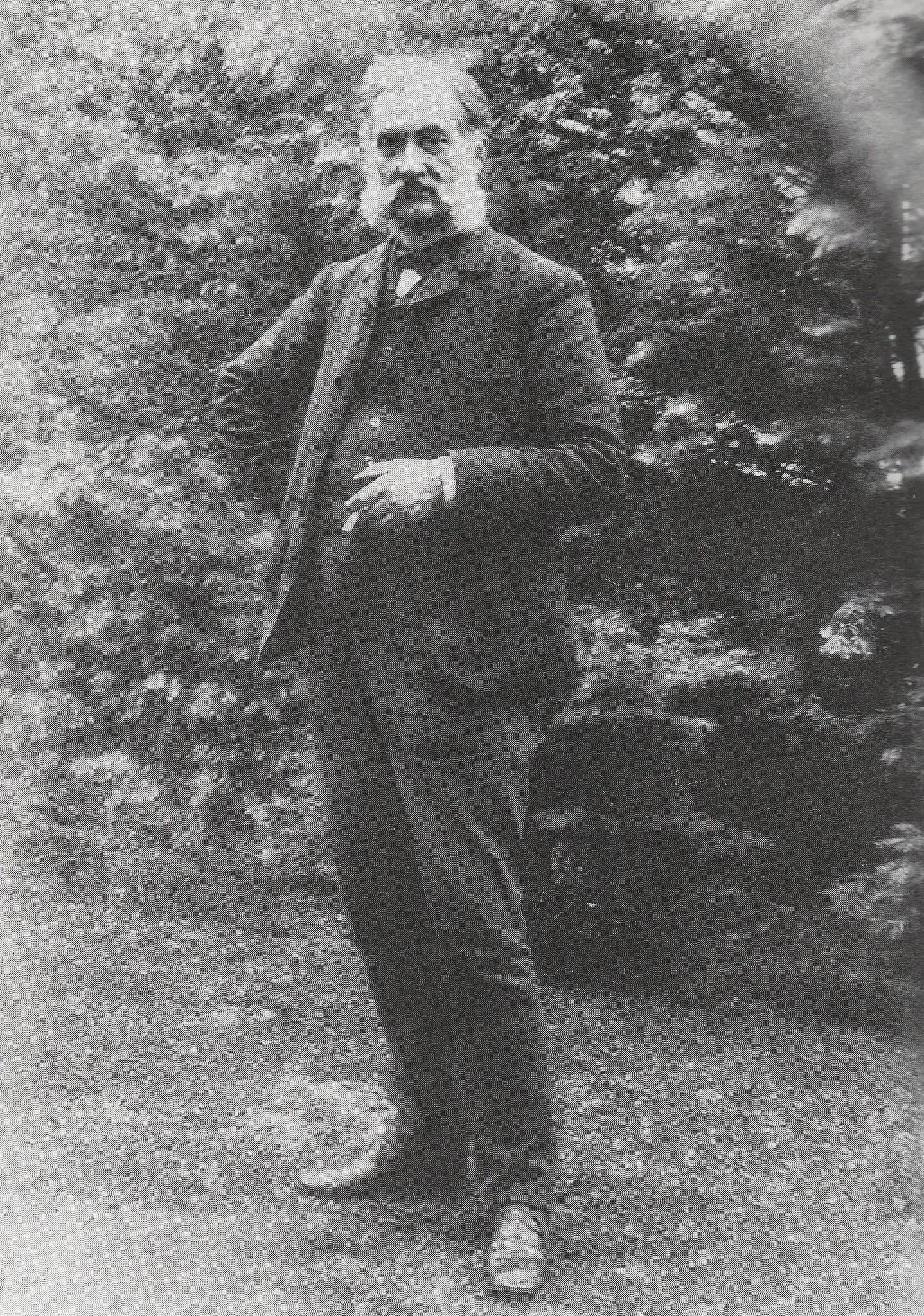
Disappearances Case file
The Inventor Who Stepped Onto a Train: Louis Le Prince, 1890
The man who shot the earliest surviving moving pictures in 1888 boarded a train at Dijon in September 1890, weeks before he was to demonstrate his work in New York, and was never seen again. No body, no luggage, no trace. The cause was never established, and the theories run from accident and suicide to fratricide and murder by commercial rivals, none ever proven.
- Case type
- Disappearance
- Status
- Unexplained
- Event date
- September 16, 1890
- Location
- Boarded a train at Dijon bound for Paris and vanished; he had filmed his pioneering 1888 footage in Leeds, England, and was traveling to demonstrate it in the United States - France
- Evidence
-
- Official record
- Testimonial
- Physical
The open question What became of Louis Le Prince after he boarded the Dijon-to-Paris train on 16 September 1890, a man who left no body, no luggage, and no trace.
On 16 September 1890, at the railway station in Dijon, Louis Le Prince boarded a train for Paris. He had been visiting his brother in the city, and he was working his way back toward England and then across the Atlantic, where he meant to show the world something no one had quite seen before: pictures that moved. Two years earlier, in a garden in Leeds, he had pointed a camera of his own design at his family and recorded a few seconds of them walking in a circle. That short strip of frames survives, and it is the oldest moving footage anyone has ever found. The demonstration in New York would have been his claim on the invention. He never made it. Friends waiting in Paris found that he was not on the train. He was never seen again, alive or dead. No body was recovered. No luggage was recovered. He was declared dead seven years later, in 1897.
That is the documented core of the case, and it is worth holding onto, because Le Prince’s disappearance is wrapped in one of the most contested origin stories in the history of technology, the question of who invented cinema, and the contest has attracted explanations that the record does not support. This is an account of who Le Prince was, what survives of his work, and what became of him. We keep three things separate, as always: what is documented, what the evidence shows, and what is only a hypothesis. There is no ending to dump in the first line, because no one has ever found one.
The documented account
Louis Aimé Augustin Le Prince was born in Metz, France, on 28 August 1841. (A 1842 birth year circulates in some genealogical sources; the date used here is 1841.) He trained as a painter in Paris and studied chemistry at Leipzig, and as a child he had spent time around the photographic work of Louis Daguerre, a family friend. He settled in Leeds, England, after befriending John Whitley, joined the family firm of Whitley Partners, and in 1869 married Sarah Elizabeth Whitley, known as Lizzie. In the early 1880s he moved to New York, and in 1889 he took French-American citizenship. His experimental work, though, stayed tied to Leeds.
What he was building there was a way to record and reproduce motion. He developed a multi-lens camera, applying for a United States patent in November 1886, and then a single-lens camera, the subject of a British patent in 1888. (The exact patent numbers cited online vary and are not reproduced here; they belong to the patent-office records, not to a popular retelling.) It is the single-lens camera, now held by the Science Museum Group and described in its collection as made by Le Prince at Leeds in 1888, that is associated with the footage that survives.
On 14 October 1888, in the garden of his in-laws’ house at Oakwood Grange in Roundhay, Leeds, Le Prince used that camera to film the sequence now called Roundhay Garden Scene. It runs about two seconds and shows his son Adolphe and members of the Whitley family walking in a circle. The Science Museum describes it as the oldest surviving film in existence. Around the same period he filmed a sequence of his son with an accordion and a street scene titled Traffic Crossing Leeds Bridge, shot from a building on the bridge. The footage ran at a low frame rate; the exact figure is disputed, with family accounts and later museum analysis giving different numbers.
It is tempting to stop there and crown him, and the temptation should be resisted. Le Prince’s footage does predate the landmarks usually cited: Thomas Edison’s first moving-picture patents in 1891, and the Lumière brothers’ first commercial projected show in December 1895. But film historians caution against calling him the father of cinema. Ian Macdonald of the University of Leeds has argued that the claim turns on whether inventing cinema requires public projection, and notes that Le Prince never gave a public demonstration of his work, while Étienne-Jules Marey publicly demonstrated projected moving images on 29 October 1888, roughly two weeks after Roundhay was filmed. The priority is also contested by other claimants of the period, among them Edison, the Lumières, and the British inventor William Friese-Greene, whose own 1889 patent likewise produced no successful public projection. The National Science and Media Museum in Bradford puts the one undisputed point carefully: Le Prince was, in its phrase, the first past the post with his pioneering work, while his fate is still unknown. He was first to the footage that survives. He was never first to a public screen, because he disappeared before he could be.
In September 1890 he was preparing to travel to the United States to premiere his work publicly, reportedly at the Morris-Jumel Mansion in New York, and to rejoin his family. He went first to France. He visited his brother Albert in Dijon, a trip connected in the standard accounts to family matters following their mother’s death. On 16 September 1890 he boarded the train at Dijon bound for Paris, meaning to continue on to England and then America. Friends expecting him in Paris found he was not aboard. Searches followed, by French police, by Scotland Yard, and by the family, and they found nothing. Neither his body nor his luggage was ever recovered. He was officially declared dead in 1897.
The aftermath played out in a courtroom he never entered. Because he vanished weeks before his planned demonstration, Le Prince never established his priority in his lifetime, and his work did not shape the commercial cinema that followed. In 1898 Thomas Edison sued the American Mutoscope Company in a patent dispute, and Le Prince’s son Adolphe testified for the defence about his father’s prior inventions. The trial court found for Edison as inventor in 1901, and that ruling was reversed on appeal in 1902. Adolphe himself did not live to see the case settled. He died of a gunshot wound in 1901 (the month is given variously as July and August in the sources), with a hunting gun nearby. The manner of his death is disputed: one account reports an official verdict of suicide, another holds it may have been an accident, and his mother, Lizzie, suspected foul play. That disputed death later became part of the conspiracy framing around the case, but it is a pattern people have read into events, not a documented cause, and it is kept out of the record here.
The evidence
Strip away the legend and the case rests on a short list of evidentiary channels. The striking feature of the list is that the most tangible items, the footage and the camera, are evidence of what Le Prince built, not of what happened to him. The evidence that bears on his fate is almost entirely an absence.
The surviving footage. Roundhay Garden Scene, and the Leeds Bridge and accordion sequences, survive as small numbers of frames. The Science Museum in London made a photographic glass-plate copy of roughly twenty surviving frames from the original negative in the 1930s, before the original was lost. What this establishes is that Le Prince captured motion on film in 1888. What it does not establish is successful public projection, which is the contested element of any first-cinema claim, and it says nothing at all about his disappearance.
The camera. The single-lens cine camera is held by the Science Museum Group, described as made by Le Prince at Leeds in 1888 and credited in the collection to a Le Prince family source. A related device is displayed at the National Science and Media Museum in Bradford, believed to be the equipment used to film the Roundhay and Leeds Bridge scenes. The collection note gives no frame rate; the figures that circulate online are reconstructions and claims, not instrument readings. Like the footage, the camera is evidence of the work, not the fate.
The patents. British, United States, and French patents are repeatedly cited and establish the documented fact of his inventive work. The exact numbers and grant dates differ between sources and are not reproduced here; they are the kind of detail that should rest on the patent offices’ own records.
The record of the journey and the search. The standard account places Le Prince at Dijon station, absent from the Paris train, and the subject of searches by French police, Scotland Yard, and the family. ACMI adds a detail that sharpens the void at the center of the case: not a single passenger on the train reported seeing him, despite his distinctive height and beard. These accounts come from reputable secondary sources rather than from the original 1890 police and railway records, which are the primary documents still to be traced.
The patent-litigation testimony. Adolphe Le Prince testified for the American Mutoscope Company against Edison. By ACMI’s account he sought to fix his father’s priority by noting that one of the people shown in Roundhay Garden Scene, his grandmother, died on 24 October 1888, which dates the film before Edison’s work. Wikipedia notes he was not permitted to enter the two cameras as evidence. The underlying court records were not consulted for this account and are named for anyone who wants the case caption and docket.
The 2003 Seine photograph. A photograph of a drowned man pulled from the Seine in 1890, said by some to resemble Le Prince, was reportedly found in 2003 in the Paris police archives. It is not an identification, and it is not treated as one here. The counter-point repeated across the sources is that the body appears too short to match Le Prince’s documented height. At best it is suggestive, and even that is generous.
The load-bearing fact in all of this is a negative one. There is no body, no luggage, and no witness to his fate. A man of distinctive appearance boarded a train, and no one on that train reported seeing him. Every theory below is built on that void.
The theories
Everything in this section is a hypothesis. None of it is proven, and two of these theories name long-dead people in wrongdoing that was never established; those are handled as attributed, contested speculation and nothing more. The ordering reflects what the evidence will and will not bear, not certainty.
Accident, illness, or a fall. The most mundane explanation is that Le Prince died of illness, an accident, or a fall in transit, with no other party involved. There is no specific evidence for it. It is the low-drama default, and given the missing body it can be neither ruled in nor ruled out.
Suicide. Some accounts hold that Le Prince, under financial and professional strain before a high-stakes demonstration, took his own life. Christopher Rawlence, author of the 1990 book and documentary “The Missing Reel,” is reported to have regarded suicide as the most likely explanation. The unconfirmed Seine photograph is sometimes cited in support, with the caveat about the body being too short to be him. The theory has its problems. An investigation cited by ACMI found that his business was in good shape, which cuts against the financial-strain version, and the sources conflict on the state of his finances. It is a leading scholarly preference rather than a proven account, and it rests partly on a photograph that identifies no one.
Fratricide. Some writers, the dossier names Jean Mitry in 1967, raised the possibility that Le Prince was killed in connection with family money, and questioned his brother Albert’s account of the journey. This must be read as exactly what it is: attributed historical speculation about a man long dead, never proven, and actively contradicted by the record. ACMI reports that family letters documented a close, loving relationship between the brothers, and that Albert funded the search for Louis after he vanished. There is no evidence that Albert Le Prince harmed his brother, and this publication does not assert that he did. The theory is listed because it exists in the literature, not because the record supports it.
Murder by Edison or commercial rivals. The most sensational theory holds that Edison or business interests had Le Prince removed to clear the patent field before his American demonstration. Le Prince’s widow, Lizzie, reportedly suspected Edison. The theory has circulated for more than a century, and it is unsupported by evidence. Even its best-known examination, Rawlence’s “The Missing Reel,” reportedly concluded that no concrete evidence has ever emerged, with Rawlence himself leaning toward suicide. No evidence ties Edison or any rival to the disappearance. It is recorded here as the family’s stated suspicion and a long-circulating popular narrative, and it is not a finding. This publication does not assert that Edison or anyone else committed a crime, because the record does not support it.
Deliberate disappearance. A final family of theories holds that Le Prince staged his own vanishing. The version that rests on something other than rumor is the one attributed to Jacques Deslandes in 1966, who proposed a voluntary disappearance for financial reasons and family convenience. There is no evidence that he did so, and the theory shares the central weakness of all the others: it explains an absence by inventing a motive for it.
None of the five is proven. Each is a way of filling a space that the evidence leaves empty.
What remains unknown
The honest residue of the Le Prince case is narrow, and a century of theory has not closed it.
A man boarded a train at Dijon on 16 September 1890 and did not get off where he was expected. No body was found. No luggage was found. No passenger reported seeing him aboard. He was searched for by two countries’ police and by his own family, declared dead seven years later, and never accounted for. The cause of his disappearance has never been established, and every explanation offered, accident, suicide, killing by a brother, murder by a rival, a staged vanishing, is an inference unsupported by any physical proof.
There is a particular irony in the void at the center of this case. Le Prince helped show the world that a camera could hold a few seconds of a life and play them back. His own footage survives, his family walking in a garden in Leeds in October 1888, frames that will outlast everyone who has ever written about him. He was first past the post, in the museum’s careful phrase, and he never got to claim it, because he stepped onto a train before he could and stepped out of the record entirely. The man who helped invent the moving image left not a single frame of his own ending.
So we will not tell you he was murdered, because no evidence has ever shown it and the man most often blamed cannot be placed anywhere near the train. We will not tell you his brother killed him, because the record shows a close relationship and a brother who paid for the search. We will not tell you he killed himself, because the leading proponent of that view conceded there was no concrete evidence, and the photograph offered in support identifies no one. We will not tell you he walked away on purpose, because that is a motive in search of a fact. What we can tell you is that on 16 September 1890, an inventor boarded a train at Dijon, and that is the last thing about him anyone can prove. The file is still open.
Sources
Primary / near-primary
- Science Museum Group Collection, “Single-lens Cine Camera by Louis Le Prince”
- Science Museum Group Collection, “Glass copy negative of Roundhay Garden Scene”
- National Science and Media Museum (Bradford), “The mystery of Louis Le Prince”
The Edison v. American Mutoscope Company litigation (filed 1898), in which Adolphe Le Prince testified, and Le Prince’s British, United States, and French patents are primary records that bear directly on the documented account. Neither was consulted in original form here, and both are named for the reader who wants the original case caption, docket, and patent numbers.
Secondary / contextual
- Wikipedia, “Louis Le Prince”
- Wikipedia, “Adolphe Le Prince”
- The Conversation, Ian Macdonald (University of Leeds), “Louis le Prince shot the first film, but did he invent movies?”
- Times Higher Education, “A movie murder mystery”
- ACMI (Australian Centre for the Moving Image), “The tragedy of Louis Le Prince”
- Wikipedia, “William Friese-Greene”
- Brighton & Hove Museums, “William Friese-Greene: a reputation set in stone”
- America Comes Alive, “May 13, 1898, Edison sues Mutoscope Co.”