Unexplained Deaths Case file
Auvers-sur-Oise, 27 July 1890: the contested death of Vincent van Gogh
For 136 years the wound has been read as self-inflicted. In 2011 the Pulitzer-winning biographers Steven Naifeh and Gregory White Smith reopened the file. The documentary record will support both readings, and the bullet was never extracted.
- Case type
- Unexplained death
- Status
- Disputed
- Event date
- July 29, 1890
- Location
- Auvers-sur-Oise, France (Auberge Ravoux, Place de la Mairie) - France
- Evidence
-
- Testimonial
- Physical
The open question How did Vincent van Gogh come to be shot on the evening of 27 July 1890 near Auvers-sur-Oise, and is the long-accepted self-infliction reading the only one the evidence will bear?
On the evening of Sunday 27 July 1890, Vincent van Gogh walked back into the Auberge Ravoux at Auvers-sur-Oise wounded by a single gunshot. He climbed the stairs to his attic room without help. The innkeeper Arthur Gustave Ravoux and his twelve-year-old daughter Adeline noticed his condition. Dr Mazery, the local Auvers physician, and Dr Paul-Ferdinand Gachet were summoned. The bullet was lodged near the spine. Both doctors judged extraction impossible without surgical facilities the inn did not have, and the bullet was never recovered. Vincent lay in the attic room for some seventy hours. His brother Theo arrived from Paris on the afternoon of 28 July. The two men spoke in Dutch. At approximately 01:30 AM on Tuesday 29 July 1890, with Theo at his side, Vincent died.
For 136 years that death has been read as a suicide. In 2011 the Pulitzer-winning biographers Steven Naifeh and Gregory White Smith reopened the case in Van Gogh: The Life with an accidental-shooting hypothesis. In July 2013 the Van Gogh Museum’s senior researchers Louis van Tilborgh and Teio Meedendorp answered in The Burlington Magazine. Neither side has carried the field. This piece is the case of the case. The documentary record for an 1890 rural death is unusually rich. The physical record is almost nothing: no autopsy, no coroner, no detailed clinical description, no recovered bullet. The question turns on what inferences the record will bear. We keep three things apart, as always. What is documented. What the evidence shows. And what remains only a hypothesis.
The documented account
Vincent Willem van Gogh was born on 30 March 1853 in Groot-Zundert, North Brabant. He moved to Paris in February 1886, sharing his brother Theo’s Montmartre apartment and studying at Fernand Cormon’s studio. In February 1888 he relocated to Arles in southern France, where his output during the next year ran to roughly two hundred paintings and more than a hundred drawings.
The crisis at Arles came on 23 December 1888. Vincent, then sharing a house with Paul Gauguin, cut part or all of his left ear with a razor. The extent of the injury is disputed. A 1930 sketch by Dr Félix Rey, the Arles physician who treated him, indicates he severed nearly the entire ear. Émile Bernard wrote in early 1889 that Vincent had cut the ear “clean through,” and Gauguin’s 1903 memoir Avant et après gives a similar account. Other sources describe the injury as confined to the lobe.
In May 1889 Vincent voluntarily admitted himself to the asylum at Saint-Paul-de-Mausole in Saint-Rémy-de-Provence. He remained there for approximately one year. Discharged in May 1890, he travelled north and arrived at Auvers-sur-Oise on 20 May 1890, placed under the care of Dr Paul-Ferdinand Gachet, a Paris physician with an interest in artists. Auvers is a rural commune approximately thirty kilometres northwest of Paris. He took a small upstairs room at the Auberge Ravoux on the Place de la Mairie, an inn owned by Arthur Gustave Ravoux. The room was an attic chamber of roughly seven square metres. He took meals downstairs and visited Dr Gachet at the doctor’s nearby house.
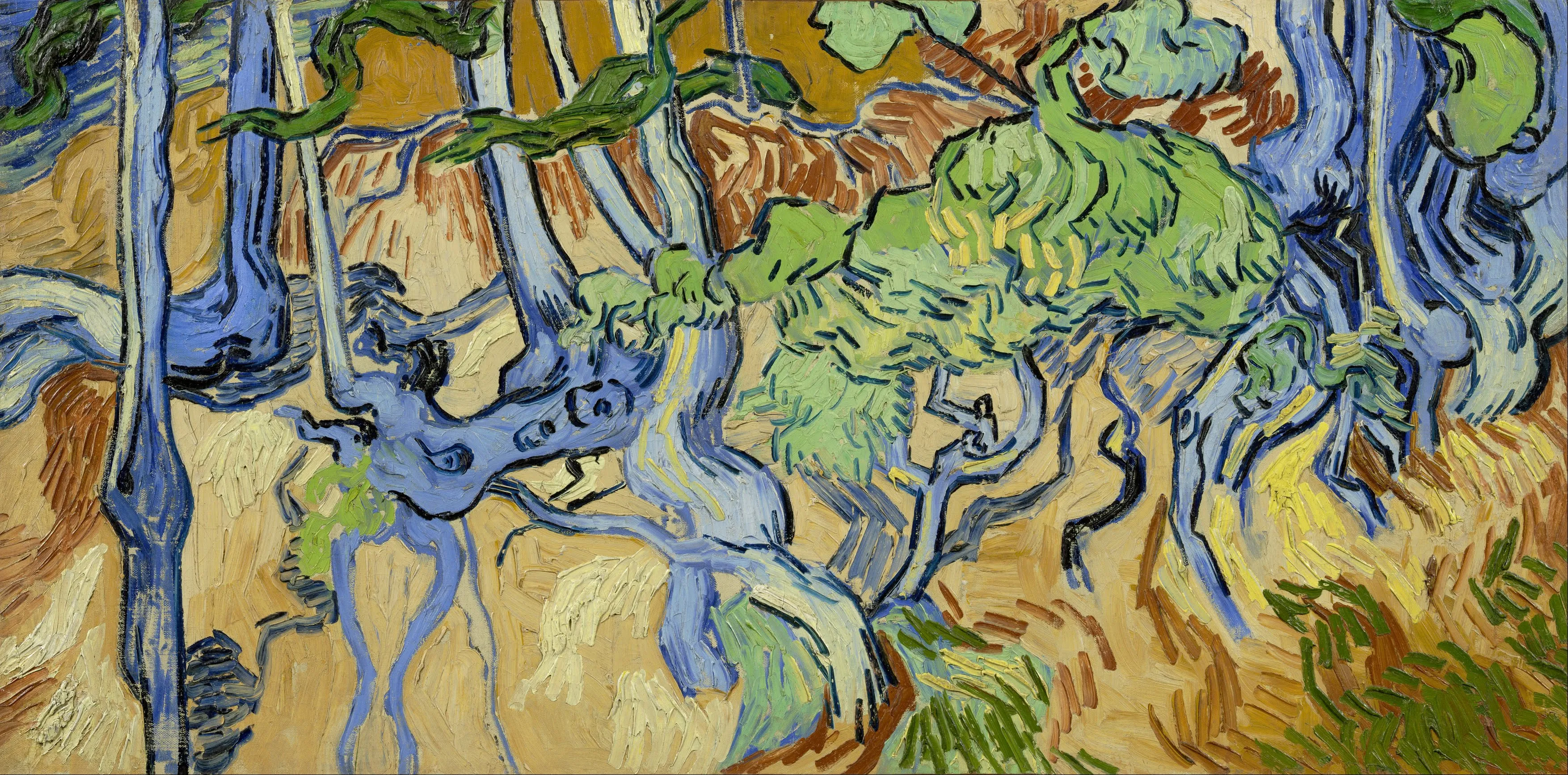
The seventy-day Auvers period was prolific. Vincent produced approximately seventy-five paintings and a comparable number of drawings, including the Portrait of Doctor Gachet, Daubigny’s Garden, Wheatfield with Crows, and Tree Roots. The popular identification of Wheatfield with Crows as his last canvas is the long-standing reading, but it is no longer the art-historical consensus. In 2012 Louis van Tilborgh and the vegetation specialist Bert Maes argued at the Van Gogh Museum that Tree Roots, not Wheatfield with Crows, was the canvas of the morning of his death. Their case rests on a 4 August 1890 letter from Andries Bonger to his parents and, since 2020, on a 1905 postcard that Wouter van der Veen of the Institut Van Gogh used to fix the precise location on the Rue Daubigny. A plaque was unveiled at the site that summer by Willem van Gogh, attending as the family’s institutional representative.
Theo van Gogh visited Auvers on Sunday 8 June 1890 with his wife Johanna van Gogh-Bonger and their infant son Vincent Willem. On Sunday 6 July 1890 Vincent travelled to Paris to see Theo and discussed Theo’s worries about his employment at the Boussod, Valadon and Cie gallery and the household’s strained finances. He returned to Auvers and resumed work. His letter to Theo of 23 July 1890, Van Gogh Museum letter number 902, is the last completed letter he sent. An earlier unfinished draft survives as RM25. A separate unsent letter was found on his body after the wounding.
On the evening of Sunday 27 July 1890 Vincent left the inn with painting equipment as he often did. He returned around dusk wounded by a single gunshot to the chest or upper abdomen. Sources differ on the entry location. Dr Gachet’s notes describe a wound to the left side. Modern summaries record the wound variously as in the chest, near the heart, or in the left abdomen, with the bullet entering at an oblique angle. Vincent climbed unaided to his attic room. Dr Mazery and Dr Gachet were summoned. The bullet was not extracted.
Local gendarmes questioned Vincent about the wound. He is reported to have said, in the version most often cited from Adeline Ravoux’s recollections, that what he had done was nobody else’s business. A second version, repeated in modern secondary literature, has him saying that his body was his own and that no one was to be blamed. Both versions come through later recollections rather than from a contemporaneous police record. No police record exists.
Theo van Gogh arrived from Paris on the afternoon of 28 July 1890, summoned by Dr Gachet’s telegram. He sat with Vincent through the day. Theo’s account of those hours, in a letter to Johanna dated 1 August 1890 from the Auberge Ravoux, records that Vincent was glad he had come and was reconciled to dying. Vincent died at approximately 01:30 AM on Tuesday 29 July 1890. The recorded cause of death was infection from the wound, consistent with peritonitis. The funeral was held the following afternoon, 30 July 1890, at the small municipal cemetery at Auvers. Theo placed sunflowers and other yellow flowers on the coffin alongside Vincent’s painting tools. Émile Bernard’s letter of 2 August 1890 to the critic Albert Aurier is the most detailed contemporaneous description of the funeral.
Theo van Gogh died six months later, on 25 January 1891 in Utrecht, of complications attributed in the contemporaneous record to syphilis. Johanna van Gogh-Bonger preserved and edited the brothers’ correspondence and published the three-volume Dutch edition in 1914, the foundational text on which the modern Van Gogh Museum letter archive is built.
The evidence
The evidence breaks into two kinds, and the imbalance between them is the case. The testimonial record is rich. The physical record is almost nothing.
The Van Gogh letter archive. The Van Gogh Museum holds and digitises the brothers’ correspondence at vangoghletters.org. The relevant items for the death are letter 902, Vincent to Theo, 23 July 1890; the RM25 draft; and the unsent letter found on Vincent’s body. Theo’s 1 August 1890 letter to Johanna, written from the Auberge Ravoux, is the best-attested document of Vincent’s final hours. The phrase most often quoted in connection with his death, “la tristesse durera toujours,” the sadness will last forever, comes through Theo in a later letter to his sister Lies and is not preserved as a contemporaneous transcription. Other reported versions of Vincent’s last words also come through Theo.
Émile Bernard to Albert Aurier, 2 August 1890. Bernard’s letter describes the funeral and Vincent’s last days, including Gachet’s report that Vincent told him “then I’ll have to do it over again.” It is the closest contemporary observer’s account outside the immediate household.
Andries Bonger to his parents, 4 August 1890. Johanna’s brother described Vincent’s last paintings, and it is partly this letter that supports the 2012 attribution of Tree Roots, not Wheatfield with Crows, as the canvas of 27 July 1890.
The Ravoux recollections. Adeline Ravoux published her recollections in a 1953 interview with Maximilien Gauthier and a 1956 memoir written in Auvers-sur-Oise. She described Vincent’s clothing, a blue drill jacket and a felt hat with large flaps, his demeanour, his return to the inn that evening, and his refusal to identify any other party. She also stated that her family had no previous relationship with Dr Gachet and that she had not seen the doctor at the inn before the wounding. Her testimony was given some sixty-three to sixty-six years after the events.
Dr Gachet’s notes and the Gachet fils volume. Dr Gachet’s own contemporaneous record is fragmentary. The fullest published account of his role is Paul Gachet fils, Souvenirs de Cézanne et de Van Gogh à Auvers (1873-1890) (Editions Pierre Cailler, 1953). Modern Van Gogh scholarship treats Gachet fils with caution. The Van Gogh Museum and van Tilborgh have flagged what they call the “Gachet legend,” a tendency in the son’s accounts to embroider or invent. Dr Gachet died in 1909. Paul Gachet fils died in 1962. Adeline Ravoux died in 1965.
The 1957 Doiteau interview with René Secrétan. Victor Doiteau, “Deux ‘copains’ de Van Gogh, inconnus, les frères Gaston et René Secrétan, Vincent, tel qu’ils l’ont vu,” Aesculape, 1957, is the only occasion on which René Secrétan publicly spoke about Vincent. He was then about eighty-two and approached Doiteau after seeing publicity for Vincente Minnelli’s 1956 film Lust for Life. He described, with his brother Gaston, befriending and pranking Vincent in Auvers in the summer of 1890, including hiding a garden snake in his paint box and putting salt in his coffee. He claimed to own a faulty revolver that misfired. He said he and Gaston had worn Buffalo Bill costumes. He did not state in the interview that he or his brother shot Vincent.
The 1960 Lefaucheux revolver. Around 1960 a farmer discovered a corroded 7mm Lefaucheux pinfire revolver of Belgian manufacture in a field behind the château at Auvers. He gave it to Roger and Micheline Tagliana, the then-owners of the café that had been the Auberge Ravoux. It remained in family custody for decades. In 2016 the Van Gogh Museum exhibited it in Amsterdam, describing it as plausibly the weapon. It was sold at Hôtel Drouot, Paris, by Auction Art Rémy Le Fur et Associés, on 19 June 2019 for €162,500, approximately US$181,600, against an estimate of €40,000 to €60,000. Specialists for the auction concluded that the revolver had been buried for well over fifty years, with corrosion consistent with abandonment in the late nineteenth or early twentieth century, and that the 7mm calibre matches Dr Gachet’s record of Vincent’s wound. The current operators of the Auberge Ravoux, the Janssen family and the Institut Van Gogh, publicly stated they had nothing to do with the sale and did not endorse the attribution. The ballistics have not been matched. The bullet was never extracted. The connection between the recovered revolver and Vincent’s death is plausible. It is not proven.
The hypotheses
Four readings sit on the record. None of them carries it.
1. Self-inflicted gunshot. The accepted reading from 1890 to the present. Its support is the testimonial record: Theo’s letter to Johanna of 1 August 1890, Bernard’s 2 August letter to Aurier, the Ravoux family’s account through Adeline Ravoux’s 1953 interview and 1956 memoir, Dr Gachet’s reports as preserved by Gachet fils in 1953, the Van Gogh Museum’s institutional position, and the van Tilborgh and Meedendorp 2013 article. Its constraints are also a matter of record. The precise wound trajectory was not clinically documented in detail. No revolver was found at the scene in 1890. The location of the shooting itself was never independently verified. No police or coroner inquiry was conducted, because the death was treated as a private matter.
2. Accidental shooting by the Secrétan brothers. Argued by Steven Naifeh and Gregory White Smith in Van Gogh: The Life (Random House, 2011), in an appendix titled “A Note on Vincent’s Fatal Wounding,” and developed further by the same authors with the forensic pathologist Dr Vincent Di Maio in “NCIS: Provence: The Van Gogh Mystery,” Vanity Fair, December 2014. The hypothesis: Vincent was accidentally shot by René Secrétan, then about sixteen, or by both brothers in a confrontation or drunken misadventure, in a barnyard or farm yard rather than a wheat field; the brothers fled; Vincent walked back to the inn and protected them with the story of a self-inflicted shot. The argument turns on the wound trajectory recorded by Gachet, the absence of powder burns suggesting the muzzle was not held against the body, the distance between the alleged shooting site and the inn, and the absence of the revolver at the scene. Its constraints are heavy. The wound was never autopsied, so the trajectory and muzzle-distance inferences rest on assumptions. The Secrétan brothers were named in no contemporaneous source as suspects. Vincent’s recorded statements to the gendarmes do not fit a cover-up. René Secrétan’s 1957 interview is read by Naifeh and Smith as an implicit admission. It is read by others as nothing of the kind.
3. The 2013 Burlington Magazine response. Louis van Tilborgh and Teio Meedendorp, “The Life and Death of Vincent van Gogh,” The Burlington Magazine, vol. 155, no. 1324, July 2013, pp. 456-462, argue that the contemporaneous evidence supports self-infliction. Their case: Naifeh and Smith’s reading of the Doiteau interview overreaches; Vincent’s own statements at the inn (declining to name another party, assuming responsibility) are inconsistent with an accidental shooting cover-up; the oblique wound trajectory and the absence of powder burns are compatible with the recovered Lefaucheux revolver being held at an awkward angle by a single shooter using his own body. They also note that René Secrétan stated he had left Auvers days before 27 July.
4. Medical-historiographical context. The published literature includes hypotheses of temporal-lobe epilepsy, bipolar disorder, lead poisoning from paints, and absinthe-related neurological symptoms as background to Vincent’s documented mental state at Arles in December 1888 and at Saint-Rémy through 1889 and 1890. These are documented hypotheses, not diagnoses, and they treat the death as a suicide rather than as a question. A fifth possibility, murder by an unnamed third party, is recorded only for completeness; no specific suspect outside the Secrétan brothers is named in any reputable source.
What remains unknown
The wound itself is the silence at the centre of the case. It was never autopsied. It was never described in clinical detail. The bullet was never extracted. Without those, the inferences that drive the accidental-shooting hypothesis (trajectory, muzzle distance, the implausibility of a self-administered shot at the recorded angle) are inferences from a record that cannot be cross-examined. The inferences that defend the suicide reading rest, in turn, on testimony given decades after the fact by witnesses with reasons to remember the events as they did. The recovered Lefaucheux revolver is plausible. It is not proven, and without the bullet it cannot be.
The closest thing to a primary statement from Vincent is what he is reported to have said at the inn: that no one was to be blamed, that his body was his own, that what he had done was nobody else’s business. Those words come to us through Adeline Ravoux’s recollections of 1953 and 1956 and through Naifeh and Smith’s later reading of the same evidence. Both sides quote them. Both sides interpret them differently. The defenders of the suicide reading hear an assumption of responsibility. The Naifeh and Smith reading hears a man shielding the people who shot him.
Gaston and René Secrétan, both long deceased, appear in this article because the 2011 biography names them. They are not named here as people who shot Vincent van Gogh, because the documentary record does not establish that they did. René’s only public statement on Vincent, the 1957 Aesculape interview, does not contain such an admission. He died not long after that interview. The reading that places them at the wounding is one reading among the documented hypotheses. It is recorded here, attributed.
What we have is what was on the record in 1890 and what has been added since: Theo’s letters, Bernard’s letter, Bonger’s letter, the Ravoux family’s later recollections, Gachet’s fragments, the 1957 Secrétan interview, the 2011 reopening, the 2013 response, the 2016 museum exhibition of the revolver, the 2019 Drouot sale, and the 2012 and 2020 attributions that fix Tree Roots as the canvas of the morning. None of those finishes the case. The case is finished only if the wound speaks, and the wound never did.