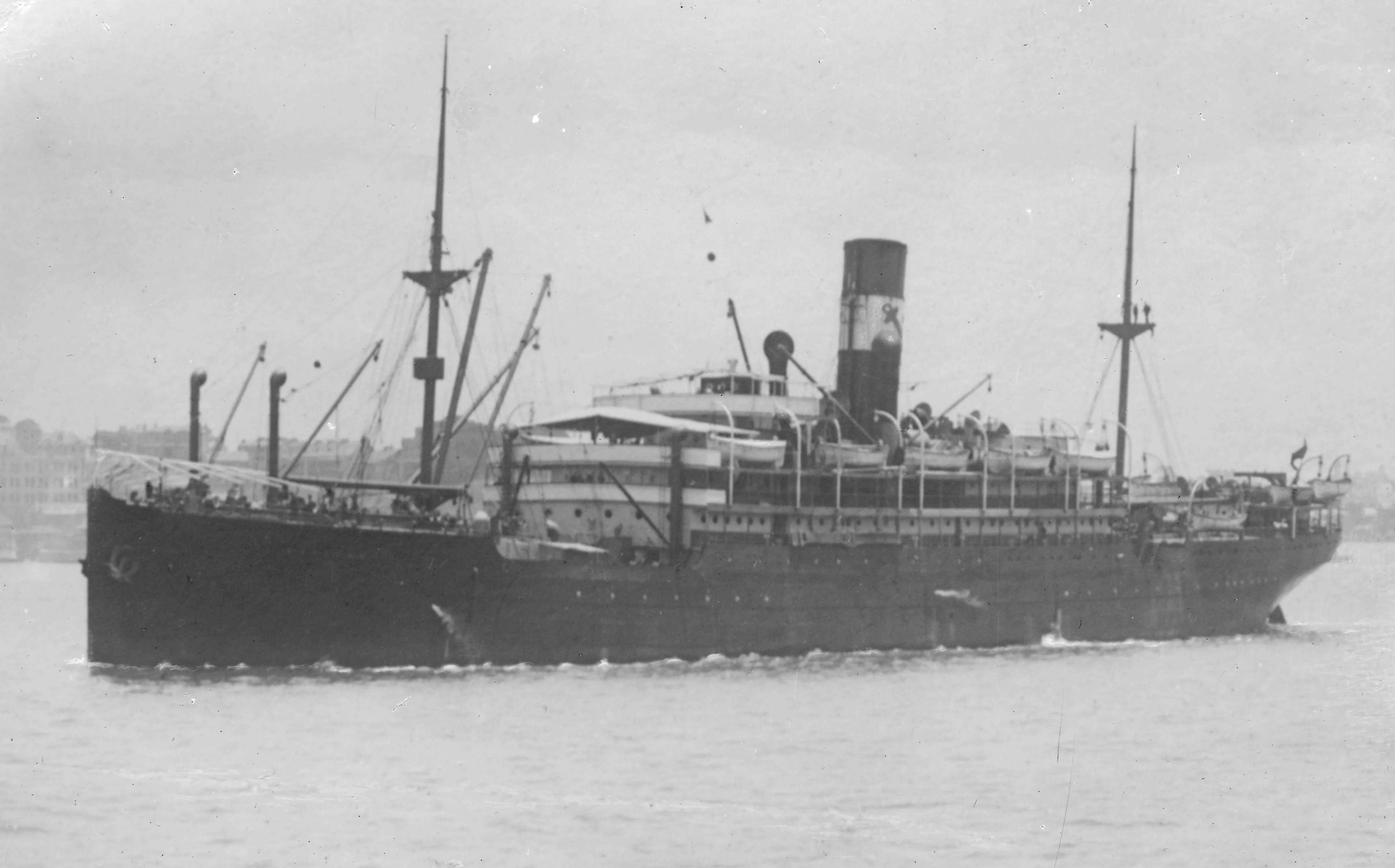
Maritime Mysteries Case file
The Liner That Never Reached Cape Town: SS Waratah, 1909
A year-old Blue Anchor liner left Durban for Cape Town in July 1909 with 211 people aboard, was last seen by another ship the next morning, and vanished in a gale with no wreckage, no bodies, and, to this day, no confirmed wreck. A 14-month British inquiry could not fix the cause. The central question of whether she was dangerously unstable was contested at that inquiry, and more than a century of searches has found nothing.
- Case type
- Maritime
- Status
- Unexplained
- Event date
- July 27, 1909
- Location
- Off the Wild Coast (Transkei) of South Africa, between Durban and Cape Town near the Mbashe (Bashee) River; she was last seen on the morning of 27 July 1909 and lost in the gale that followed - Indian Ocean (Agulhas Current coast) - South Africa
- Evidence
-
- Official record
- Testimonial
The open question What sent SS Waratah and her 211 people to the bottom somewhere off the Wild Coast in July 1909, a dangerously unstable ship or simply an exceptional sea, given that no wreck has ever been found.
At about a quarter past eight on the evening of 26 July 1909, the steamer SS Waratah cleared the harbor at Durban and stood out into the Indian Ocean, bound for Cape Town with 211 people aboard. She was a year-old liner of nearly ten thousand tons, the newest and one of the largest ships on the Blue Anchor Line’s emigrant run between London and Australia, and she was due in Cape Town in three days. The next morning she came up on a slower cargo steamer off the Wild Coast, exchanged signals, and drew ahead. A severe gale closed over the coast within hours. The Waratah never reached Cape Town, and she was never again seen with certainty. No wreckage was recovered, no body, no lifeboat. More than a century later, no wreck has ever been confirmed as hers.
The defining fact of this case is an absence. Most famous sea losses leave something to examine: a hull on the rocks, a debris field, a court that surveyed the wreck. The Waratah left a paper trail that runs up to one morning off the Mbashe River and then stops. Around that silence three different kinds of material have accumulated, and they have to be kept apart. There is the documented record: the ship, the final voyage, the last confirmed contact, the gale, the failed searches, and a Board of Trade inquiry that sat for fourteen months and could not fix the cause. There are the disputed sightings, none of them firm. And there are the theories, the foremost of which turns on a genuinely contested question about whether the ship was dangerously unstable, an argument that was fought out at the inquiry itself and never resolved. This is an account of what the record holds, what each line of evidence can and cannot show, and what is still open. We keep three things separate, as always: what is documented, what the evidence shows, and what is still only a hypothesis.
The documented account
SS Waratah was a new twin-screw passenger and cargo steamer of 9,339 gross tons, launched on 12 September 1908 by Barclay, Curle and Company at Whiteinch, Glasgow, for the Blue Anchor Line of W. Lund and Sons. She was about 465 feet long, built for the emigrant trade between London and Australia by way of the Cape, with several hundred berths and substantial cargo capacity. She had been classed “+100 A1,” Lloyd’s highest rating, and had passed the inspections of her builders, her owners, the Board of Trade, and Lloyd’s.
She was commanded by Captain Josiah (also known as Joshua) Ilbery, the Blue Anchor Line’s most senior master. He was an experienced commander of long standing with the line, though sources differ on exactly how long, and he was widely regarded as among its most trusted.
From early in her short career there were remarks about how the Waratah handled. Passengers and crew are recorded saying that she listed in calm conditions, rolled heavily, and was slow to right herself. It is important to mark at the outset that this reputation was contested even at the time. Other people who sailed in her described her as comfortable and stable, and the contradiction is itself part of the documented record rather than a settled fact. The substance of that argument belongs to the later sections; here it is enough to say the unease was on the record and so was the rebuttal.
The Waratah sailed from Australian ports in mid-1909, worked her way around to Durban, and departed Durban for Cape Town at about 20:15 on 26 July 1909, due in Cape Town on 29 July. She carried 211 people, commonly given as 92 passengers and 119 crew, together with a heavy cargo that included lead and iron concentrates, bullion, flour, wool, and frozen goods. She had no wireless fitted, which was not unusual for a merchant ship of the period but which meant that once she was over the horizon she could neither call for help nor be raised.
Early on 27 July 1909, off the Eastern Cape near the mouth of the Mbashe River, also written Bashee, the Waratah overtook the slower cargo steamer SS Clan MacIntyre. The two ships exchanged signals by lamp and flag. As later accounts render the exchange, each identified itself and its destination, the Clan MacIntyre asked after the weather and the Waratah answered, and the ships wished each other a good voyage. The Waratah, the faster vessel, drew ahead and was lost to view at about half past nine that morning. This is the last contact treated as confirmed.
A severe gale then struck the coast on 27 and 28 July. The Clan MacIntyre’s master later described it as the worst weather he had met in thirteen years at sea. The Waratah did not reach Cape Town. When she failed to arrive, tugs, Royal Navy vessels, and chartered ships searched the coast and the open sea. The Union-Castle cargo ship Sabine, chartered with Admiralty and Australian-government backing, searched roughly 14,000 nautical miles over about eight weeks in September and October 1909, and the Wakefield searched again into 1910. No wreckage, no lifeboat, and no confirmed body was ever recovered.
The British Board of Trade convened a Court of Inquiry in London, at Caxton Hall, sitting across late 1910 into 1911, an investigation that ran some fourteen months in all. It faced an unusual handicap: there were no survivors of the final voyage and no wreck to survey, so it heard its evidence largely from maiden-voyage passengers and crew, from the builders, and from port and survey personnel, and it concentrated on the stability question. The court concluded that the ship had been lost, foundering in the gale of late July 1909, but it did not establish the cause definitively. It found the ship well designed, well built, and properly classed, while it heard sharply conflicting evidence on her stability. It is reported to have been critical of the Blue Anchor Line’s practices for assessing the seaworthiness of a new ship, without directly blaming the company for the loss. (The precise wording of the court’s judgment should be read in the original report and the contemporaneous press; a verbatim quotation is not relied on here.)
No wreck has ever been confirmed as the Waratah. The single most famous claim to have found her came in July 1999, when a sonar target off the Eastern Cape was announced as a likely candidate. A dive in 2001 disproved it: the wreck was a different ship, the Second World War cargo vessel Nailsea Meadow, sunk by a U-boat in 1942. The South African explorer Emlyn Brown, who had led the search for more than two decades, ended his effort in 2004. The Waratah remains unlocated.
The evidence
The Waratah case has almost nothing physical at its center, and that is the first thing to be honest about. There is no wreck, no recovered debris, no body, and no lifeboat. What the case rests on instead is documentary and testimonial: the record of the last confirmed contact, the contested accounts of the ship’s handling, a set of disputed sightings, the record of the failed searches, and the Board of Trade inquiry. Every reading of what happened is a reconstruction built on that material, not an observation of the event. With that stated, here is what each channel shows and where it stops.
The last confirmed contact. The exchange with the Clan MacIntyre on the morning of 27 July is the strongest single item in the file. Two ships identified each other and fixed the Waratah’s position off the Mbashe River, steaming normally, the morning before the storm. The limit is fundamental: it establishes only that she was afloat and on course that morning. It says nothing about what happened in the gale that followed. The last firm fact in the case is a ship in good order, drawing ahead, and then nothing.
The stability reports and Claude Sawyer. There was documented contemporary unease about the Waratah’s motion, and it has to be presented precisely as what it was, a split record. A passenger named Claude G. Sawyer, an engineer who had sailed an earlier leg, disembarked at Durban rather than continue, citing the ship’s rolling and listing. He is reported to have cabled home that he thought the Waratah top-heavy and had landed at Durban; the exact wording of the telegram varies between accounts and is given here only as its reported gist. Crew remarks in the same vein are reported, to the effect that the ship recovered too slowly and that she was not trusted by some who sailed her. Set squarely against all of this is the inquiry. Other passengers and crew called her stable and comfortable, and expert witnesses testified that she was properly designed and built. The stability evidence was directly contradicted in court. The record is genuinely split, and the honest position is that the “top-heavy” reputation is documented but contested, not an established fact.
The disputed sightings. Three further sightings are often attached to the Waratah’s last hours, and all three are contested, each in its own way.
The crew of the SS Harlow reported, around half past five on the evening of 27 July, heavy smoke from a large steamer astern of them, then two bright flashes, after which that ship’s lights disappeared. The limit is serious: the Harlow’s captain is said to have first taken the glow for bush fires ashore and not to have logged the observation until the news of the loss broke, and the distance was on the order of a dozen miles or more. An explosion is only one possible reading of two flashes seen at night from that range.
The SS Guelph, late on the same evening, exchanged lamp signals with a vessel in poor visibility and could make out only the last three letters of its name, “T-A-H.” That is consistent with the Waratah but is partial and unverifiable, and proves nothing on its own.
A man named Edward Joe Conquer, a Cape Mounted Rifleman ashore, said he had watched through a telescope a ship matching the Waratah’s description roll heavily to starboard and be overwhelmed by a following wave. The decisive limit is that he did not report this publicly until 1929, some twenty years later, and the account is uncorroborated. Other reports of bodies or objects in the water in the weeks after the loss were never verified or recovered, and at least one was disputed at the time as possibly a roll of red-wrapped paper rather than a body. Some later “wreckage” claims were exposed as hoaxes. None of this material can carry weight as evidence.
The absence of wreckage, bodies, and boats. The most striking evidentiary fact is what was never found. An extensive immediate search, roughly 14,000 nautical miles by the Sabine alone, recovered nothing that could be confirmed as the Waratah. This is consistent with a very rapid capsize or foundering in deep water beyond the continental shelf, where a ship and her boats could go down together with little time to launch and little left to drift ashore. But the significance has a hard limit: absence of evidence is not, by itself, a mechanism. It tells us the loss was likely sudden and complete. It does not tell us what caused it.
The Board of Trade inquiry record. The formal investigation is the case’s anchor in the official record, and its weakness is built into it. With no survivors of the fatal voyage and no wreck to examine, its findings rest on inference from prior voyages, expert opinion, and the design and loading records. It heard the conflicting stability testimony, found the ship well built and well classed, attributed the loss to the gale, and declined to fix a definitive cause. It could establish that she was lost. It could not establish how.
What all of this returns to is the defining absence. No wreck has ever been located. No debris field was identified. No body and no lifeboat were recovered. No distress signal was sent, because she carried no wireless to send one. Every theory below is an attempt to fill that void with a sequence the record does not contain.
The theories
Everything in this section is a hypothesis. The cause of the loss was never established, the inquiry reached no firm determination beyond foundering in the gale, and none of what follows is proven. The most credible conventional reading is given the most weight, and the later legend is included only because the popular story contains it, marked strictly as the unverified layer it is.
Capsize in the gale, possibly a freak wave. This is the mainstream and inquiry-aligned reading: that the Waratah was overwhelmed in the severe gale of 27 and 28 July on a notoriously dangerous stretch of coast. The waters off the Wild Coast, where the warm, fast Agulhas Current runs against opposing swells, are known for producing exceptionally large and steep waves, and a freak or rogue wave is one form this explanation takes. The support is that a violent storm is documented in exactly the window after the last sighting, and that a sudden capsize would fit the total absence of survivors, signal, and recoverable wreckage. The limit is that the precise mechanism, a single giant wave against progressive heavy-weather flooding, is not established, because nothing was observed and nothing was found.
Instability or top-heaviness. This is the theory built on the contested stability reports, and it has to be labeled as contested. On this reading a poor stability condition, a high center of gravity and a slow recovery from a roll, let the ship heel and founder quickly, which would also help explain the lack of launched boats. The physicist Professor William Bragg is cited for the observation that in some conditions her metacentre sat close to or below her center of gravity, so that once heeled she would tend to hang rather than right herself smartly. That is one analyst’s point within the theory, not a proven fact about the ship. And the theory runs directly into the inquiry, where the stability case was contradicted by other witnesses and by expert testimony that the ship was properly designed. The instability reading is strongly argued and genuinely unresolved.
Cargo shift. A related mechanism holds that her heavy bulk cargo, commonly cited as on the order of a thousand tons of lead or iron concentrate, shifted under the ship’s motion in the gale, destroyed her stability, and brought on a sudden capsize. It was raised at the inquiry and in later analyses. It is a plausible contributory mechanism rather than a proven cause, and it is tied to the disputed question of how heavily she was actually laden.
Fire or explosion. This theory is built largely on the Harlow’s reported heavy smoke and two bright flashes, and on a coal-bunker fire recorded during the maiden voyage. It is speculative. The Harlow account is itself unconfirmed and was reinterpreted at the time as possible shore fires, and an explosion is generally thought an unlikely way to sink a ship so completely and so fast that nothing at all came back.
The later legend. A popular and sensational layer grew up around the loss after the fact, and it must not be mistaken for evidence. Claude Sawyer is said to have reported recurring nightmares before he left the ship, which he later read as a warning, and the spiritualist interest of the period, including Arthur Conan Doyle, attached itself to the story, with séances claiming to reach the lost. This is the legend, not contemporaneous documentation, and reputable accounts explicitly note that such claims were never verified. It belongs here, briefly and clearly labeled, as the cultural layer that formed afterward. It tells us nothing about why the ship was lost.
What remains unknown
The honest residue is stark. A year-old liner with 211 people aboard left Durban on the evening of 26 July 1909, passed another ship in good order the next morning off the Mbashe River, and steamed ahead into a gale that the master of that other ship called the worst in thirteen years at sea. She never arrived at Cape Town. The searches that followed, including roughly 14,000 nautical miles by the Sabine, found nothing. The Board of Trade inquiry sat for fourteen months, concluded she had foundered in the gale, and could not fix the cause. The 1999 candidate proved to be a different ship, the Nailsea Meadow, and the long search ended in 2004 with the wreck still unfound.
The cause was never determined. The stability question, whether she was dangerously top-heavy or simply a sound ship caught by an exceptional sea, was argued at the inquiry from documented reports on one side and direct contradiction on the other, and it has never been resolved. The wreck has never been located on a coast that ships pass to this day. What the evidence best allows is a capsize in the gale, perhaps aided by her loading or by a freak wave on the Agulhas coast, overcoming her quickly enough to leave no signal, no boat, and nothing to find. But that is an inference the record permits, not a finding the record proves, and the contradiction at the heart of the stability evidence keeps even it short of certain.
So we will not tell you the case is solved, because the court that investigated it could not solve it, and the most credible reading remains a reconstruction rather than a finding. What we can tell you is that somewhere off the Wild Coast, on a stormy night after the morning of 27 July 1909, a ship of nearly ten thousand tons, with 211 people in her, went down so completely that not one confirmed trace of her or of them was ever recovered. The cause was never established. The file is still open.
Sources
Primary / documentary
- “THE WARATAH. INQUIRY COURT’S JUDGMENT. ANALYSIS OF EVIDENCE,” The Mercury (Hobart), 8 April 1911, via Trove
- “LOSS OF THE S.S. WARATAH,” 21 February 1911, via Trove
- Lloyd’s Register Foundation Heritage & Education Centre, Board of Trade / Waratah inquiry correspondence (1910), LR-FAF-TB5-0153-L
- Lloyd’s Register Foundation Heritage & Education Centre, Board of Trade / Waratah inquiry correspondence (1910), LR-FAF-TB5-0156-L
- The official Board of Trade wreck report on the loss of the SS Waratah (the inquiry’s primary record) should be consulted directly for the exact wording of the court’s judgment, which is paraphrased rather than quoted in this article. P. J. Smith, The Lost Ship SS Waratah: Searching for the Titanic of the South (Tempus, 2004), is a book-length specialist treatment of the inquiry and the stability question, recommended for the same purpose; neither was read directly for this draft.
Secondary / contextual
- Wikipedia, “SS Waratah”
- State Library of South Australia, “‘Australia’s Titanic’, the sinking of the SS Waratah”
- NUMA (National Underwater and Marine Agency), “Waratah” expedition page
- Discovery UK, “What Happened to the SS Waratah and Has it Been Found?”
- Master Mariners of Australia, “The Other Titanic? SS Waratah, the Lost Ship of South Africa”
- Pauline Conolly, “SS Waratah, Australia’s Titanic” (2014)
- Find a Grave, “CAPT Josiah Edward ‘Joshua’ Ilbery (1840-1909)”
- Independent Online (IOL), “Search for Waratah goes on after ‘false’ find”
- Amusing Planet, “The Disappearance of the Waratah”