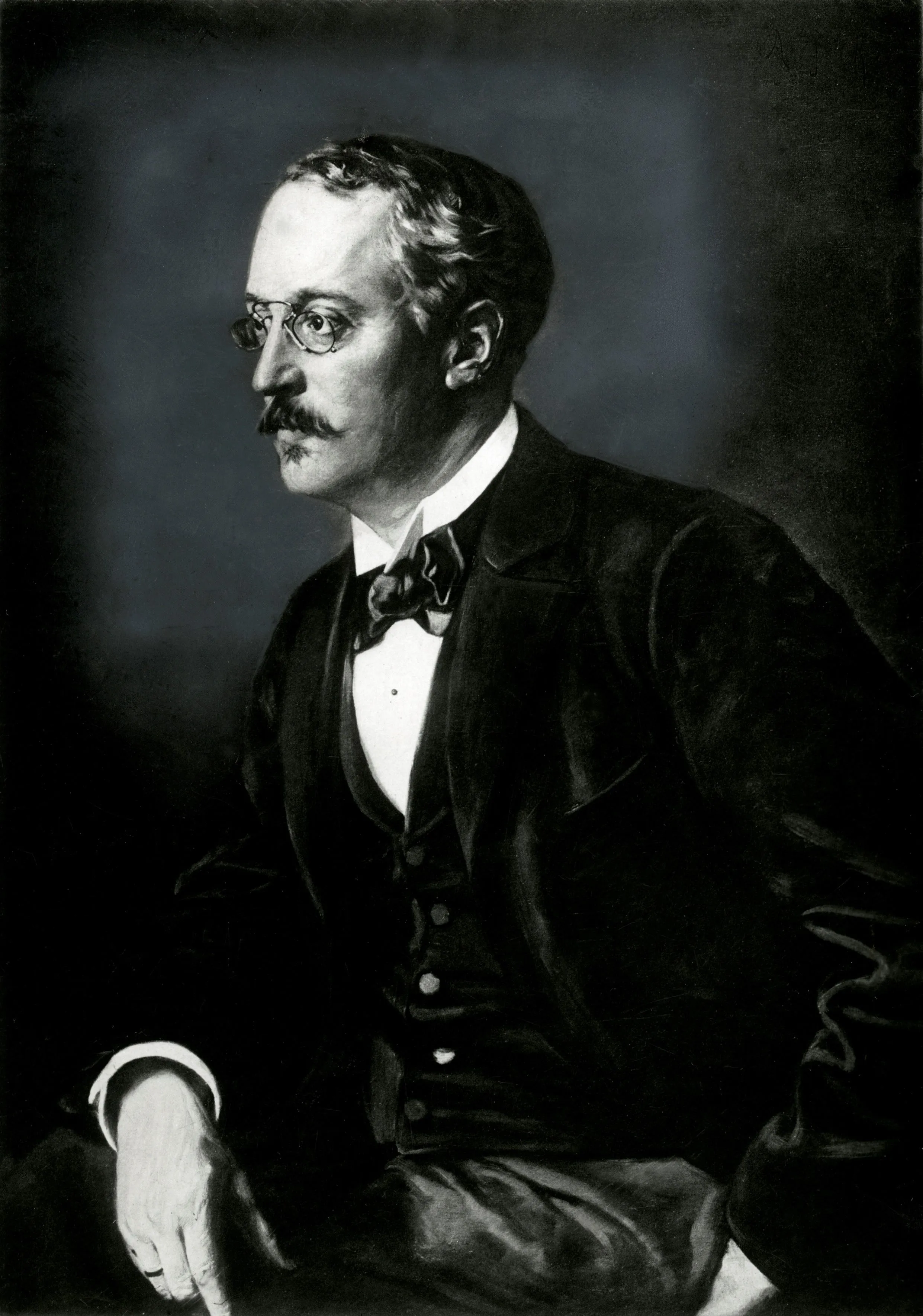
Unexplained Deaths Case file
A Folded Coat on the Deck: The Death of Rudolf Diesel, 1913
On the night of 29 September 1913 the inventor of the diesel engine boarded a Channel steamer, dined, retired to his cabin, and was never seen alive again. The manner of his death was never established.
- Case type
- Unexplained death
- Status
- Unexplained
- Event date
- September 29, 1913
- Location
- Aboard the SS Dresden, Antwerp to Harwich (his effects found in the Eastern Scheldt, Netherlands) - English Channel / North Sea
- Evidence
-
- Physical
- Testimonial
The open question What happened to Rudolf Diesel after he vanished from the deck of the Dresden, and was his death suicide, murder, or accident?
On the evening of 29 September 1913, Rudolf Diesel boarded the steamer Dresden at Antwerp, bound across the North Sea for Harwich. He was one of the most famous engineers alive, the man whose name was already attached to the compression-ignition engine he had patented two decades earlier. He dined aboard with two companions, retired to his cabin for the night, and was never seen alive again. The next morning his bed had not been slept in. A hat and a neatly folded overcoat were found on the deck.
What happened to Diesel between that dinner and that morning has never been established. About ten days later a badly decomposed body was found floating at sea, too far gone to recognise; the men who found it took the personal effects from its clothing and returned it to the water, so no one ever examined it. His son later identified those effects as his father’s. That is very nearly the whole of the documented record, and the gap inside it is the case. We keep three things apart throughout, as always: what the record documents, what the surviving evidence can and cannot show, and what is only hypothesis.
The fact that governs everything else belongs at the top rather than at the end. No body was ever recovered or examined, there was no autopsy, and the authoritative reference record describes no formal inquest or coronial finding of cause. Encyclopaedia Britannica says only that Diesel “disappeared from the deck of the mail steamer Dresden en route to London and was assumed to have drowned,” and assigns no cause. Most historians lean toward suicide, and we will set out honestly why. But suicide was never proven, the murder theories that formed within the week have never been disproven, and the evidence is too thin to choose among them with confidence. The mystery is not a whodunit. It is a documented blank.
The documented account
The defensible core is spare, and it is worth stating how spare.
Rudolf Diesel was born on 18 March 1858 in Paris, to German parents. He studied engineering under Carl von Linde, conceived his compression-ignition engine around 1890, secured a German patent in 1892, and demonstrated a working engine in 1897. The engine was a major commercial success and brought him substantial royalty wealth. By 1913, as the evidence below sets out, his finances had nonetheless collapsed.
On the evening of 29 September 1913 he boarded the SS Dresden, a Great Eastern Railway steamer, at Antwerp, Belgium, bound for Harwich, England. The purpose of the crossing was business. He intended to land at Harwich, travel to Ipswich to inspect a new diesel-engine works belonging to the Ghent industrialist George Carels, and attend a meeting of Consolidated Diesel Manufacturing Ltd. in London. The Ipswich works and the London meeting are the better-anchored parts of his itinerary. Many accounts add that he was also to meet Royal Navy representatives about powering British submarines with diesel engines; that detail is central to the murder theories and is repeated almost everywhere, but it is not pinned in the top-tier reference sources, and we report it as widely repeated rather than as established fact. Travelling with him were Carels and Carels’ chief engineer, Alfred Luckmann. The three dined together aboard.
After dinner Diesel retired to his cabin. Several accounts add that he did so around ten in the evening and left word to be called at 6:15 the next morning; those details are widely repeated but secondary, and we report them as such. When his cabin was checked the following morning, 30 September, it was empty and his bed had not been slept in. The unslept bed is the firmest single physical fact in the case. Widely repeated secondary accounts add that his nightshirt had been laid out and his watch left where it could be seen from the bed, and that on the deck, near the stern, lay his hat and a neatly folded overcoat. We report those as reported.
Roughly ten days after he was last seen, the crew of a vessel found a badly decomposed, unrecognisable male body floating at sea. The best-anchored account names a Dutch pilot boat and places the find in the Eastern Scheldt, the North Sea estuary in the Netherlands. (It was not, as one careless retelling has it, near Norway.) Because of the body’s condition and the weather, the crew did not bring it aboard. They removed the personal effects from the clothing and returned the body to the sea. It was therefore never recovered and never examined. The effects, variously listed across sources as a pill case, a wallet, an identity card, a pocketknife, and a spectacles case, were the only physical link to the man in the water. On 13 October 1913, Diesel’s son Eugen identified them as his father’s. The body itself was gone.
Before he left, Diesel had given his wife, Martha, a bag with instructions not to open it until the following week. When she did, she found, by the most-cited account, about 20,000 German marks in cash and financial statements showing that the family’s bank accounts were virtually empty. (At least one retrospective describes the bag’s contents differently, as holding little money and his designs; the contents vary between sources.) His finances had collapsed, attributed to unsuccessful stock-market speculation and poor real-estate dealings. We report this soberly, as evidence, and draw no verdict from it here.
The evidence
The defining feature of this case is how little there is to weigh, and that the little there is sits on the far side of a missing body. There was no autopsy, no forensic examination, no recovered remains, and no documented inquest finding of cause. Every theory below is an inference from a thin circumstantial record: an empty cabin, items on a deck, a decomposed corpse identified only by its pockets, a reported diary mark, and a documented financial collapse.
The empty, unslept cabin. That Diesel’s bed had not been slept in is the most consistently reported and the most load-bearing physical fact. It supports the inference that he went over the side in the evening or early night of 29 to 30 September, before he would have gone to bed, rather than in the small hours. It is well attested in substance. The further cabin details, the laid-out nightshirt and the positioned watch, are secondary and attributed.
The hat and the folded overcoat. A hat and a neatly folded overcoat reported on the deck near the stern are consistent with a man who removed his outer clothing before going over the side, which is how suicide proponents read them. But the same scene is equally consistent with an accidental fall, and, in the murder reading, with staging. The placement is a secondary detail. The evidentiary value cuts in more than one direction, and it is not proof of intent.
The reported diary cross. According to one widely repeated account, the diary Diesel carried aboard bore a cross drawn on the page for 29 September, “possibly indicating death.” This detail is one of the two pillars of the suicide reading, and it is weakly sourced: it traces in the reference record to a single popular book rather than to a primary document or to Eugen Diesel’s biography of his father. We report it strictly as a reported detail, attributed, and we do not treat it as documented fact or gloss it as proof of intent. The interpretation of a cross as a death-mark is itself speculation, not a recorded statement of intent.
The recovered effects. The effects taken from the decomposed body are the sole physical basis for concluding that the body was Diesel’s, and the identification rests on Eugen Diesel recognising the items rather than on any examination of the body, which was already gone. Because the corpse was advanced in decomposition and never recovered, the identification is inferential. That is an honest evidentiary limit, and it is the seam the faked-death theory later tries to open.
The documented financial distress. The strongest documented circumstance is that Diesel was in severe financial difficulty at the time, with heavy debt and accounts that were nearly empty, the cash and the financial statement left for Martha being part of that record. This is the best-anchored element of the suicide case and is corroborated across encyclopedic and reputable secondary sources. It establishes a motive for despair. It does not establish that he died by suicide.
The decisive absence. No body was examined, no remains survive, no forensic identification was made, and no documented inquest assigned a cause. Britannica records only an assumption of drowning. This absence is not a gap that better research will close; it was already a blank when the body went back into the sea. It is the reason the case is genuinely unresolved, and it is the spine of any honest account of it.
Hypotheses and open questions
Everything in this section is a hypothesis. None is established and none is endorsed. They are laid out roughly most-favored first, which is not the same as most likely.
Suicide. This is the most commonly favored reading, advanced by Diesel’s biographers and repeated across encyclopedic and popular sources. In its favor: the documented near-insolvency and heavy debt; the bag of cash and the financial statement left for his wife with instructions to open it later, read as a man setting his affairs in order; the reported diary cross; and the unslept bed with the hat and folded coat on deck, read as a man preparing to go over the side. Against it, or in caution: no body was examined and no inquest established a cause; the diary-cross pillar is weakly sourced; the deck clothing and the bag are also consistent with an accident or with staging; and the “official suicide ruling” that some popular accounts assert is not documented in the top-tier record. The honest statement is that most historians lean toward suicide and that it was never proven. We report that lean as a fact about the state of historical opinion, and not as a verdict.
Murder to keep diesel technology from Britain. This theory holds that Diesel was killed, or thrown overboard, to stop him sharing diesel-engine technology, valuable for submarines, with Britain on the eve of the First World War. It formed almost immediately: a 1913 headline cited by History.com ran “Inventor Thrown Into the Sea to Stop Sale of Patents to British Government.” In its favor, supporters point to the 1913 timing, the rising Anglo-German naval tension, the strategic value of diesel power for submarines, and his reported intent to meet the Royal Navy. Against it: there is no evidence of foul play, no identified perpetrator, and no body to examine. Where powerful names appear in such tellings, they appear as interested parties with a motive in a theory, never as anyone shown to have ordered or committed a killing.
Murder by oil or industrial rivals. A parallel theory holds that interests threatened by the diesel engine, most often framed as the major oil concerns, had him killed. It too formed at once: a 1913 headline cited by History.com ran “Murdered by Agents from Big Oil Trusts.” In its favor, supporters point to the engine’s disruptive threat to incumbent fuel and engine businesses. Against it: again, no evidence and no identified perpetrator, and critical coverage treats the oil-murder theory as unsupported. We present it as attributed popular theory, and we name no one as a culprit.
Accident. A fall from the deck of a night Channel crossing, in the dark and possibly in rough conditions, requires no motive and is consistent with Britannica’s neutral “assumed to have drowned.” Against it, the bag left for his wife and the reported diary cross point away from a pure accident, though the physical scene does not exclude one. It is plausible and undetermined, and it is the explanation that best fits Britannica’s deliberately neutral framing.
A faked death. In a 2023 popular book, the novelist Douglas Brunt argues that the death was neither suicide nor murder but faked, and that the floating corpse was not Diesel at all. One version of the thesis, reflected in the reference summaries, holds that the British government staged the death to cover a defection, after which Diesel supposedly worked on submarine-engine development in Canada. This is Brunt’s attributed hypothesis, not a finding. Brunt is a researched but non-academic author advancing a thesis, and reviewers are mixed: one came away convinced the floating corpse was not Diesel, while others were unpersuaded. We attribute it strictly to Brunt and do not adopt it. The book exploits exactly the seam noted above, that the body was identified only by its effects, but the thin identification leaves that question open without proving the body was someone else.
What remains unknown
Set the readings side by side and the same hard kernel survives all of them: there is not enough left to choose. The manner of Rudolf Diesel’s death is unestablished, and it is probably now unknowable. The body was never recovered or examined. There is no documented inquest finding of cause. The identification rests on a few effects taken from an unrecognisable corpse and recognised by a grieving son. Against that thin physical record sit a documented financial collapse and a reported, weakly sourced diary mark that incline most historians toward suicide; a strategic context that has sustained murder theories since the week he vanished; a plausible accident; and a recent faked-death thesis. No version is proven.
So we will not tell you Diesel killed himself, because the cause was never established and the strongest pillars of the suicide reading are an inference of motive and a weakly sourced diary mark, not a finding. We will not tell you he was murdered, because nothing in the record documents a crime or a perpetrator, and we will name no one. We will not tell you it was an accident, though it fits the neutral record as well as anything. And we will not adopt the faked-death thesis, because it is one author’s argument and the identification it disputes was never strong enough to settle either way.
What we can tell you is the documented blank itself, which is the real and permanent mystery. A world-famous inventor, near-ruined, walked his ship’s deck on a night crossing and was never seen again. He left a folded coat on the deck, an unslept bed, and a bag for his wife. Ten days later the sea gave up a body too decayed to know, and then took it back before anyone could examine it. The file is thin, and it is not going to close.
Sources
Primary / authoritative reference
Secondary / contextual
- Wikipedia, “Rudolf Diesel”
- History.com, “Inventor Rudolf Diesel mysteriously vanishes (September 29, 1913)”
- The Classic Car Trust, “The Mysterious Death of Rudolf Diesel”
- Leader’s Edge Magazine, “A Famous Death That Wasn’t?”
- Douglas Brunt, “The Mysterious Case of Rudolf Diesel” (Simon & Schuster, 2023), publisher page