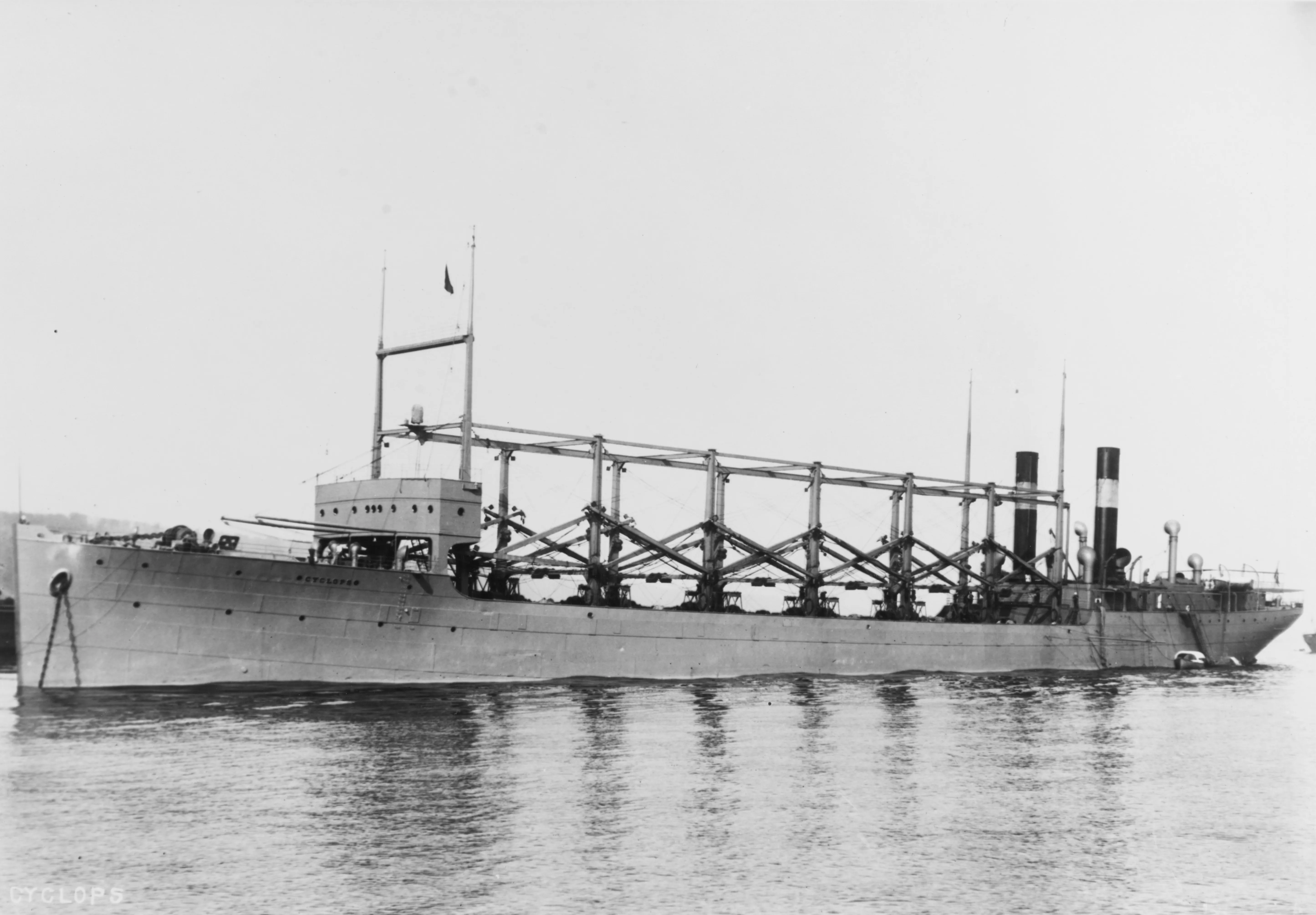
Maritime Mysteries Case file
Vanished With All Hands: USS Cyclops, 1918
A 540-foot Navy collier with about 300 people aboard left Barbados for Baltimore in March 1918 and was never seen again, the largest non-combat loss of life in United States Navy history. The official cause is still unknown. The leading engineering explanation lies in the dense manganese ore she carried, and in two sister ships later lost the same way, while the wartime treachery suspicions and the Bermuda Triangle framing are things the record does not support.
- Case type
- Maritime
- Status
- Unexplained
- Event date
- March 4, 1918
- Location
- Last departed Barbados on 4 March 1918, bound for Baltimore; lost somewhere in the western Atlantic between the Caribbean and the US East Coast (she had loaded manganese ore at Rio de Janeiro) - Atlantic Ocean - United States
- Evidence
-
- Official record
- Testimonial
The open question What sent USS Cyclops and her roughly 300 men to the bottom without a wreck, a body, or a signal, somewhere between Barbados and Baltimore in March 1918.
On 4 March 1918 the United States Navy collier USS Cyclops cleared the harbor at Barbados, bound for Baltimore with a cargo of manganese ore and about 300 people aboard. She was due in port some nine days later. She never arrived. There was no distress signal, no wreckage, no body, no oil slick, and no claim by any enemy. A ship 540 feet long, one of the largest in the fleet, sailed into the western Atlantic and left nothing behind. More than a century on, the Navy still records the cause of her loss as unknown, and she remains the single largest non-combat loss of life in United States Navy history.
The defining fact of this case is an absence. Almost every famous sea mystery leaves something to examine: an abandoned hull on the shoals, a derelict found adrift, a court that surveyed the wreckage. The Cyclops left none of that. What survives is a paper trail that runs up to her departure from Barbados and then stops. Around that silence three very different stories have grown. The official one is short: cause unknown, probably a storm. The engineering one, favored by naval analysts, points to the dense ore in a hull built for coal, and draws its strongest support from the fact that two of her sister ships were later lost the same way. The third is a cluster of legends, a wartime suspicion that her German-born captain betrayed her, and a much later Bermuda Triangle framing, that the documented record does not bear out. This is an account of what the record holds, what each line of evidence can and cannot show, and what is still open. We keep three things separate, as always: what is documented, what the evidence shows, and what is still only a hypothesis.
The documented account
USS Cyclops (AC-4) was the second of four Proteus-class colliers, fuel ships built to carry coal and refuel the fleet at sea, ordered for the United States Navy before the First World War. She was launched on 7 May 1910 at the William Cramp & Sons yard in Philadelphia and commissioned into the Naval Auxiliary on 1 May 1917, after America entered the war, under Lieutenant Commander George W. Worley. She was large for her day, reported at roughly 542 feet in length and around 65 feet in beam, with a full-load displacement near 19,000 long tons and a service speed in the region of 15 knots. (These dimensions come from secondary specification tables derived from the Navy’s own ship history and should be confirmed against that record directly; they are given here as approximate.)
After American entry into the war she made a convoy run to France in mid-1917 and then worked along the East Coast. On 9 January 1918 she was assigned to the Naval Overseas Transportation Service and sailed south to fuel British warships operating in the South Atlantic, departing Norfolk with roughly 9,960 tons of coal.
At Rio de Janeiro, in mid-February 1918, she took on her last cargo: approximately 10,800 long tons of manganese ore, a dense metallic load, for delivery to Baltimore. Manganese ore is far heavier for its volume than the coal the ship was designed to carry, a detail that becomes important later. She departed Rio on 16 February, called at Salvador in Bahia on 20 February, and on 22 February left for Baltimore with no further stops scheduled.
She then made an unscheduled call at Barbados in early March. The accounts tie this stop to provisions and to concerns about her loading. By some reports her waterline sat above the Plimsoll mark, the line that indicates a ship is loaded beyond her safe limit. Set against that, a post-loss investigation at Rio is reported to have concluded that the ship “had been loaded and secured properly.” Both findings are in the record, and they partly conflict; the true degree of any overloading is contested. Before leaving Barbados, Commander Worley had reported that the starboard engine had a cracked cylinder and was inoperative, which had reduced the ship to roughly 10 knots. A survey board is reported to have recommended that she return to the United States for repairs. She proceeded instead.
Cyclops departed Barbados on 4 March 1918, bound for Baltimore. She was never seen or heard from again. A reported sighting on 9 March by the molasses tanker Amolco, off Virginia, circulated afterward, but that account was disputed and denied, and it is treated here as a rumor only, not as a fixed point in the timeline. She was due at Baltimore around 13 March. When she failed to arrive, French and American vessels searched the trade routes between Barbados and Baltimore and found nothing. On 1 June 1918, Assistant Secretary of the Navy Franklin D. Roosevelt declared the ship officially lost and all hands deceased.
Among those aboard was the United States Consul-General at Rio de Janeiro, Alfred Louis Moreau Gottschalk. Several court-martialed prisoners were also reported to have been carried aboard. Her commander, George W. Worley, was German-born, recorded as Johan Frederick Wichmann; that biographical fact is documented and is set out plainly here, and it is kept distinct from the wartime suspicions that later attached to it, which belong with the hypotheses below. No wreckage, no body, and no distress signal were ever recovered. The cause of loss remains officially unknown.
The evidence
The Cyclops case has almost nothing physical at its center, and that is the first thing to be honest about. There is no wreck, no recovered debris, no body, and no surviving witness. What the case rests on instead is the Navy’s own official record of the loss and the documentary testimony around the final voyage: the loading accounts at Barbados, Worley’s pre-departure report on the engine, the search records, and the later naval analysis. Every reading of what happened is reconstruction built on that paper, not observation of the event. With that stated, here is what each channel shows and where it stops.
The official record. The Navy’s history holds that the wreck has never been found and that the cause is unknown, while noting that she probably sank in an unexpected storm. The loss is documented in the Navy’s ship-history record and in the National Archives account of the case, which states plainly that the ship’s loss remains unknown and that not a bit of her wreckage has ever been found. The limit is fundamental: this is a record of an absence. It establishes that the ship was lost and that the cause was never determined. It cannot establish the cause, because there was nothing left to examine.
The Barbados loading records. The unscheduled Barbados call is the last firm event in the timeline, and the loading question turns on it. Some reports place her waterline above the Plimsoll line, indicating she was over her safe limit; the investigation at Rio is reported to have found her loaded and secured properly. Both are in the record. The honest position is that the degree of overloading is contested, and that the tension between these two findings is itself part of the case rather than something the writer can resolve.
The mechanical state. The cracked cylinder on the starboard engine, and the reduction to about 10 knots, are reported as drawn from Worley’s own pre-departure report. That is documentary testimony, not an independent inspection. There was no follow-up survey of the engine, because the ship was lost; the report is where this detail begins and ends.
The sister-ship losses. This is the strongest corroborating evidence for a structural explanation, and it is circumstantial. Two of Cyclops’s three Proteus-class sisters were lost without trace in the Second World War under broadly similar conditions: USS Proteus, lost after about 23 to 25 November 1941, and USS Nereus, lost after 10 December 1941, both while carrying a heavy metallic ore cargo in the same general Atlantic and Caribbean region. The point about cargo needs precision. Cyclops carried manganese ore; the WWII cargo of the two sisters is reported as heavy metallic ore, and one summary describes it as bauxite rather than manganese. The exact ore should not be blurred across the three ships. The engineering point holds either way: dense ore in a hull designed for coal. Naval analysts read the loss of three ships of one class, all carrying dense ore, as pointing to a class-wide vulnerability. The limit is that the two WWII losses were also never directly observed. The pattern is strong circumstantial corroboration. It is not proof for any single ship.
The German-records check. The Imperial German Navy denied any involvement during and after the war, and a post-war examination of German naval records is reported to have found no U-boat attack and no mine claim associated with Cyclops. The limit cuts in one direction: the absence of a German record does not by itself make enemy action impossible, but it removes the affirmative evidence that any enemy-action theory would need. There is no German claim to point to.
The captain’s documented background. United States naval intelligence inquiries are reported to have established that Worley was German-born, that he had entered the country by jumping ship at San Francisco in the 1870s, and that he had taken the name Worley by the late 1890s. He was also documented as an unpopular and harsh commander. These are biographical facts and documented contemporary impressions. They are not evidence of any wrongdoing in the ship’s loss, and they are recorded here as biography, nothing more.
What all of this returns to is the defining absence. No wreck has ever been located. No debris field was identified. No body was recovered. No distress signal was sent or received. There was no witness to the ship’s last hours. Every theory below is an attempt to fill that void with a sequence the record does not contain.
The theories
Everything in this section is a hypothesis. The official cause of the loss is unknown, the Navy reached no firm determination beyond a probable storm, and none of what follows is proven. They are set out with the most credible conventional explanation given the most weight, and the wartime suspicion of treachery is included only because the record contains it, marked strictly as an attributed and unsubstantiated suspicion of the period and never as a finding.
Foundering in a storm. This is the Navy’s own assessment: that the ship probably sank in an unexpected storm. The skeptic and researcher Larry Kusche reached a compatible conclusion, placing the loss in a heavy gale of roughly 9 to 10 March 1918 in the waters off the mid-Atlantic coast. The support is that a gale is documented in that window, and that a ship running on one engine would have been slower and harder to handle in heavy weather. The limit is that no wreck or debris fixes a foundering location; the storm is inferred from the calendar and the weather record, not from the ship.
Structural failure or capsizing from the dense-ore load. This is the explanation naval analysts favor, and it is the one we treat as the leading conventional reading, while still labeling it a hypothesis. On this account the loss came not from a single cause but from a synergy: a hull under structural stress, possibly weakened over years of carrying coal, loaded with dense manganese ore it was not designed for, running on one engine, and meeting heavy weather. Manganese ore concentrates a great deal of weight low in the ship and, if it shifts, can produce violent rolling and a sudden loss of stability. A ship in that state can capsize fast enough to leave no time for a signal, which would fit the total silence. The strongest support is the sister ships. Proteus and Nereus, of the same class, both carrying heavy ore, were both lost without trace in 1941, which engineers read as a class-wide weakness once something failed. The limits are real. The event was never observed, and the contested “loaded properly” finding at Rio cuts against any story that rests purely on overloading. This is the most credible conventional explanation available, and it remains unproven.
Enemy action, a U-boat or a mine. German submarines did operate in the West Indies during the war, and wartime suspicion naturally turned to them. The war context is the whole of the support. Against it stands the German record: Germany denied involvement during and after the war, and the post-war review of German naval records is reported to have found no attack and no mine claim for Cyclops. No German claim, no captured ship, no record of a sinking ever surfaced. This is speculation that the German record does not support.
Captain treachery or defection. This strand must be handled with care, because it is the one that risks doing harm, and the record does not justify the charge. As a WWI-era loyalty suspicion, fed by Worley’s German birth and his unpopularity, some at the time wondered whether he had taken the ship over to Germany, and the same suspicion was extended by some to the passenger Gottschalk, who was said to have pro-German sympathies. That suspicion is best understood as a product of the period’s anti-German climate, and it is recorded here only because it is part of the historical record, attributed to 1918 and not adopted in this publication’s voice. It was never substantiated. No ship ever turned up in German hands, no German record corroborates it, and no proof was produced. Nothing in the record establishes that Worley, Gottschalk, or any German-born or German-surnamed member of the crew committed a crime or betrayed the ship, and this account makes no such claim. It is an attributed, unsubstantiated suspicion of the wartime era, and the post-war German records cut against it.
The Bermuda Triangle. This is the framing the loss is best known for in popular culture, and it is a later overlay rather than a contender within the 1918 record. The Triangle as a concept was popularized decades after the loss, by Vincent Gaddis in the 1960s and by Charles Berlitz in the 1970s, and Cyclops was absorbed into it retroactively. It was never a contemporaneous finding. In 1975, Larry Kusche examined the Triangle cases in The Bermuda Triangle Mystery: Solved and concluded the broader legend was a manufactured mystery built on careless research, attributing the loss of Cyclops to the March 1918 gale. Rejecting the Triangle does not solve this case. It only removes a label that was never evidence.
What remains unknown
The honest residue is stark. A 540-foot collier with about 300 people aboard left Barbados on 4 March 1918, was due in Baltimore around the 13th, and was never heard from again. No distress signal was sent. No wreck has ever been found. No body, no debris, and no enemy claim ever surfaced. The Navy looked, declared her lost on 1 June 1918, and recorded the cause as unknown, where it has stayed for more than a century.
What the evidence best supports is the engineering reading: a hull built for coal, carrying dense ore it was not designed for, possibly overloaded, running on one engine, and overcome quickly enough to leave no signal. The loss of two of her sister ships the same way, decades later and carrying heavy ore of their own, is the strongest reason to credit it. But it is an inference the record allows, not a finding the record proves, and the conflicting account of her loading at Rio keeps even that explanation short of certain. The wartime suspicion that her German-born captain betrayed her was never substantiated and is contradicted by the German records. The Bermuda Triangle was invented long after she was gone.
So we will not tell you the case is solved, because the Navy that lost her never could, and the most credible explanation remains a reconstruction rather than a finding. What we can tell you is that on some night after 4 March 1918, in the western Atlantic, a ship one and a half times the length of a football field, with roughly 300 men in her, went down so completely that not one trace of her or them was ever recovered. The cause was never established. The file is still open.
Sources
Primary / documentary
- National Archives, “Unwritten Record” blog, ”‘…her loss remains unknown…’: The Mysterious Disappearance of the USS Cyclops (AC-4)” (28 Oct 2021)
- United States Navy ship history of USS Cyclops, in the Dictionary of American Naval Fighting Ships and the Naval History and Heritage Command record (official position: wreck never found, cause unknown, probably an unexpected storm). Consulted via the secondary and archival sources listed here; the Navy pages themselves should be read directly to confirm wording and specifications.
- Secretary of the Navy Josephus Daniels, Annual Report of the Secretary of the Navy for 1918, the likely source of the often-quoted statement that the disappearance of Cyclops was among the most baffling mysteries in the annals of the Navy. The exact wording should be confirmed against the report itself before it is quoted as an official line.
Secondary / contextual
- Naval Historical Foundation, “The Unanswered Loss of USS Cyclops, March 1918” (2013)
- History.com, “Bermuda Triangle Mystery: What Happened to the USS Cyclops?”
- US Naval Institute, Naval History Magazine, “USS Cyclops: The Deadliest Unsolved Mystery in the Navy” (Oct 2021)
- North Carolina Dept. of Natural & Cultural Resources, “USS Cyclops, Lost at Sea, 1918” (2016)
- Navy Times, “100 years later, the question remains: What happened to the USS Cyclops?” (2018)
- Larry Kusche, The Bermuda Triangle Mystery: Solved (1975), bibliographic record
- Wikipedia, “USS Cyclops”
- Wikipedia, “Larry Kusche”