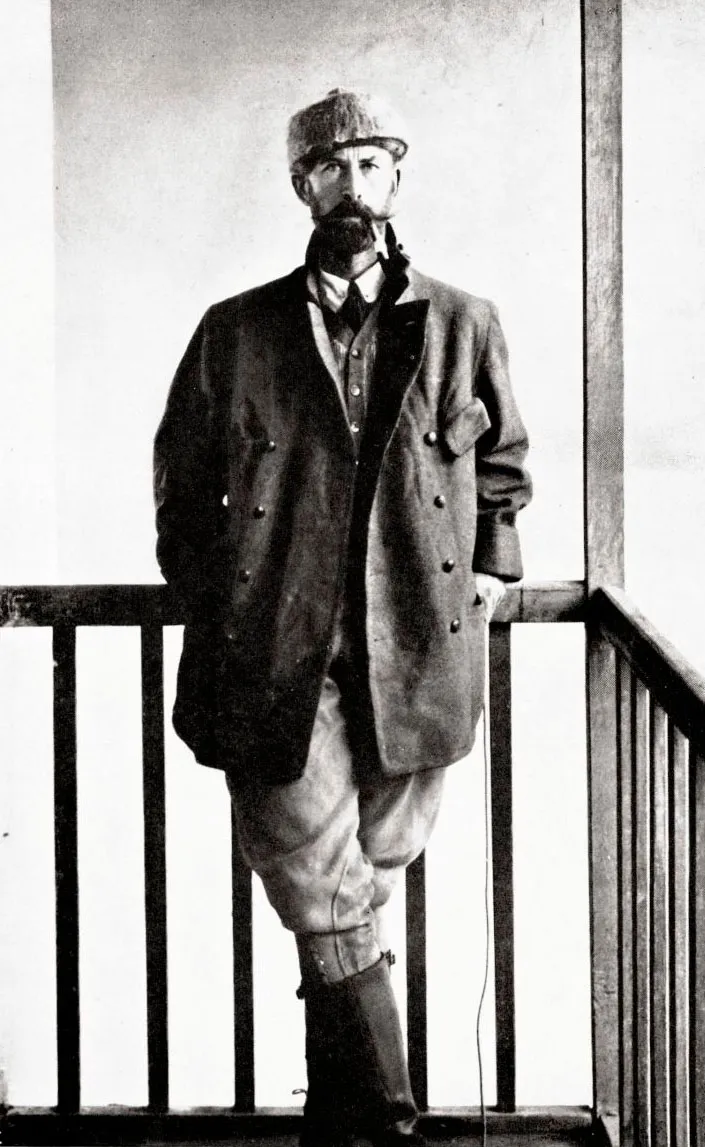
Disappearances Case file
Into Unexplored Territory: Colonel Fawcett and the Search for Z, 1925
A celebrated explorer, his son, and his son's friend walked into the Mato Grosso after a last letter dated 29 May 1925 and were never found. The lost-city quest was real, but it was built partly on a disputed 1753 manuscript, and a century of answers, a confessed-bones case, sightings, and stories blaming named indigenous peoples, has produced no proof of how, where, or at whose hands they died.
- Case type
- Disappearance
- Status
- Unexplained
- Event date
- May 29, 1925
- Location
- Dead Horse Camp and the Mato Grosso interior, Brazil (the party set out from Cuiabá toward the Upper Xingu region in search of a lost city Fawcett called Z) - Brazil
- Evidence
-
- Testimonial
- Official record
The open question What became of Percy Fawcett, his son Jack, and Raleigh Rimell after their last letter of 29 May 1925, and whether they died of the country itself or at someone's hands.
On 29 May 1925, from a place he called Dead Horse Camp somewhere in the interior of the Brazilian state of Mato Grosso, Colonel Percy Harrison Fawcett wrote a letter to his wife. He was a surveyor and explorer of real standing, trained by the Royal Geographical Society and the veteran of seven Amazon expeditions. With him were his son Jack, who was twenty-one, and Jack’s friend Raleigh Rimell. The party had been deliberately kept small. Fawcett’s plan was to send his Brazilian guides back from this camp and push on alone with the two young men, into country he described as unexplored, in search of an ancient ruined city he had named Z. The guides carried the letter out. It was the last confirmed word from any of the three men. They were never definitively found.
That is the documented core, and it is worth holding onto, because the Fawcett case has spent a hundred years collecting things that are not documented at all. Two distortions in particular need to be kept straight from the start. The first is the city itself: the central piece of “evidence” for Z was Manuscript 512, a Portuguese document of 1753, and a disputed one. It is real, but it describes a ruined city, it does not prove that one existed, and many scholars regard it as romantic fiction. The second is the long parade of solutions to the disappearance. A confessed killing attached to a set of bones, recurring sightings, a signet ring, and a tradition of stories blaming named and still-living indigenous peoples have all been offered as the answer. None of them has ever been verified. This is an account of what the record establishes, what the surviving evidence does and does not show, and what is only hypothesis. We keep three things separate, as always: what is documented, what the evidence shows, and what is still only a hypothesis. There is no ending to dump in the first line, because no one has ever found one.
The documented account
Percy Harrison Fawcett was a Royal Artillery officer who became a surveyor. He joined the Royal Geographical Society in 1901 to train in surveying and mapmaking, and from 1906 the RGS sent him repeatedly into the Amazon basin, beginning with boundary-survey work on the Bolivia-Brazil frontier. Over roughly 1906 to 1924 he made seven expeditions and built a reputation as a hardy, almost ascetic bushman who traveled light and survived where larger and better-supplied parties did not. His reports fed the popular imagination as well as the maps: Arthur Conan Doyle drew on them for The Lost World in 1912.
By about 1914 Fawcett had formed the idea that gives the case its name. He had come to believe that a complex ancient civilization had once existed in the Mato Grosso interior, and that its ruins might still be found. He called the target city Z. His documentary basis for this, such as it was, came chiefly from Manuscript 512, a 1753 document held in the National Library of Brazil, where it was rediscovered in 1839. The manuscript describes explorers stumbling on an abandoned city with arches, statuary, and inscriptions. Fawcett treated it as a clue worth following. He also kept a roughly ten-inch basalt idol given to him by the novelist H. Rider Haggard, an object he came to associate with a lost civilization and even with Atlantis. Z was conceptually distinct from the gold-obsessed El Dorado legend, but Fawcett’s own mysticism blurred the lines, and the idol belongs to that blurring rather than to any archaeology.
The 1925 expedition was built around a conviction that a small group could move and survive where a large one could not. Fawcett wrote that this would be, in words attributed to him, “no pampered exploration party, with an army of bearers.” The three who would press on were Fawcett, the twenty-one-year-old Jack, and Raleigh Rimell. The venture was backed by the Royal Geographical Society, the American Geographical Society, and the Museum of the American Indian, and it was financed in part by selling exclusive dispatch rights to a syndicate of North American newspapers, the North American Newspaper Alliance, so that readers across the continent could follow the search as it happened. The men had sailed from the United States in January 1925. They reached Cuiabá and set off into the interior on 20 April 1925.
The last dispatch came five weeks later. On 29 May 1925, from the spot he called Dead Horse Camp, named for a horse he had been forced to shoot there on an earlier trip, Fawcett wrote to his wife Nina. He reported the party’s progress and condition, described the Brazilian guides turning back, and said the three of them would now go on alone into unexplored territory. The location he gave does not perfectly resolve. The figure in the record is roughly 11 degrees 43 minutes south, 54 degrees 35 minutes west, but a separate reading of 13 degrees 43 minutes south also appears, so even the position of the last camp is not firmly settled. Fawcett had also left standing instructions, reputably reported and consistent with his method, that if the expedition did not return, no rescue party should be sent, lest the rescuers share his fate.
After 29 May 1925 there is nothing definitive. The men did not emerge. By January 1927 the Royal Geographical Society treated them as lost. Over the decades that followed, searchers, journalists, and mystics mounted expeditions of their own, and objects surfaced, a Fawcett nameplate in 1927 and a theodolite compass in 1933, but both were traced to earlier journeys, not to the fatal one. No bodies, and no conclusively identified remains, have ever been produced.
The evidence
Strip away the legend and the case rests on a short list of evidentiary channels. None of them is physical evidence of the disappearance itself. What survives is the documentary record, the official record of the institutions involved, and one forensic examination. Each establishes something, and each fails to establish something else.
The Dead Horse Camp letter of 29 May 1925. This is the single firmest piece of evidence and the last datum in the case. It establishes that on that date the three men were alive, together, and about to send their guides back and continue alone into unmapped country. Its limits are real. The lines most often quoted from it are paraphrased inconsistently across sources rather than reproduced from a confirmed text, and the stated coordinates are internally inconsistent, so the letter fixes the men’s intent and morale far better than it fixes their location or their fate.
The “no rescue parties” instruction. Reputably reported and consistent with Fawcett’s documented self-reliance, the instruction that no one should come after the party is part of why the disappearance produced so little immediate, organized searching. Its exact wording varies between sources and is best treated as a paraphrase. It tells us how Fawcett thought, not what happened to him.
Manuscript 512. The document is real, genuinely held in the National Library of Brazil, genuinely dated 1753 and rediscovered in 1839. What it shows is that Fawcett had a documentary basis, of a kind, for believing in a lost interior city. What it does not show is that any such city existed. Its authorship is unknown, it omits a location, and its Greco-Roman architecture and exotic inscriptions are exactly the features that lead many scholars to treat it as romantic fiction or forgery. Teodoro Sampaio, who traveled the region around 1879 to 1880, judged it fictional. It is evidence of a legend, not of a city.
The Haggard idol. The basalt figure is best understood as evidence about Fawcett’s state of mind, not about any lost civilization. Archaeology Magazine assesses it flatly as a fake, its costume and glyphs without parallel in genuine artifacts, and notes that Fawcett took it to a psychometrist whose mystical reading reinforced his Atlantis-tinged beliefs. It shows how documentary research and esoteric enthusiasm both fed the 1925 quest.
The post-1925 artifacts. The 1927 nameplate and the 1933 compass were both traced to earlier expeditions and do not bear on the disappearance. They are red herrings, useful mainly as a demonstration of how readily anything connected to Fawcett’s name was over-read as a clue.
The 1951 bones. This is the most concrete “we found Fawcett” claim the case has produced, and it failed the only test applied to it. Bones said to be Fawcett’s were brought to London and examined by the Royal Anthropological Institute, in a report dated 24 October 1951 by Professor A. J. E. Cave with M. L. Tildesley and Dr. J. C. Trevor. The examination concluded that the remains were not Fawcett’s, the clearest evidence being a comparison of the upper jaw against Fawcett’s spare upper denture. The chain by which the bones reached London is not perfectly clear in the sources: they are commonly tied to Orlando Villas-Bôas, while the institute’s own archive references the press magnate Assis Chateaubriand arriving with the remains, and the two are not necessarily in conflict. What the examination establishes is narrow and solid: the most concrete identification ever advanced was tested and did not hold. It says nothing about where any real remains might be.
One widely repeated claim does not belong in the evidence column at all. It is often said that around a hundred would-be rescuers died searching for Fawcett over the years. The figure is repeated as fact by reputable outlets, but it does not survive scrutiny: it is described as a fictitious tale, with the actual toll given as one, a single man who went after Fawcett alone. The hundred-deaths number is part of the legend the case generated, not part of its record, and it is treated here as such.
The theories
Everything in this section is a hypothesis. None of it is proven, and the indigenous-involvement claims in particular must be read as attributed, disputed theory and never as fact. The ordering reflects what the evidence will and will not bear, not certainty.
Death from the country itself. The most parsimonious explanation is that the three men died of starvation, illness, exhaustion, or accident in lethal terrain, with no other party involved. This is the view advanced by people who knew Fawcett, including Henry Costin, who had accompanied him on five earlier expeditions and doubted the murder stories, believing Fawcett had succumbed to a lack of food or to exhaustion. The reasoning is straightforward. Jack and Rimell were inexperienced and, by some accounts, unwell; the country was deadly; and this explanation requires no culprit and no crime. Its weakness is the weakness of the whole case: no remains have ever confirmed it. It is the honest default precisely because it asks the least of the missing evidence.
Killed by hostile indigenous people. A long tradition of explanation holds that the party was killed by one indigenous group or another, and this is the cluster that must be handled with the most care, because the peoples named in it are real and, in several cases, still exist today. These accounts were mostly relayed by non-indigenous intermediaries. They conflict with one another on who, why, and how, and they have never been substantiated. The one set of bones ever produced under such a story was shown not to be Fawcett’s. No indigenous group has ever been shown to have killed the Fawcett party. Every version of this theory is recorded here as an unproven historical claim, attributed to whoever advanced it, and nothing more. It is not a finding, and this publication does not name a culprit, because the record does not support one.
The Kalapalo’s own account. The people most directly placed near the party’s last known movements were the Kalapalo, a Xinguano people who live in the Upper Xingu region today and who were interviewed by David Grann in 2005 and by the BBC in 1998. Their account deserves at least equal weight to the murder theories, because it comes from people who were there rather than from later intermediaries, and it is their own. As recorded by Grann, the Kalapalo say Fawcett’s small party, among the first Europeans they had ever seen, stayed at their village; that the Kalapalo warned the men that going east meant encountering tribes they considered dangerous; that the men went east anyway; and that the Kalapalo then watched the party’s campfire smoke each evening for about five days, until it stopped. In 1998 a Kalapalo elder, Vajuvi, told the BBC’s Benedict Allen that the 1951 bones were not really Fawcett’s and denied that the tribe had killed him. It is worth being exact about one point. Grann’s reporting presents the Kalapalo as concluding that some group to the east probably killed the men, but that is the Kalapalo’s own inference about unnamed third parties, pointing away from their own village. It is their speculation, offered in their framing, and it is not established fact, and it is not laundered here into a murder finding against anyone.
Fawcett chose to stay. A romantic family of theories holds that Fawcett did not simply die but intended to remain in the interior. The most cited modern version comes from the television director Misha Williams, who in 2004, working from Fawcett papers, argued that Fawcett may have meant to found a commune in the jungle on theosophical principles centered on his son Jack, rather than merely to find a city. Related folklore had Fawcett living on as a captive or as a “white god” among a tribe, language that belongs to the era that produced it and not to the record. These readings sit comfortably with Fawcett’s documented mysticism, the idol, the psychometrist, the Atlantis ideas, but there is no evidence that any of the three men survived. They are reconstruction and legend, attributed and labeled as such.
The hoaxes and false sightings. Across the decades the disappearance generated claimed sightings, supposed messages, and a signet-ring story, in which a Fawcett signet ring reportedly surfaced in a Brazilian pawnshop in 1979 and was sometimes read as evidence of robbery and murder. The 1951 bones belong in this category too, as a claim that did not survive testing. None of these strands has held up on examination. Their value to the case is as illustration of how a genuine mystery generated a century of unreliable answers.
There is one honest footnote that cuts the other way. Fawcett’s specific vision of Z, a windowless stone city with a pyramidal temple, has no archaeological support. But his underlying instinct that the region had once held something substantial has aged better than the man’s reputation as a crank suggested it would. The archaeologist Michael Heckenberger’s work on large pre-Columbian settlements in the Upper Xingu, the Kuhikugu complex, with its earthworks and moats, shows that the region did host substantial, organized societies before European contact. Z as Fawcett imagined it did not exist. Something real, though, did lie out there, which is part of why the case still pulls at people.
What remains unknown
The honest residue of the Fawcett case is narrow, and it is harder to close than the legend around it suggests.
Three men walked out of Cuiabá in April 1925, sent a last letter from Dead Horse Camp on 29 May, dismissed their guides, and went on alone into country no map covered. After that the record stops. They were never found. No body, no grave, no conclusively identified remains have ever been produced, and the precise location of even their last camp is uncertain. The most likely explanation, that the country killed them, fits Fawcett’s own method and the youth and inexperience of his companions, but it is an inference unconfirmed by any remains.
What can be said clearly is what cannot be said. No person and no community has ever been shown to have killed Percy Fawcett, Jack Fawcett, or Raleigh Rimell. The stories that name indigenous peoples as the killers are unproven, mutually inconsistent, and contradicted by the people most often accused, who say they warned the party and watched its smoke recede to the east. The single set of bones offered as proof was tested and was not Fawcett’s. The lost-city manuscript that drew the men into the interior is more plausibly fiction than fact, even as the region itself turned out to hold real antiquity.
So we will not tell you the Kalapalo killed them, because no evidence has ever shown it and the people themselves deny it. We will not tell you the bones were found, because the bones produced were proven not to be theirs. We will not tell you Fawcett walked off to found a jungle commune, because that is reconstruction, not record. And we will not tell you the case is solved, because no one has ever found the three men or learned how they died. What we can tell you is that after 29 May 1925, a small, under-prepared party went into unmapped territory and did not come out, and that the cause of their disappearance is unknown. The single open question that survives all the rigor is the plain one: did the country itself take them, or did something else, and on that the record has nothing certain to say. The file is still open.
Sources
Primary / documentary
- Royal Anthropological Institute, “Fawcett Papers (A69)” archive (the 1951 examination of the alleged Fawcett bones)
- TIME magazine archive, “Brazil: Skull & Bones” (1951)
- Wikipedia, “Manuscript 512” (the 1753 document Fawcett cited, with the authenticity debate)
Fawcett’s letters and logs, including the Dead Horse Camp letter, survive chiefly through Brian Fawcett (ed.), Exploration Fawcett (1953), and the Royal Geographical Society holds the expedition correspondence and the record of the 1927 “lost” status. Neither was consulted in primary form here, and both are named for the reader who wants to chase the original wording.
Secondary / contextual
- David Grann, excerpt from “The Lost City of Z: A Tale of Deadly Obsession in the Amazon” (2009)
- Wikipedia, “Percy Fawcett”
- Wikipedia, “Lost City of Z”
- Wikipedia, “The Lost City of Z (book)”
- National Geographic, “The man who died searching for the Lost City of Z”
- Archaeology Magazine (archive), “Fawcett’s Deadly Idol”
- History.com, “The Enduring Mystery Behind Percy Fawcett’s Disappearance”
- History Hit, “10 Facts About Percy Fawcett”
- Mental Floss, “Percy Fawcett’s Doomed Search for the Lost City of Z”
- TIME, “The Lost City of Z: True Story Behind the Movie” (2017)