Aviation Mysteries Case file
The Line at 8:43: Amelia Earhart and Fred Noonan, 2 July 1937
A famous flyer and her navigator hunted a four-mile island they could hear calling them but could not see. The legend is spies and secret photographs. The record is a fuel gauge, a sun line, and the largest search of its day finding nothing.
- Case type
- Aviation
- Status
- Disputed
- Event date
- July 2, 1937
- Location
- Central Pacific Ocean, on the leg from Lae, New Guinea toward Howland Island - Pacific Ocean - International waters
- Evidence
-
- Testimonial
- Official record
- Physical
- Photographic
The open question Did Earhart and Noonan go down into the ocean near Howland Island when the fuel ran out, or did they reach the line of position and follow it southeast to Gardner Island and die there as castaways?
The radio operators on the USCGC Itasca could hear her getting closer all morning. Her voice came up out of the static off Howland Island, a four-mile coral speck in the central Pacific, growing stronger as the hours passed, until near eight in the morning it was loud enough that the men on watch expected to see the aircraft any minute. They never did. She told them she could not hear them. She told them her gas was running low. At 8:43 a.m. she gave a navigational line and the channel went quiet. The largest air-sea search the United States had ever mounted to that point found no wreckage, no bodies, and no aircraft. Nearly nine decades later it still has not.
What happened to Amelia Earhart and her navigator Fred Noonan is, in the popular telling, a riot of spies and conspiracies: a secret mission for President Roosevelt, capture and execution by the Japanese, a woman who supposedly lived out her days under another name, a “smoking gun” photograph. Almost none of that survives contact with the evidence. The genuine mystery is narrower and more disciplined, and it comes down to two explanations that actually compete on the record. This is an account of what the documents establish, what the physical evidence does and does not prove, and which of those two readings the evidence supports. We keep three things separate, as always: what is documented, what the evidence shows, and what is still only a hypothesis.
The documented account
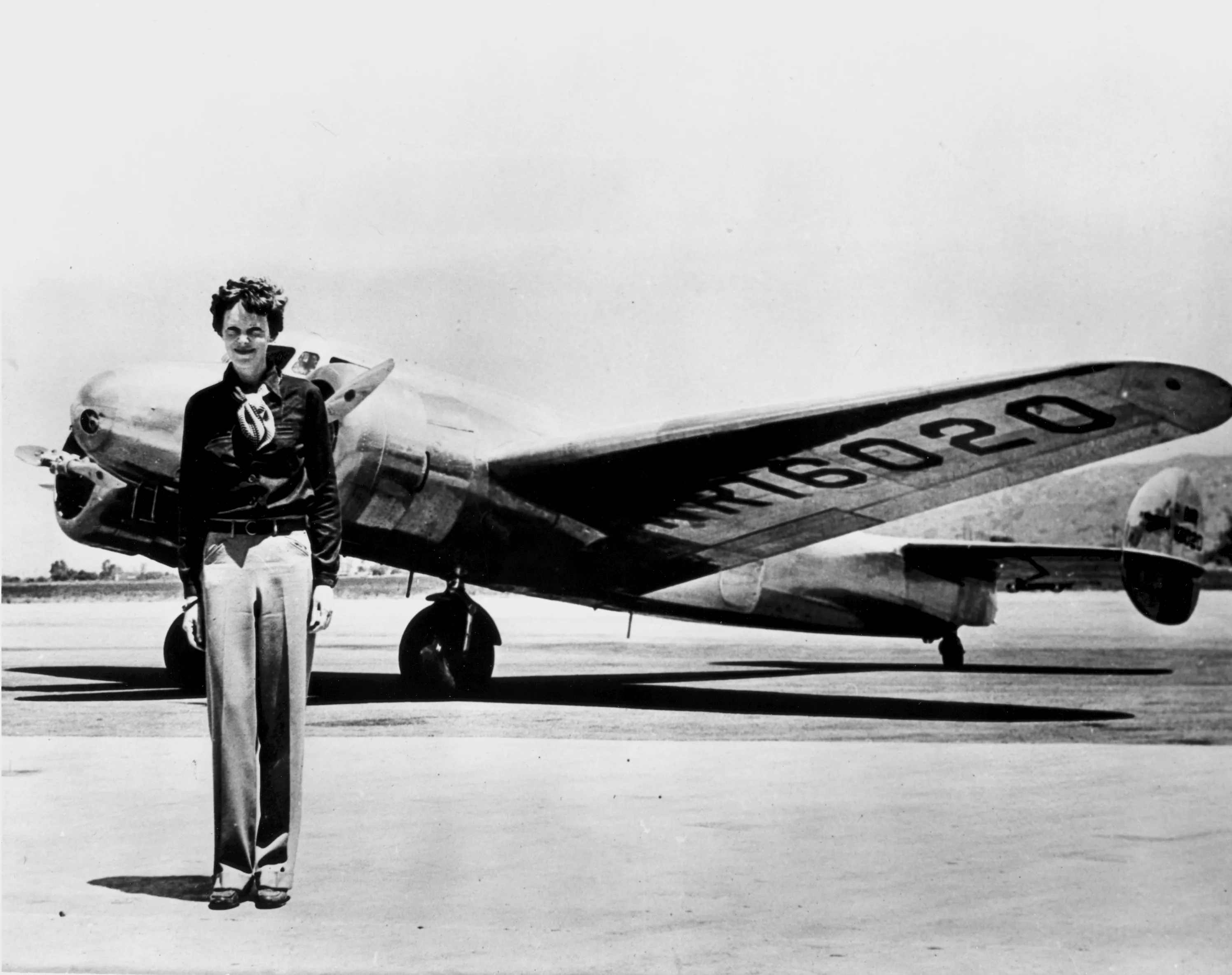
The aircraft was a twin-engine Lockheed Model 10-E Electra, an all-metal monoplane Earhart had acquired in 1936 with funding routed through the Purdue Research Foundation and nicknamed the “Flying Laboratory.” Her plan was to circle the globe near the equator. After an aborted first attempt, she and Noonan flew eastbound from Oakland, California, departed Miami on 1 June 1937, and reached Lae, New Guinea, on 29 June, roughly 22,000 miles into the route. Fred Noonan was no amateur. He was a licensed ship’s captain and an experienced marine and air navigator who had helped pioneer Pan American’s trans-Pacific “China Clipper” routes and trained the airline’s navigators.
The leg that killed them was one of the last. On 2 July 1937 they left Lae bound for Howland Island, a US-administered dot in the central Pacific some 2,556 miles away, where the government had built an airstrip for the flight. To keep the timeline honest, this account stays on Itasca and Howland time throughout. That matters here more than in most cases: Lae sits west of the International Date Line and Howland east of it, so naive “local time” comparisons across the leg are misleading. Departure from Lae was about 10:00 a.m. local time there, roughly midnight Greenwich, with an expected flight of about 20 hours. The fuel load is commonly given as about 1,100 US gallons, though that figure, like the endurance estimate, is an estimate and not a logged measurement.
Stationed off Howland was the US Coast Guard cutter USCGC Itasca, there to hold radio contact with the Electra, send homing signals, attempt radio direction-finding, and make smoke for visibility. The plan failed at the most basic level. Earhart and the Itasca never established two-way contact. The Smithsonian attributes this to a tangle of mismatched communications arrangements and to the fact that neither Earhart nor Noonan could use Morse code, which was the cutter’s natural medium. Frequencies and equipment did not line up. The result was that the Itasca could often hear her, but she apparently could not hear the cutter, or could not get usable bearings from it.
The final cluster of transmissions came on the morning of 2 July, logged by chief radio operator Leo G. Bellarts and his watch. The exact wording of the famous lines varies between reproductions, and this account treats them as attributed renderings rather than confirmed verbatim text from the primary log. After routine, static-broken weather contacts around 2:45 and 5:00 a.m., she reported being within about 200 miles and asked for bearings near 6:14 a.m., and asked again around 6:45 a.m., now “about 100 miles out.” Near 7:42 a.m. came the line most often quoted, commonly reported as words to the effect of “We must be on you but cannot see you but gas is running low… We are flying at 1,000 feet.” At 7:58 a.m. her signal was at its strongest, and she said she could not hear the Itasca and asked it to send signals so she could take a bearing on them. Then, at 8:43 a.m., the last transmission. The US National Archives renders the logged text as:
“we are on the line 157 337 wl rept msg we wl rept…”
That is, “we are on the line 157 337, will repeat message, we will repeat.” The popular fuller version adds that she was “running north and south,” but that clause is a frequent addition and is not confirmed against the log here, so we set it aside. After 8:43 a.m. the Itasca logged nothing further it could confirm as hers.
The search that followed ran from 2 July to 18 July 1937 and was the largest and most expensive air-sea operation in US history to that date. It drew in the battleship USS Colorado, whose scout floatplanes overflew the Phoenix Islands on 9 July, and the aircraft carrier USS Lexington with its aircraft. By common description it swept on the order of 250,000 square miles of ocean, a “Texas-sized” area in the Smithsonian’s phrasing, though the precise square-mileage figure varies by source and should be read as an estimate. It found nothing. Amelia Earhart was officially declared dead on 5 January 1939.
The evidence
Strip away the legend and the case rests on a handful of evidentiary channels, each of which establishes something and, just as importantly, fails to establish something else. The honest work is in that second half.
The Itasca radio log. This is the closest thing to a primary instrument record of the disappearance. It establishes that contact was one-way and deteriorating, that her signals grew strong near 7:58 to 8:43 a.m. (which suggests she was relatively close to Howland by then), and that the last logged transmission was the 157/337 line at 8:43. What it establishes is real but limited: that she reached the vicinity of Howland, could not find it, could not get usable bearings, and was low on fuel near the end. What it does not establish is her exact position, her heading after 8:43, or where the aircraft came down. The signal-strength inferences are indirect, and the exact transmission wordings vary between reproductions.
Fuel and endurance. With roughly 1,100 US gallons and a planned flight of about 20 hours, the aircraft had been airborne about that long by mid-morning and was, on the leading analysis, at or very near fuel exhaustion when contact ended. This is the backbone of the crash-and-sink reading: it sets a hard outer bound on how far she could have flown after 8:43. But the limits are serious. Fuel burn depended on power settings, winds, leaning technique, and altitude, none of them precisely known. The gallons, the consumption rate, and the reserve remaining at 8:43 are all estimates, not logged measurements. Both camps use fuel math, the crash-and-sink side arguing she had nothing left to reach another island, the Nikumaroro side arguing she had just enough to follow a line south. The figures are genuinely contested.
The line of position. “157 337” denotes a line of position oriented roughly northwest-to-southeast, the kind Noonan would derive from a sun observation at dawn. Such a line runs through or near Howland and, extended to the southeast, passes near the Phoenix Islands, including Gardner Island, known today as Nikumaroro and part of Kiribati, roughly 350 nautical miles south-southeast of Howland. This is a genuine navigational fact, not an invention, and it is the geometry that makes the Nikumaroro hypothesis discussable at all. Its limit is equally plain: that a line passes near an island is not evidence she flew down it to that island. The same line is consistent with a ditching near Howland. It is geometry, not a track.
Post-loss radio signals. For days after the disappearance, numerous stations reported possible distress calls on Earhart’s frequencies. TIGHAR, the group that has championed the Nikumaroro hypothesis for decades, has cataloged these and argues that a subset is credible, including signals reportedly heard by more than one station and the much-discussed “Betty’s Notebook,” the transcription a fifteen-year-old in Florida named Betty Klenck made of what she believed were distress calls. The logic TIGHAR draws is straightforward: a floating or sunken land plane cannot transmit, so if any post-loss signal is genuinely the Electra, the aircraft must have been on land, which would favor Nikumaroro. The limit is that the signals are disputed. Skeptics class most or all of them as misidentifications, hoaxes, or harmonics from other stations, and the genuineness of any single signal, Betty’s Notebook included, is not established. It is worth flagging that the framing that “credible signals were ignored” comes substantially from TIGHAR and TIGHAR-aligned reporting; it is an advocate’s reading, not a neutral consensus.
The 1937 aerial pass over Gardner Island. On 9 July 1937, three scout planes from the USS Colorado, under senior aviator Lt. John Lambrecht, overflew Gardner Island. As reproduced by TIGHAR from the Navy search material, Lambrecht’s report described the island as showing “signs of recent habitation,” but repeated circling and low passes drew no answering response, and the fliers saw a wrecked tramp steamer on the reef (the SS Norwich City, wrecked in 1929) and no sign of the missing plane. No one landed. What this establishes is ambiguous. “Signs of recent habitation” on an island the searchers believed uninhabited is the seed of the entire Nikumaroro idea. But an eighteen-minute aerial pass over a four-mile island is not a search of the ground, the impression is brief, and vegetation, the wreck, and earlier visitors could account for it. It neither confirms the hypothesis nor rules it out.
The Nikumaroro bones. This is the forensic heart of the case, and it is a genuine, unsettled dispute rather than an identification. In 1940, colonists under Gerald Gallagher, a British Western Pacific High Commission officer, recovered a partial skeleton on Nikumaroro, commonly cited as thirteen bones, along with artifacts reported to include part of a shoe, a sextant box, and a Benedictine bottle. The bones were sent to Fiji, where in 1941 Dr. D. W. Hoodless of the Central Medical School examined them and concluded they were male, roughly 45 to 55 years old and about five and a half feet tall. The bones are now lost. They were not retained or have been misplaced, and they cannot be re-examined. Only Hoodless’s recorded measurements survive.
In 2018, Richard Jantz of the University of Tennessee published a reanalysis in the journal Forensic Anthropology. Working from Hoodless’s measurements rather than the bones, and from an estimate of Earhart’s own dimensions drawn from photographs and clothing, Jantz applied modern quantitative methods and argued that the 1941 “male” determination was unreliable by today’s standards and that the measurements are more consistent with Earhart than with 99 percent of a large reference sample. As his conclusion has been carried in reputable coverage of the paper, he wrote that until definitive evidence is presented that the remains are not Earhart’s, “the most convincing argument is that they are hers.”
That is a serious, peer-published argument, and it deserves to be stated as such. So do its limits, plainly. Jantz worked from 1941 measurements of bones that no longer exist, and from estimates of Earhart’s body. “More similar than 99 percent of a reference sample” is statistical compatibility, not identification. There is no retained bone, no DNA, and no confirmed match. A published counter-argument exists: Cross and Wright, writing in 2015, defended Hoodless’s first-hand examination over a reanalysis conducted by proxy. The bones are a live forensic debate, not a settled identification.
TIGHAR’s artifacts and the Bevington Object. A photograph taken at Nikumaroro in October 1937 by British colonial officer Eric Bevington shows an object protruding from the water at the reef edge. TIGHAR’s imaging analyst judged its shape consistent with Lockheed Electra landing gear, and TIGHAR has cited it, along with recovered aluminum pieces, shoe parts, a possible cosmetic jar, and bottle glass from its expeditions, as supporting the hypothesis. These are suggestive, hypothesis-consistent items. None of them is a confirmed piece of the Electra or a confirmed personal effect of Earhart’s. The Bevington Object in particular is an interpretation of a tiny, blurry feature in an old photograph, not a verified aircraft part. Because TIGHAR is the proponent of the Nikumaroro hypothesis and not a neutral party, every one of these claims should be read as TIGHAR’s, not as established fact.
Hypotheses and open questions
Everything in this section is a hypothesis, ordered best-evidenced first. Only the relative ranking is asserted. None of these is proven.
Hypothesis A: crash and sink near Howland. This is the leading, official-consensus reading. The Electra ran out of fuel near Howland, ditched, and, being a land plane, filled and sank in deep water, never to be found. It was the US Navy’s contemporaneous conclusion and is the position argued most prominently by Elgen Long in Amelia Earhart: The Mystery Solved and favored by the Smithsonian and most aviation historians. The case for it is the cleanest in the file: it matches the radio log (strong signals near Howland, then nothing), it matches the fuel and endurance math (at or near exhaustion at 8:43), and it is consistent with a search that found nothing in very deep water. Deep-ocean sonar surveys by the company Nauticos in 2002 and 2006, covering on the order of 2,000 square nautical miles around the projected ditching area, in water roughly 17,000 feet deep, found no wreck, which proponents note is unsurprising given the depth and the difficulty of finding a small aircraft. The honest weakness is that the wreck has never been found despite repeated, expensive searching, so the best-supported reading is still not confirmed by physical evidence, and it has to treat every post-loss radio signal as spurious.
Hypothesis B: the Nikumaroro castaway hypothesis. This is the main evidence-based competitor, and it is unproven. The claim, advanced by TIGHAR and its founder Ric Gillespie, is that, unable to find Howland, Earhart followed the 157/337 line to the southeast, landed on the reef flat at Gardner Island, survived briefly there with Noonan as a castaway, and died, with the aircraft later washed off the reef. The case rests on the bundle laid out above: the line of position passing near Gardner, the 1940 bones and the Jantz reanalysis, the 1937 “signs of recent habitation,” the post-loss signals, and the Bevington Object. It is the only alternative with an actual evidence base and a peer-published forensic argument behind it. But every strand is contestable. No confirmed piece of the aircraft has been recovered in more than three decades of expeditions; the bones are lost and the Jantz analysis is disputed by the original male finding and by Cross and Wright; the artifacts are unmatched; and the post-loss signals are unproven. It is strong as a hypothesis and unproven as a conclusion.
The remaining theories are not in serious contention on the evidence, and one of them caused real harm. They are set out here so they can be set firmly aside.
Captured or executed by Japan, the spy mission, “Tokyo Rose.” A family of claims holds that the pair came down in, or were taken to, the Japanese-mandated Marshall Islands or the island of Saipan, and died in custody or were executed, sometimes wrapped in a story that Earhart was flying a covert reconnaissance mission for the Roosevelt administration, or even that she became the wartime propaganda broadcaster “Tokyo Rose.” There is no credible evidence for any of it. Saipan is roughly 2,700 miles from Howland and the Marshalls hundreds of miles off the route, both beyond the Electra’s remaining fuel; a 2004 archaeological dig on Tinian found nothing; the alleged witnesses are unnamed or unverifiable; and the spy-mission claim has no documentary support. This strand also accuses a nation and its military of a killing with no credible evidence, and it must be treated as the unproven speculation it is, never as fact.
The most public version of this strand collapsed in public. In 2017 the History Channel aired Amelia Earhart: The Lost Evidence, built around a photograph said to show Earhart and Noonan in Japanese custody. Within days, a Japanese blogger named Kota Yamano traced the same image to a Japanese-published travel book printed in 1935, two years before the disappearance. The photograph could not show the missing flyers because it predated the flight. The documentary was pulled.
Survived under another identity. In 1970, Joe Klaas published Amelia Earhart Lives, which claimed Earhart had survived, returned to the United States, and lived under a new identity. The book identified her with a real, living New Jersey woman. This is a debunked theory, and it is included here only as a cautionary example of how a mystery’s legend can harm a living person. The woman it named publicly denied the claim, called it a hoax, and sued; the publisher withdrew the book; and her own documented biography rules out the identification entirely. The identification was false. It is not a live possibility and the woman it named was not a “candidate” for anything. The right way to remember this strand is as a wrong done to a real person, not as an open question.
What remains unknown
The honest residue of this case is narrow and real, and it is worth more than the conspiracies stacked on top of it.
The leading reading is fuel exhaustion and a ditching at sea near Howland. It fits the radio log and the fuel math better than any alternative, and it remains the position of most aviation historians. But the wreck has never been found, despite deep-ocean searches built specifically to find it, so even the best-supported answer is not confirmed by a single recovered piece of the aircraft.
The Nikumaroro castaway hypothesis is a genuine, tested alternative, not a fantasy. It has a navigational basis in the line of position, a set of recovered artifacts, and a peer-published forensic argument that the 1940 bones are statistically more consistent with Earhart than with almost anyone else. And it remains unproven on every count that would settle it. The bones are lost, with only 1941 measurements surviving. There is no DNA and no confirmed identification. The artifacts have not been matched to the Electra. The post-loss radio signals are disputed. No confirmed piece of the aircraft has been recovered at Nikumaroro.
So we will not tell you she was a spy or a prisoner, because the distances, the fuel, and a barren archaeological record all say otherwise, and the one photograph offered as proof turned out to predate the flight. We will not tell you she lived on under another name, because that claim was false and named a real woman who denied it and sued. We will not tell you the bones were hers, because the bones are gone, there is no DNA, and a careful forensic argument that they are consistent with her is not the same as proof that they were. And we will not tell you the case is solved, because no one has ever found the aircraft.
What we can tell you is that on a July morning in 1937, a navigator and a famous flyer were close enough to Howland Island that the men on a Coast Guard cutter expected to see them at any moment, that the gas was running low, that she reported a sun line at 8:43 a.m., and that the largest search of its day then looked across a quarter of a million square miles of ocean and found nothing at all. The single open question that survives all the rigor is small and specific: did they go straight down into the sea by Howland when the tanks ran dry, or did they reach the line and follow it south to Gardner, and die there. The record, as it stands, has not closed it. The file is still open.
Sources
Primary / official
- US National Archives, “Radio Log of the Last Communications of Amelia Earhart”
- Richard Jantz, “Amelia Earhart and the Nikumaroro Bones,” Forensic Anthropology 1(2), 2018
Secondary / contextual
- Smithsonian National Air and Space Museum, “Amelia Earhart: Missing for 80 Years But Not Forgotten”
- National Geographic, “Top 3 Theories for Amelia Earhart’s Disappearance”
- Britannica, “The Disappearance of Amelia Earhart”
- Elgen Long, “Crash and Sank Theory” (advocate, Hypothesis A)
- Nauticos, “Aviation History Remembered” (deep-ocean search company)
- TIGHAR, Earhart Project archive (proponent of the Nikumaroro hypothesis)
- Wikipedia, “Speculation on the disappearance of Amelia Earhart and Fred Noonan”
- FlyingMag, “History Channel’s Amelia Earhart Story Quickly Unravels”