UFO/UAP Case file
Targets Over the Capital: The Washington Radar Flap, 1952
Over two July weekends in 1952, unidentified targets were tracked on radar at three facilities around Washington and seen by airline pilots and ground observers; jets were scrambled, and the Air Force held a major press conference blaming a temperature inversion. But the controllers who watched the scopes disputed that explanation, and the radar-visual flap over the capital has never been fully settled.
- Case type
- UAP
- Status
- Disputed
- Event date
- July 1, 1952
- Location
- Washington, D.C.: radar targets tracked at Washington National Airport and Andrews Air Force Base, with sightings over the capital - United States
- Evidence
-
- Radar
- Testimonial
- Official record
The open question Were the targets tracked over Washington on those two July 1952 nights anomalous radar propagation from a temperature inversion, as the Air Force concluded, or something the experienced controllers were right to insist they had never seen behave that way?
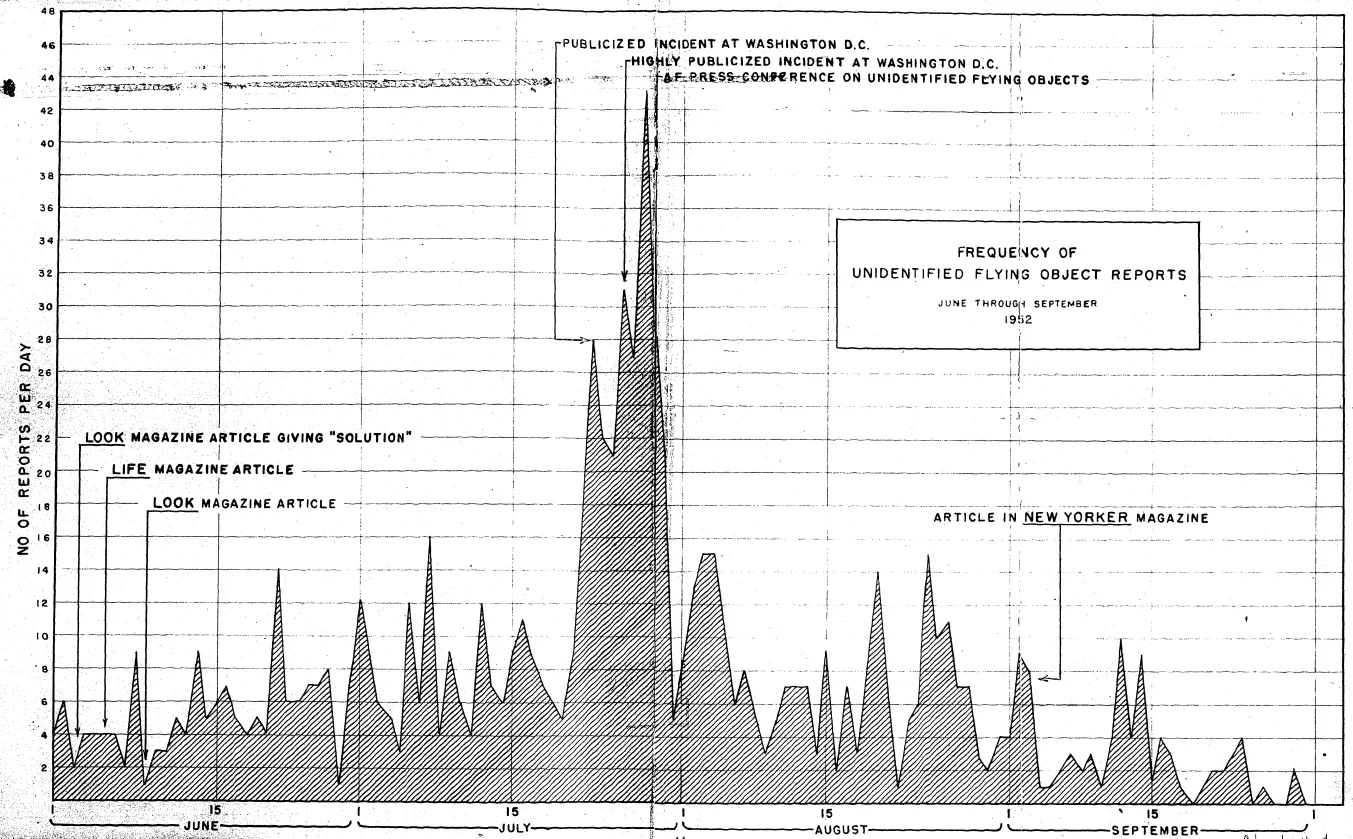
In the summer of 1952 the United States was in the middle of a national surge of UFO reports, and on two July weekends the surge arrived over the capital in a form harder to wave away than most: blips on a radar scope. On the nights of 19-20 July and again on 26-27 July, unidentified targets were tracked at three radar facilities around Washington, while airline pilots and ground observers reported lights over the city and Air Force jets were scrambled to chase them. On 29 July, the Air Force held a Pentagon press conference and attributed the radar returns to a temperature inversion bending the radar beam, and the visual sightings to misidentified stars and meteors.
That should have closed the matter, and on paper it did. But several of the men who had watched the scopes that week did not accept it, and said so. They were not hobbyists. They were air traffic controllers and radar operators who looked at returns for a living, and their objection was specific: these targets did not behave like the propagation clutter they routinely ignored. That disagreement, between an official meteorological explanation and the people who were in the room, is the case. It has never been resolved.
This is an account of what the record establishes, what each strand of evidence can carry, and why the explanations are still in conflict. As always, we keep three things separate: what is documented, what is testimony or interpretation, and what is hypothesis. They are not allowed to blur into one another.
The documented account
The backdrop. By July 1952 the country was in the peak month of a national wave of UFO reports. Project Blue Book, the Air Force’s UFO investigation office at Wright-Patterson Air Force Base under Capt. Edward J. Ruppelt, was a small operation reportedly overwhelmed by the volume of reports coming in. This is the context in which the Washington events landed on the front pages, and it matters: expectation was high, and the staff meant to evaluate the sightings was stretched thin.
The night of 19-20 July. Shortly before midnight on 19 July, at the Washington National Airport Air Route Traffic Control Center, controller Edward Nugent picked up seven slow-moving targets roughly fifteen miles south-southwest of the city, in airspace with no known traffic and off the established airways. The senior controller on duty, Harry Barnes, came over to look. Barnes had the radar checked for a malfunction; it tested normal. He then telephoned National’s radar-equipped control tower, where controllers Howard Cocklin and Joe Zacko reported unidentified blips of their own. Cocklin would later say he also saw a hovering light through the window that then left at speed.
As the night went on, targets appeared across several sectors. When returns moved over the area of the White House and the Capitol, Barnes contacted Andrews Air Force Base, about ten miles off. Andrews initially reported nothing unusual on its scope, but two enlisted men there, airman William Brady and S/Sgt. Charles Davenport, reported orange and red lights moving erratically. On a National runway, Capital Airlines pilot S.C. Pierman, alerted by the tower, reported six white, tailless, fast-moving lights over a span of about fourteen minutes. Barnes is reported to have said afterward that each of Pierman’s sightings coincided with a radar pip near the aircraft. That claim, that the radar and the eyes were tracking the same thing, is the load-bearing one in this case, and we return to it.
Two F-94 Starfire interceptors were scrambled from New Castle Air Force Base in Delaware and reached Washington around 3 a.m. on 20 July. According to the participants’ accounts, the radar targets faded as the jets arrived and returned after the low-fuel jets had to leave. We flag that pattern now and treat it below as a participant interpretation, not as established behavior. The activity tapered off by daybreak.
The night of 26-27 July. A week later it happened again. Around 8:15 p.m. on 26 July, a National Airlines crew reported lights, and within minutes the National center and Andrews were once more tracking unidentified targets. Andrews M/Sgt. Charles Cummings reported seeing lights he said did not behave like shooting stars. Blue Book’s press spokesman, Albert M. Chop, was present and declined reporters’ requests to photograph the radarscopes. The scopes reportedly showed targets in every sector, with speeds quoted as high as 7,000 mph. That figure is a reported, back-calculated number, not a reading off an instrument, and we treat it as such. Around 11:30 p.m., two more F-94s arrived from New Castle. The flight leader, Capt. John McHugo, reported seeing nothing. His wingman, Lt. William Patterson, reported four white glows, gave chase, and broke off, saying he could not overtake them.
After midnight, Maj. Dewey Fournet, Blue Book’s Pentagon liaison, and Lt. John Holcomb, a Navy radar specialist, reached the National radar center. Holcomb was told the weather station had measured a slight temperature inversion, but, by Ruppelt’s later account, he judged it too weak to explain the “good and solid” returns on the scope. The activity again faded near sunrise.
The official response. On 29 July 1952, Maj. Gen. John A. Samford, the Air Force’s Director of Intelligence, and Maj. Gen. Roger Ramey, the Director of Operations, held a press conference at the Pentagon, reported as the largest there since the Second World War. Samford’s message, as it comes down through the reporting, was twofold: a certain percentage of UFO reports came from credible observers describing things that were genuinely hard to explain, but the phenomena posed no threat to national security. The radar targets, he said, were consistent with a temperature inversion, and the visual sightings were largely misidentified stars, meteors, and lights. The wording attributed to Samford, including the often-quoted line about “credible observers of relatively incredible things,” traces mainly to Ruppelt’s 1956 memoir and later retellings rather than to a verified transcript, and we treat it as paraphrase. Project Blue Book’s standing disposition filed the radar events as temperature inversion, that is, as anomalous propagation rather than solid objects.
The evidence
Five strands of evidence carry this case. Each is worth weighing for what it establishes and where it stops.
The radar returns. This is the defining feature, and the reason the Washington flap is taken more seriously than a crowd of lights in the sky. Multiple independent facilities, the National center, the National tower, and Andrews, reportedly tracked unidentified targets on the same nights, with controllers conferring by telephone to confirm they were watching the same returns. The strongest specific account has an object hovering over a radio beacon and then vanishing from all three radar centers at the same moment. The limits are real and important. No radar film or scope photographs survive in the public record; Chop declined photography on the second night, and nothing else was preserved. The high speeds and the cross-site simultaneity rest on participant recollection and secondary retellings, not on a saved instrumental record. And 1952-era air traffic control radar had no clutter filtering, which is the foundation of the skeptical reading set out below.
The visual sightings. The witnesses were varied and were in different roles and locations: an airline pilot, a second airline crew, enlisted men at Andrews, tower controllers, and an interceptor pilot. That spread is part of the case’s weight. The limit is equally clear. Every one of these reports is of lights, not of structured craft, and point-source lights are exactly what the standard misidentification explanations, stars, meteors, and refracted ground lights, are built to cover. None was photographed.
The pilot intercepts. F-94s were scrambled on both weekends, and Patterson’s pursuit of four glows on the second night is the most cited. The recurring narrative has the targets behaving evasively around the jets, fleeing as they arrived and returning as they left. Two cautions apply. The results were mixed even within a single scramble: on 26-27 July, McHugo saw nothing while Patterson reported lights. And the “objects fled the jets” pattern is a participant interpretation, advanced chiefly by Barnes and repeated heavily since. It is not an established mechanism, and we do not present it as one.
The Project Blue Book file. The case is part of the Blue Book record. Ruppelt led the office, and Fournet, Holcomb, and Chop are documented participants. Ruppelt’s 1956 book, The Report on Unidentified Flying Objects, is the closest thing to an insider primary narrative and is the origin of many of the most-quoted lines in the case, including Holcomb’s objection and the Pierman correlation. Its limit is that it is a memoir, written after Ruppelt left the program. It is a primary participant account, but it is not a contemporaneous official document, and it carries his perspective. The exact final-disposition wording should be read from the Blue Book file itself rather than from secondary summaries.
The press-conference record. The 29 July conference is real and was widely covered in the contemporaneous press. The limit is that nearly every Samford quote in circulation is paraphrase or secondhand, traceable to Ruppelt and later accounts rather than to a verified transcript. We quote none of it as a confirmed verbatim record.
At the center of all five strands sits one question: the radar-visual correlation. The claim that the radar pips matched what the pilots and ground observers were seeing, that the scopes and the eyes were registering the same objects, is the thing that would lift this case above either a radar-only oddity or a crowd of misidentified lights. It is asserted by the participants, most directly by Barnes about Pierman. It was not independently recorded. That is the gap the whole dispute opens onto.
The theories
Everything in this section is hypothesis. None of it has closed the case, and the speculation here is kept out of the account and the evidence above.
A temperature inversion and anomalous radar propagation (the official explanation). This is the Air Force’s position from the 29 July conference, and it has support beyond the Pentagon. The Civil Aeronautics Administration’s Technical Development and Evaluation Center reported that an inversion was present in nearly every instance of the unidentified returns. More than fifteen years later, the federally funded Condon Report of 1969 examined the meteorology, and its consulting meteorologist concluded in Appendix L that the atmosphere over Washington on both nights was capable of generating anomalous propagation on weather radar displays. The broader skeptical case was made by the Harvard astronomer Donald Menzel and by the Aviation Week editor Philip Klass. Klass’s core point, made again in 2002, was that 1952 radar could not filter out birds, balloons, and propagation artifacts, and that when such filtering was introduced in the 1970s, radar UFO reports fell off. On this reading, the targets were the atmosphere fooling the equipment, and the lights were ordinary things seen in a jumpy summer.
The inversion does not fit (the unexplained reading). This was the objection of several participants and of the atmospheric physicist Dr. James E. McDonald of the University of Arizona, and it is a qualitative one. Ruppelt noted that inversions were close to nightly in a Washington summer, yet the solid returns appeared on only a handful of nights; if the inversion were the cause, why not every night? Holcomb judged the measured inversion too weak for the solid returns he was shown. Fournet reported that the radar room was convinced the targets were solid metallic objects and that the operators were distinguishing them from the routine weather and ground returns they normally disregarded. Barnes told McDonald the targets were not the shapeless blobs one gets from ground returns under anomalous propagation. A Weather Bureau figure noted that inversion returns usually appear as a steady line rather than as discrete moving objects. McDonald, after interviewing pilots and radar personnel, called the Air Force explanation physically impossible. The point to hold precisely is this: the participants’ objection is qualitative, that these returns did not look or behave like the propagation echoes they routinely saw, while the meteorological case is that the conditions for such echoes existed. Both can be true on their own terms, and neither resolves the other.
It is worth stopping here on a claim that circulates widely and is wrong. A number of retrospectives state that in 1969 a scientific report concluded a temperature inversion strong enough to produce these effects could not exist in the atmosphere. That is a misattribution, and it inverts the actual record. The only 1969 scientific study of the case is the Condon Report, and its meteorological analysis reached the opposite conclusion: that anomalous-propagation conditions were present on both nights. We note the popular claim only to correct it. The honest framing is the reverse of the legend: the official inversion explanation was disputed by the participants who watched the scopes, but the one 1969 scientific study to examine the meteorology actually found the inversion plausible.
Mixed and mundane causes (no single explanation). A defensible middle reading holds that a genuine inversion produced some spurious radar returns, while independent misidentifications of stars and meteors, amplified by the heightened expectation of that summer, produced others, and the press and the participants wove the two into a single “flap.” On this account the events were real but over-integrated, not one craft over the capital. It is a hypothesis, not a finding, and we present it as such.
A genuine unknown craft. This is the strong-anomaly reading: that real, unidentified objects were present, tracked, and observed. It is the popular interpretation, and it rests on the participants’ conviction, Barnes, Holcomb, Fournet, and on the absence of a fully satisfying mundane account. It is not established by the public record. There is no preserved physical or instrumental proof, and we present it as the open question the case leaves, clearly labeled as speculation.
The cover-up framing, as an attributed claim only. Some accounts read the 29 July conference and the events that followed as a deliberate effort to suppress or debunk UFO data. What is documented is narrower. The 1952 wave, Washington included, helped prompt the CIA-convened Robertson Panel of January 1953, a scientific panel chaired by the physicist H.P. Robertson, which recommended that the Air Force work to strip unidentified flying objects of the special status and aura of mystery they had acquired. After the panel, Blue Book rarely publicized cases it had not labeled as solved. The UFO writer Nick Pope has characterized the episode as a conspiracy of ignorance rather than a deliberate cover-up. We present any cover-up reading strictly as an attributed interpretation and an open question. We do not assert that Samford or any named official lied or knowingly concealed evidence. A debunking-oriented recommendation and a drop in publicity are documented facts; they are not the same thing as proof that known craft were concealed, and we do not treat them as such.
What remains unknown
Set the explanations side by side and the same hard residue survives all of them. The official explanation is on the record and is not flimsy: an inversion was reportedly present, the CAA found one in nearly every instance, and the one scientific study to examine the meteorology agreed that anomalous propagation was possible on both nights. Against that stand the people who were watching the scopes, who said, with specifics, that these returns were not the clutter they spent their careers ignoring. No scope film survives to test the claim that the radar and the eyes were tracking the same objects, which is the single point on which the case turns. We are left weighing a credible meteorological account against credible observers, with the one piece of evidence that could decide between them never having been preserved.
So we will not tell you it was a craft, because the record describes lights and radar returns and nothing about shape or origin, and no physical or instrumental proof was ever produced. We will not tell you it was simply the weather, because the men who read radar for a living looked at these returns and said they had never seen propagation behave that way, and no surviving record lets us check who was right. And we will not tell you it was covered up, because what the documents actually show is an inversion explanation offered in public, a later panel that wanted the mystery dialed down, and reduced publicity afterward, not proof that anyone concealed a known craft. The case is a genuine standoff. On two July nights in 1952, targets crossed the scopes over the capital, jets went up after them, the Air Force named a cause, and the people in the radar rooms said it was wrong. Seventy years on, the record does not settle which of them to believe.
Sources
Primary / closest-to-primary
- Condon Report (1969), Appendix L, Consulting Meteorologist’s Report
- Condon Report (1969), Section II, Summary of the Study
- Edward J. Ruppelt, The Report on Unidentified Flying Objects (1956). The insider memoir by the Blue Book chief and the origin of many quoted lines; a primary participant account, not a contemporaneous official document.
- US Air Force Project Blue Book file, 1952 Washington events (National Archives, RG 341; the digitized Blue Book collection). The official investigation record and the authority for the case’s final disposition.
- Contemporaneous press, July 1952 (Washington Post and wire-service coverage, including the 30 July reporting on the Samford press conference). The authority for the conference’s scale and for the wording attributed to Samford.
- CIA Robertson Panel records (January 1953). The declassified panel report and its recommendations.
Secondary / contextual
- Wikipedia, “1952 Washington, D.C. UFO incident”
- HISTORY.com, “UFOs Buzzed the White House and the Air Force Blamed the Weather”
- MUFON, “UFOs Over Washington, D.C., 1952”
- Patrick Gross / ufologie.org, “The US UFO flap of 1952”
- Biblioteca Pleyades, “1952: Second American Sighting Wave”
- Britannica, “Condon Report”
- We Are The Mighty, “The 1952 UFO Washington sighting”