Aviation Mysteries Case file
Two Radar Blips Merging Over Lake Superior: The Kinross Incident, 1953
On a November night in 1953, a US Air Force interceptor was vectored onto an unknown target over Lake Superior. The two radar returns merged on the scope, the jet vanished without a distress call, and no wreckage has ever been found. The official explanation accuses an air force that has formally denied it.
- Case type
- Aviation
- Status
- Unexplained
- Event date
- November 23, 1953
- Location
- Over Lake Superior, near the Canadian border (approximately 70 miles off Keweenaw Point, Michigan) - Lake Superior - United States
- Evidence
-
- Official record
- Testimonial
- Radar
- Instrumental
The open question What was the unknown radar return that an alert-status F-89 was vectored onto over Lake Superior on 23 November 1953, and what happened to the interceptor when the two returns merged on the scope?
The hard kernel of the Kinross incident is short enough to put on a single radar console. On the evening of 23 November 1953, an alert-status US Air Force interceptor was scrambled over Michigan’s Upper Peninsula to identify an unknown target moving across the northern end of Lake Superior. Ground radar vectored it down to about 8,000 feet, roughly 70 miles off Keweenaw Point, on the Canadian side of the lake. There the two radar returns merged on the scope. The interceptor’s IFF transponder dropped out, no distress call followed, and the aircraft was never seen on the screen again. A multi-day US and Canadian air-sea search found nothing. No wreckage of the F-89 has ever been verifiably recovered. Two crewmen, 1st Lt. Felix Eugene Moncla Jr. and 2nd Lt. Robert L. Wilson, were officially declared dead.
What the case has, instead of a wreck, is a documented contradiction between two national air forces. The USAF’s accident investigators eventually identified the unknown as a Royal Canadian Air Force Dakota C-47 wandering off its filed course; the RCAF formally rejected that account and said no Canadian aircraft had been in the intercept area at all. Seventy-two years later, that contradiction is still in the file. We keep three things separate, as always: what is documented, what the evidence shows, and what is still only a hypothesis.
The Account
Kinross Air Force Base sat in Michigan’s eastern Upper Peninsula, about 20 miles south of the Soo Locks. In late 1953 it was an Air Defense Command alert base for the 30th Air Division’s sector covering the northern Great Lakes. Its host squadron was the 438th Fighter Interceptor Squadron, but the aircraft that scrambled that night belonged to a detachment of the 433rd Fighter Interceptor Squadron, home-based at Truax Field, Madison, Wisconsin, on temporary assignment to Kinross. (Wikipedia, “Kinross Air Force Base”; NICAP archive; UFOBC persons-involved page.)
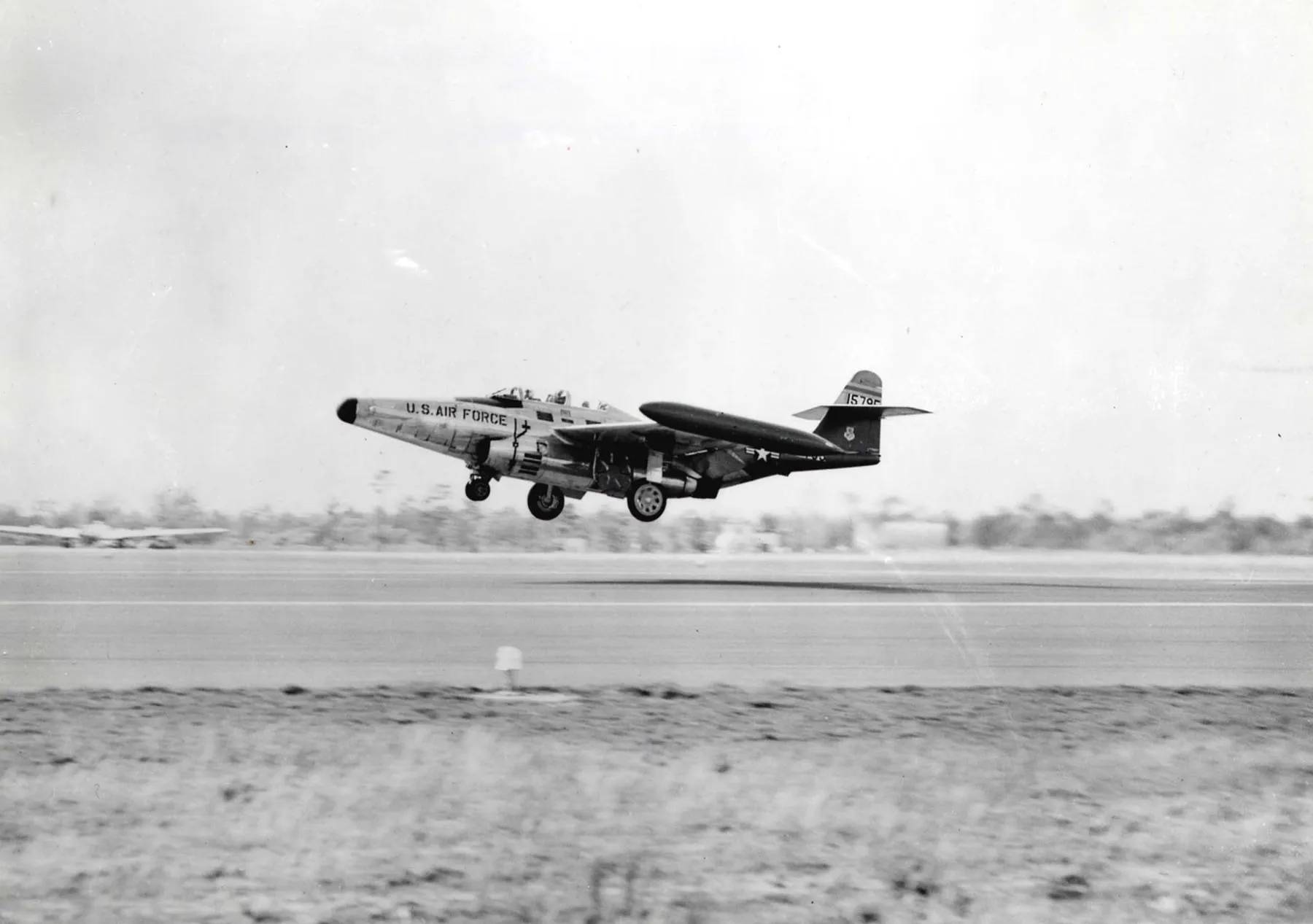
The aircraft was a Northrop F-89C-40-NO Scorpion, all-weather jet interceptor, serial 51-5853A, callsign “Avenger Red.” (The Joe Baugher USAF serials concordance places 51-5837 through 51-5856 in the F-89C-40-NO block, and the Aviation Safety Network entry for the airframe gives the same designation.) Its pilot, 1st Lt. Moncla, was 27 years old, from Mansura, Louisiana, and had over 800 flying hours by the most-cited summary, with one outlying figure giving fewer. Its radar operator, 2nd Lt. Wilson, was from Ponca City, Oklahoma. (Wikipedia, “Felix Moncla”; UFOBC persons-involved page; Northern Michigan History; History.com; Aviation Safety Network.)
At about 1817 local, a ground-control intercept radar site codenamed PILLOW, P-16, at Calumet Air Force Station on the Keweenaw Peninsula, picked up a target crossing Lake Superior from west to east at 7,000 feet. According to the USAF accident report’s identification language carried by the UFOBC research project, the target “was believed to be VC-912,” an RCAF Dakota C-47 on a Winnipeg-to-Sudbury flight plan, “but because the aircraft was off the flight plan course by about 30 miles, it was classified as ‘Unknown.’” The 2nd Lt. Douglas A. Stuart at Calumet was the GCI controller of record. (UFOBC, “What Caused the Alert”; Open Skies Project; verbatim attribution to the accident report rests on secondaries pending review of the report PDF.)
Avenger Red took off from Kinross at 2322 Zulu, 1822 local, on a heading of 300 degrees at 30,000 feet, as carried by ThinkAboutItDocs and the Aviation Safety Network entry from the accident report’s own wording. Control was initially handled by NAPLES, the GCI site at Sault Ste. Marie Air Force Station, and then transferred to PILLOW. Over the next half-hour PILLOW vectored the F-89 toward the unknown and brought it down through the altitude band. By about 1851 local PILLOW called a right turn, by 1852 the unknown was at “11 o’clock, ten miles out,” and the F-89 was leveling at roughly 8,000 feet. (Open Skies Project chronology; UFOBC, “What Merged on Radar”; History.com.)
The merge came at approximately 2355 Zulu, about 1855 local. The accident report’s wording, as carried by ThinkAboutItDocs, runs: “At approximately 2355 Zebra the unknown aircraft and the F-89 merged together on the radar scope.” The further language, as carried by the UFOBC research project, reads: “Radar returns from both aircraft were then seen to merge on ‘Pillow’s’ radar scope,” and “The radar return from the other aircraft indicated it was continuing on its original flight path, while the return from the F-89 disappeared from the GCI station’s radar scope.” The F-89’s IFF signal dropped out at the same time. No distress call was received and radio contact was not re-established. Squadron historical data archived by NICAP frames it this way: “The fighter and the bogey blips merged on the GCI radar scope. There was no further transmission from the fighter, the bogey was not aware of any aircraft in the area, and GCI saw no blips break off from the target.” (ThinkAboutItDocs; UFOBC; NICAP, kinross3.htm. Every quoted line attributed to the accident report rests on these secondaries pending direct review of the report PDF.)
Two further F-89s went up from Kinross. Avenger Black, flown by 2nd Lt. William Mingenbach, was airborne by about 1915 local. After the search began Mingenbach told the accident board he believed he had heard a brief radio transmission from the missing aircraft about 40 minutes after it vanished from the scope, an apparent contact no one else corroborated and which left no recording. Avenger Red was declared overdue at fuel exhaustion, around 2007 local. (Open Skies Project; UFOBC; Wikipedia, “Felix Moncla.”)
The air-sea search began that night and ran for several days, with US Air Force SA-16 amphibians, C-47s, a helicopter, a Cessna and a B-25, and Royal Canadian Air Force participation. It was officially suspended on 28 November 1953. Researchers tracking the operation estimate roughly 80 percent of the designated search area was covered. No wreckage, no debris that could be tied to 51-5853A, no remains, and no fuel slick of the right kind were recovered. (Open Skies Project; History.com.)
The USAF Aircraft Accident Investigation Board’s report later identified the unknown as RCAF Dakota C-47 VC-912 on a Winnipeg-to-Sudbury flight plan, off its filed course by about 30 miles. The board noted “a possibility that Lt. Moncla was subject to attacks of vertigo a little more than the normal degree,” but vertigo was not elevated to a finding or conclusion in the board’s findings section. The Aerospace Technical Intelligence Center later told a separate inquirer, in language carried by Wikipedia and UFOBC, that “there is no record in the Air Force files of sighting at Kinross AFB on 23 November 1953.” (Wikipedia, “Felix Moncla”; UFOBC; History.com.)
The Royal Canadian Air Force did not agree. On 14 April 1961, Flt. Lt. C. F. Page, writing on behalf of the Chief of the Air Staff, told the researcher Jon Mikulich, in a letter held in the NICAP archive: “A check of Royal Canadian Air Force records has revealed no report of an incident involving an RCAF aircraft in the Lake Superior area on the above date.” Sqn. Ldr. W. B. Totman, in a separate observation reproduced by NICAP, noted that the alleged C-47 was on a flight plan over Canadian territory, which made an intercept “unlikely” on its face. The C-47 pilot eventually named in the USAF reading, Gerald Fosberg of 412 Squadron at Rockcliffe, has subsequently told interviewers, in a David Cherniack documentary made for VisionTV, that his aircraft was never 30 miles off course and that he was never informed at the time that an interception had been attempted. (NICAP RCAF letter archive; HowStuffWorks; Fear of Landing; UFOBC persons-involved page.)
Project Blue Book, the Air Force’s UFO clearinghouse, carried the case but did not classify it as a UFO event; the case was handled as an aircraft accident. Donald Keyhoe, the retired Marine Corps major and founding director of NICAP, wrote about Kinross in his 1955 book The Flying Saucer Conspiracy and again in Flying Saucers from Outer Space. Keyhoe reported that he had obtained a leaked Air Force document in which an Air Force radar observer was quoted with what has since become the most-cited line in the entire UFO literature on the case: “It seems incredible, but the blip apparently just swallowed our F-89.” That sentence is widely passed around as if it were a verbatim 1953 radar log. It is, in its sourced form, Keyhoe’s reporting of a leaked document, and that is the level at which it stands. (HowStuffWorks; Wikipedia, “Felix Moncla.”)
A 1968 footnote, reported in the Wikipedia entry and not load-bearing here, has a USAF officer confirming that aircraft parts found on the eastern shore of Lake Superior in October 1968 were from a military jet. The identity of those parts was not made public and the Canadian government reportedly has no record of any such find; the parts have never been positively associated with 51-5853A.
In September 2006 the case briefly returned to the news. A person identifying himself as Adam Jimenez, representing what was described as the Great Lakes Dive Company, announced through Linda Moulton Howe’s Earthfiles and other UFO-adjacent venues that the F-89 had been located in 2005 in deep water off the Keweenaw Peninsula and that a metallic object had been imaged about 212 feet from it. The announcement collapsed under investigation. MUFON’s then-director James Carrion reported that no such company was registered in Michigan and that recognised Great Lakes maritime bodies did not know the named individuals; an embedded “Associated Press” item in the announcement appeared to be fabricated; Brendon Baillod of the Great Lakes Shipwreck Research Center told Northern Express that “their claim that they used a fish finder with Sharc2 software to produce their images from 500 ft of water pretty much debunks it for me”; Woods Hole Oceanographic Institute judged the imagery not to be side-scan sonar at all. The company’s website went dark. Jimenez stopped responding. The UFO Chronicles editor Frank Warren later summarised it: “The Great Lakes Dive Company debacle was a hoax created out of whole cloth.” The F-89 has not been verifiably located. (The UFO Chronicles 2006 series; Northern Express; Earthfiles.)
A privately erected cenotaph stands at Sacred Heart Cemetery in Moreauville, Louisiana, in Moncla’s name. The Moncla family corresponded with Donald Keyhoe in the 1950s, and the family has long been part of the documented public memory of the case. (Find a Grave; UltimateUnexplained.)
The Evidence
The case rests on a thin documentary chain and a complete absence of physical evidence. The weight is in a radar event, a radio silence, and an unresolved institutional contradiction.
The GCI radar record. The PILLOW track is the case’s only quasi-instrumental record. What it shows is a half-hour controlled intercept of an unknown by an alert-status interceptor, ending with the F-89’s return merging with the unknown’s return on the scope, the F-89’s IFF signal dropping out, and the F-89 disappearing from the scope while the unknown continued on track. What it does not show is, equally, important. The AN/FPS-3 ground radar of the period had a range resolution of roughly half a mile, so “merged” means “within about a half-mile of each other on the scope,” not “collided.” The original scope photography and any contemporaneous tape are not in the public record. The reconstruction we have is from the accident report and from controller testimony, not from a raw instrumental recording that can be reopened today. (Open Skies Project on AN/FPS-3 resolution; UFOBC; NICAP.)
The radio record. The F-89 made no distress call before the merge, and no radio contact was re-established after it. The silence is consistent with a sudden catastrophic event of some kind, but it is not by itself diagnostic of any cause. Cutting against a clean instantaneous-loss reading is the disputed transmission Mingenbach reported hearing roughly 40 minutes later from Avenger Black. He believed, but did not confirm, that it came from the missing aircraft. Nothing was recorded, and no other pilot picked it up. (Open Skies Project; UFOBC.)
The absence of wreckage. This is the load-bearing fact, the one that keeps the case open. An eight-day, multi-service search of about 80 percent of the designated area produced no debris, no remains, no recoverable trace. Lake Superior is the deepest of the Great Lakes, at roughly 1,300 feet, very cold year-round, and it is known to keep its dead; many Great Lakes losses have never floated wreckage. The absence of recovered wreckage in deep, cold water is not itself a mechanism, and it does not single-handedly support any particular reading. What it does is leave every reading at the level of inference. There is no airframe to inspect. (Open Skies Project; History.com.)
The accident investigation board report. This is the institutional reconstruction of the night. It is the report that identifies the unknown as RCAF Dakota C-47 VC-912 and that names pilot vertigo as a possibility without elevating it to a finding. Its limits are real. It is a relayed institutional reading, not a physical examination of an aircraft. Its central identification of the unknown is contradicted by the air force it implicates. Its vertigo language sits in the body of the report and not in its conclusions. And the report’s verbatim wording, as quoted across the secondary literature, is itself reliant on copies circulating through the Kinross research community, copies the publication will treat as authoritative only after a primary reviewer has opened the document and confirmed the lines. (Wikipedia; UFOBC; History.com.)
The RCAF correspondence. This is the other half of the documented institutional contradiction at the centre of the case. The Page letter of 14 April 1961 is a formal denial, on behalf of the Chief of the Air Staff, that any RCAF aircraft was in the Lake Superior area on the date in question. The Totman observation and the later interviews with Fosberg run in the same direction: not just no incident, but no plausible reason for an intercept of a Dakota on a Canadian flight plan over Canadian territory. The denial does not rule out that a Canadian aircraft was somewhere in the sky that night; the central dispute is whether any such aircraft was where the USAF report puts it and behaved as the USAF report says. That, and not the existence of Canadian aviation on 23 November 1953, is the contested fact. (NICAP RCAF letter archive; Open Skies Project; Fear of Landing.)
The Project Blue Book entry. The case is on the books and was handled as an aircraft accident, not as a UFO classification. The publicly available file is brief. The leaked-document material Keyhoe reported in the late 1950s suggests some internal Air Force unease about the case, but that material reaches us through Keyhoe’s reporting, not through the Blue Book card itself. (HowStuffWorks; Wikipedia.)
The 2006 sonar claim. The Great Lakes Dive Company announcement is in the record as a claim and in the case literature as a fabrication. The investigative work by Carrion, Baillod, and Woods Hole, the dark website, and the unreachable claimant are what move it from “the wreck has been found” to “an attributed claim that did not survive investigation.” It is not evidence about what happened in 1953. It is evidence about a 2006 episode in the case’s afterlife.
The honest summary of the evidence is this. A half-hour controlled intercept ended with the F-89’s return merging with an unknown’s return, the F-89’s IFF dropping out, and the F-89 vanishing from the scope. No distress call. No recovered debris. One disputed radio transmission heard 40 minutes later by a single witness. An official identification of the unknown that the country named has not confirmed and has formally denied. And no physical evidence in 72 years.
The Theories
None of what follows has been proven. The cause of the F-89’s loss has never been established. We present the readings in roughly the order the record itself treats them, and we crown none of them.
Mechanical failure or loss of control in poor weather. The most parsimonious mundane reading is that F-89C 51-5853A suffered a mechanical or systems failure, or its crew suffered spatial disorientation in instrument conditions at low altitude over cold open water, and went into the lake. The F-89C had a documented history of structural problems in 1952 and 1953 significant enough to prompt fleet-wide groundings and modifications. The accident report itself raised the possibility of pilot vertigo. Eight thousand feet over Lake Superior at night in late November is not a great deal of altitude in which to recover from a loss of control or a critical mechanical event. What works against this reading is what is missing from it: the radar record shows a smooth, controlled intercept up to the moment of the merge, not the erratic vectors one would expect from a disoriented crew; the accident board declined to elevate vertigo to a finding even though it raised it; and Mingenbach’s reported later transmission, if it happened at all, sits awkwardly against a clean instantaneous-loss model. This is the most ordinary candidate available, plausible on its face, and unproven.
Collision with RCAF Dakota C-47 VC-912. This is the USAF Accident Investigation Board’s adopted reading: that the F-89 closed on, and accidentally struck, a Canadian C-47 wandering about 30 miles off its filed Winnipeg-to-Sudbury course, with the C-47 either undamaged or barely so and continuing on its way while the F-89 fell into the lake. The reading is internally coherent. An RCAF Dakota was on a Winnipeg-to-Sudbury flight plan that evening; the radar pattern (one return continuing, the other gone) is mechanically consistent with one aircraft going down and the other flying on. What it has against it is the documented institutional contradiction: the RCAF has formally denied that any of its aircraft was in the intercept area or was being intercepted, and the C-47 pilot eventually named has insisted the aircraft was never 30 miles off course and that he was never informed an interception had been attempted. The AN/FPS-3 radar’s roughly half-mile range resolution means that “merged blips” does not by itself imply contact. No physical evidence of a collision has ever been produced on either airframe. The official reading is on the books; it is contested by the institution it implicates; and it has never been substantiated.
An unknown craft of indeterminate type. This is the reading that has driven the case’s fame in the UFO literature, originating with Donald Keyhoe and reproduced ever since. In its rigorous form the claim is narrow: the radar pattern (smooth approach, sudden merge, loss of one return and continuation of the other, loss of IFF, total radio silence) is consistent with the popular reading; the USAF’s later identification of the unknown was rejected by the RCAF; the Blue Book file is brief; and a leaked Air Force document Keyhoe reported is the source of the much-cited line, “It seems incredible, but the blip apparently just swallowed our F-89.” What weighs against the reading is everything we do not have. There is no physical evidence. There is no instrumental record beyond the GCI track and the IFF dropout. The headline quote is not a 1953 radar log; it is a 1950s author’s report of a document. The reading has been attributed to the case for seventy years. It is one interpretation. The record does not allow us to crown it.
A foreign aircraft (Cold War overlay). A separate strand of speculation places the unknown as a Soviet reconnaissance aircraft on a long-range incursion. The date sits in the active Cold War, and Air Defense Command’s whole posture in 1953 was directed at exactly that scenario across the polar approaches. There is no positive evidence of a Soviet aircraft in the area on 23 November 1953, the unknown’s reported speed and altitude do not specifically match any known Soviet airframe of the period, and the institutional response, on both sides of the border, did not invoke a foreign aircraft. The reading sits on the shelf, not in the record.
The 2006 “wreck found” claim. The Great Lakes Dive Company announcement is in the case’s afterlife rather than its evidentiary core. The investigative consensus is that it was fabricated. We treat it as the documented hoax it appears to be, not as a finding about what happened to the F-89.
What Remains Unknown
What was the unknown radar return that an alert-status F-89 was vectored onto over Lake Superior on 23 November 1953? The accident board said it was an RCAF Dakota 30 miles off course; the RCAF said it was not. Both readings are in the file. Neither has been substantiated. What happened to the F-89 when the two returns merged on the scope? It dropped its IFF, vanished from radar, and made no distress call. Beyond that, the record is silent. Where is the wreckage? Somewhere in Lake Superior, presumably, in deep, cold water that has kept other losses; nowhere that 72 years of search and one documented hoax have been able to verify.
What is missing from the case is the artifact that would let any of the readings be tested: the aircraft. Until something verifiable is recovered, the spine of the case is a radar event, a radio silence, and a contradiction between two national air forces. That is enough to keep the file open. It is not enough to close it.
Sources
Primary / official
- USAF Aircraft Accident Investigation Board report, F-89C 51-5853A, 23 November 1953 (NICAP archive entry)
- RCAF letter of denial, Flt. Lt. C. F. Page to Jon Mikulich, 14 April 1961 (NICAP archive)
Secondary / contextual
- UFOBC.ca Kinross research project
- UFOBC.ca, “What Caused the Alert?”
- UFOBC.ca, “What Merged on Radar?”
- Open Skies Project, “The Kinross Incident”
- Wikipedia, “Felix Moncla”
- Aviation Safety Network, F-89C 51-5853, 23 November 1953
- Joe Baugher, USAF Fighter Serials, F-89 page
- History.com, “This Air Force Jet Was Scrambled to Intercept a UFO, Then Disappeared”
- HowStuffWorks, “The 1953 Kinross UFO Incident”
- Fear of Landing, “Another Unsolved Mystery: The Kinross Incident”
- ThinkAboutItDocs, “1953: The Kinross Air Force Base Incident”
- Northern Express (Brendon Baillod), “Truth or Hoax: Disappearance of F-89”
- The UFO Chronicles, “Mystery of the Kinross Incident Deepens” (2006)
- The UFO Chronicles, “Investigation of Great Lakes Dive Company” (2006)
- Earthfiles (Linda Moulton Howe), “Updated 1953 Kinross AFB Mystery” (2006)
- Northern Michigan History, “The Mysterious Disappearance of an Air Force Jet Over Lake Superior”
- Wikipedia, “Kinross Air Force Base”
- Find a Grave, 1LT Felix Eugene “Gene” Moncla Jr.