Maritime Mysteries Case file
Found Drifting 600 Miles Off Course: The MV Joyita, 1955
A 69-foot wooden cabin cruiser sailed from Apia for the Tokelau Islands on 3 October 1955 with 25 people aboard, missed her destination, and was found five weeks later drifting derelict more than 600 miles west of her route. A New Zealand Crown Commission of Inquiry established how she flooded but declared the fate of the 25 inexplicable on the evidence submitted.
- Case type
- Maritime
- Status
- Unexplained
- Event date
- October 3, 1955
- Location
- South Pacific, between Apia, Samoa and the Tokelau Islands - South Pacific Ocean
- Evidence
-
- Official record
- Testimonial
- Physical
The open question What persuaded an experienced master, a doctor, and a district officer to leave a buoyant ship in deep Pacific water, and where the 25 people who left her went.
At about five in the morning on Monday 3 October 1955, a 69-foot wooden cabin cruiser called the Joyita stood out of Apia harbour, Samoa, on the first leg of a routine charter run for the Tokelau Islands, about 270 nautical miles to the north. She carried twenty-five people, sixteen crew and nine passengers, and a routine government-charter manifest of medical supplies, foodstuffs, timber, and eighty empty oil drums. Her port engine clutch had failed the day before, and she was sailing on a single engine. She was due at Fakaofo, the southernmost of the Tokelaus, within about forty-eight hours. She did not arrive. A Royal New Zealand Air Force search beginning four days later covered more than a hundred thousand square miles of ocean and recovered nothing. Five weeks after she sailed, a passing merchant ship found her drifting derelict, heavily listed and abandoned, more than six hundred miles west of her planned course. The twenty-five people who had sailed in her were gone.
That much is in the record, and the record here is unusually full for a South Pacific vanishing. A New Zealand Crown Commission of Inquiry sat in Apia in February 1956 with the salvaged hull in front of it, established a coherent mechanical cause for the flooding (a fractured cooling pipe and blocked bilge pumps), made specific findings against the master, and then, on the central question of what became of the twenty-five, declared their fate inexplicable on the evidence submitted at the inquiry. A book-length treatment by Robin Maugham (1962) and a later reconstruction by David Wright (2002) have each offered a specific account of what happened in the hours before the abandonment. Neither has carried the field. This article holds the line at what the Commission did and did not conclude, treats the later books as the named, attributed hypotheses they are, and lets the genuine residue stand. We keep three things separate, as always: what is documented, what the evidence shows, and what is still only a hypothesis.
The documented account
The Joyita was older than her purpose. She had been built in 1931 at the Wilmington Boat Works in Los Angeles as a luxury yacht for the Hollywood film director Roland West, who named her for his wife, the actress Jewel Carmen (“joyita” is Spanish for “little jewel”). She was a 69-foot wooden vessel, cedar planking on oak frames, with twin Gray Marine diesel engines and a hold lined with cork that had been intended for refrigeration and that incidentally gave her a substantial buoyancy reserve, on the order of 640 cubic feet. The US Navy acquired her in October 1941 and ran her through the Second World War as a yard patrol vessel out of Pearl Harbor, working the waters around the Big Island, Hawaii. In 1943 she ran aground and was extensively repaired; during the repair, her original copper and brass piping was replaced with galvanized iron. She was decommissioned in 1946, sold in 1948, and passed through several private owners before, in 1952, being acquired by the anthropologist Dr. Katharine Luomala, who chartered her to a British-born trader and master mariner, Thomas Henry “Dusty” Miller, then operating out of Samoa on copra and cargo runs.
Miller was forty-one years old. His first mate on the fatal voyage was Charles R. “Chuck” Simpson, an American aged twenty-eight. The remaining crew were drawn from across the Pacific: two engineers, a Gilbertese bosun, Tokelauan seamen, greasers, and a cook, and a Tokelauan radio operator. The nine passengers included an Irish-born physician, Dr. Alfred Dennis Parsons, travelling specifically to perform an amputation in the Tokelaus; the New Zealand district officer for Tokelau, Roger Derrick Pearless; the New Zealand pharmacist Bert Hodgkinson; and a Tokelauan dispenser, Lapana Takama, travelling with his wife and two adopted children. At least one passenger was reportedly carrying substantial cash for copra purchases.
The voyage went wrong before it began. On 2 October 1955 the port engine’s clutch failed, delaying departure. Miller sailed the next morning at about five on the starboard engine alone. Two other defects were established later. The radio’s antenna cable was broken, and the break had been painted over, leaving the set technically functional but with an effective range of only about two miles. The bilge pumps were clogged.
The Joyita’s ETA at Fakaofo was the morning of 5 October. She did not arrive. On 6 October the Royal New Zealand Air Force began an air-sea search with Sunderland flying boats, covering an area variously reported as more than a hundred thousand square miles or about 260,000 square kilometres of ocean between Samoa and Tokelau, and running into 12 October. No wreckage, no survivors, no oil slick, nothing. The search was called off, and the Joyita was given up for lost.
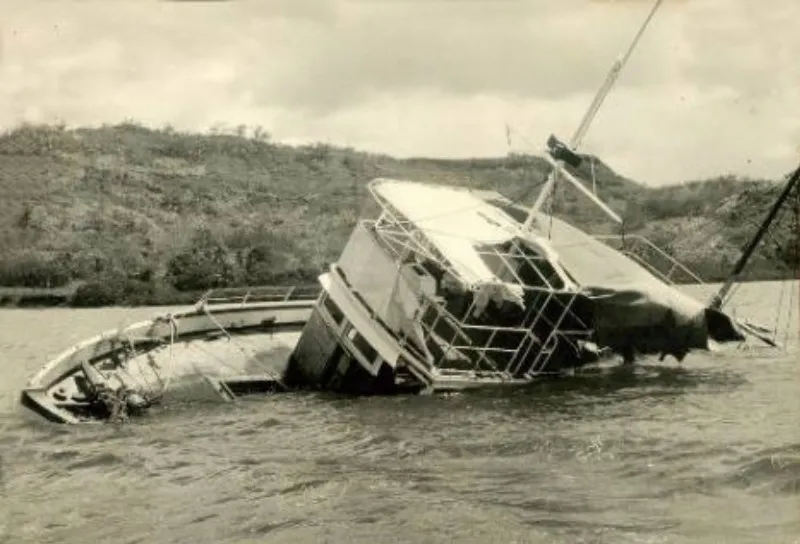
Thirty-eight days later, on 10 November 1955, the merchant vessel MV Tuvalu, under Captain Gerald Douglas, sighted a derelict hulk drifting north of Vanua Levu, Fiji, more than six hundred miles west of the Joyita’s planned course. It was the Joyita. She was partially submerged and listing heavily to port, her port deck rail awash, with the heel later reported at angles up to forty-five degrees. There was no one aboard.
On boarding and during the salvage tow back to Suva, those who examined her recorded what follows. The dinghy and all three Carley liferafts were gone. The ship’s logbook, the sextant, the mechanical chronometer, other navigational equipment, and the captain’s firearms were missing. About four tons of cargo were gone, a figure widely reported and the kind of detail the inquiry record is the proper place to confirm. The port engine clutch was partially disassembled, consistent with attempted in-voyage repair. The starboard engine was covered with mattresses. The radio was tuned to the international maritime distress frequency, 2182 kHz, with the antenna cable still broken and painted over. The electric clocks had stopped at 10:25, and the cabin and navigation light switches were in the “on” position. A doctor’s bag lay on a table with a stethoscope, a scalpel, and what reputable summaries describe as four lengths of bloodstained bandages. A canvas awning had been rigged on deck. The flying bridge was smashed and the deckhouse windows broken. Barnacle growth high above the normal waterline showed that the heavy port list had been long established, many days, possibly weeks, before the Tuvalu found her.
The New Zealand Crown Commission of Inquiry convened in Apia in February 1956. Western Samoa was then a New Zealand-administered United Nations trust territory, and the inquiry was a New Zealand Crown one sitting in Samoa, with the salvaged hull and the boarding record available to it.
It was able to establish a coherent mechanical cause for the flooding. A cooling-water pipe in the port auxiliary engine’s raw-water circuit had fractured, the failure traceable to galvanic corrosion on the galvanized iron piping that had been installed during the 1943-1946 US Navy repair in place of the original copper and brass. With the bilge pumps clogged and the vessel lacking watertight bulkheads, water entered the lower hull. The pipe in question lay buried under cabin flooring, which later analysts emphasized because it meant a crew could not have found the leak at sea even if they had looked.
The Commission made specific findings, on the record, against Captain Miller. It found him reckless for sailing on one engine with numerous minor faults, negligent for failing to provide a working radio or a properly equipped lifeboat, and in breach of maritime law for allowing the vessel’s passenger licence to lapse. These are public findings of a New Zealand Crown commission on a man long deceased, and they are reported here as such. The exact verbatim wording of the findings should be read in the primary report; the phrasing used in reputable summaries is given here without claiming verbatim status.
On the central question, what became of the twenty-five, the Commission’s stated conclusion, as widely reported across reputable summaries, was that the fate of the passengers and crew was inexplicable on the evidence submitted at the inquiry. Why competent seamen and a doctor and a district officer would abandon a vessel that was, by virtue of her cork lining and the eighty empty drums in her cargo, very difficult to sink, in deep water far from rescue, in rafts they could not bring to land, the Commission did not say.
The Joyita herself was salvaged, refloated, sold at auction in July 1956, and run on in Fijian trade. She ran aground in 1957 and again in 1959, by which time she was being called an unlucky ship. The author Robin Maugham bought the hulk in the early 1960s, sold her in 1966, and she had disintegrated by the late 1970s. Memorial plaques were placed at Apia and at Fakaofo Village in 2012, with a parliamentary memorial in New Zealand the same year. The Tokelau community has actively maintained the memory of those lost.
The evidence
The evidentiary spine of the Joyita case is unusually deep for a 1955 South Pacific vanishing: a formal New Zealand Crown Commission of Inquiry with a sitting record, a salvaged hull that was forensically examined, a documented mechanical cause for the flooding, and a fuel-burn calculation that placed the point of abandonment on the chart. Its weakness is identical to every vanishing of this kind. No survivor, no body, no witness to the abandonment, and no recovered raft or dinghy, after a sea-and-air search that began promptly and covered tens of thousands of square miles. With that stated, here is what each channel actually shows, and where it stops.
The hull’s documented condition. The Joyita was found partially flooded, heavily listed to port, with barnacle growth high above her normal waterline, showing the list had been long established. The flying bridge was smashed, the deckhouse windows broken. A canvas awning had been rigged on deck. Read together, these describe a vessel that had been abandoned alive, before any single catastrophe a witness could have seen, and had then drifted, listing, for weeks. The awning and the position of the switches and the mattresses point to people who had been on deck and working in the hours before they left her. The limit is real. The damage to the bridge and deckhouse is also consistent with prolonged drift in heavy weather after the abandonment, not necessarily with damage that drove the crew off. The smashed bridge cannot be made to do the work of an “attacked” detail without other evidence the case does not contain.
The missing boats and the missing instruments. Gone: the dinghy, three Carley liferafts, the ship’s logbook, the sextant, the chronometer, other navigation gear, the captain’s firearms, and roughly four tons of cargo. Left behind: the doctor’s bag and its instruments, the radio, the bulk of the vessel and her stores. Taking the boats, the navigation instruments, the logbook, and the firearms is the exact pattern of a deliberate, officer-led abandonment. It is what a captain takes when he means to navigate, identify, and defend the party that leaves the ship. It does not, on its own, select among the possibilities. A voluntary precautionary abandonment and an orderly but coerced departure produce the same pattern at this level of detail. The four tons of missing cargo is the one item that does not fit a clean “abandon ship” reading; cargo is not normally loaded into a liferaft. The figure should be confirmed against the inquiry’s cargo evidence before any reading is built on it, and the difference between “four tons missing” and “the empty drums floated free” would matter.
The mechanical cause of the flooding. This is the Commission’s solid finding. A fractured cooling-water pipe in the port auxiliary engine’s raw-water circuit, the failure traceable to galvanic corrosion on the galvanized iron piping installed in 1943-1946, with the bilge pumps clogged and no watertight bulkheads. What it shows is that the ship took on water through a small, mechanical, locatable failure. What it does not show is the abandonment. With cork-lined holds and eighty empty drums in her cargo, the Joyita could not, in principle, sink even fully flooded. Why people who had spent hours fighting the water then chose to leave a buoyant ship in deep water is precisely the question the inquiry could not answer.
The fuel-burn calculation. From the working engine’s fuel consumption, the Joyita is reported to have run about 243 nautical miles before abandonment, placing the point of abandonment within roughly fifty nautical miles of Tokelau, with the leak beginning after about nine in the evening of the second night. The honest attribution is that this geometry comes substantially from David Wright’s 2002 reconstruction by way of the New Zealand Herald, not directly from the 1956 Commission’s findings. If the underlying numbers are in the Commission record they should be cited there; if they are Wright’s derivation, they belong to him. Either way, what they suggest is an abandonment probably at night, probably close enough to land that climbing into rafts could be thought rational, after the engine room had begun flooding and the working engine had been kept turning as long as the fuel held. The numbers themselves are a derived estimate, not a direct observation.
The radio set to 2182 kHz. The radio was tuned to the international distress frequency when found. The antenna cable was broken, and the break had been painted over. In the moments before abandonment, someone attempted to transmit a distress call, and that call could not have travelled to any plausible rescuer. The painted-over break is also evidence that the radio’s unfitness had been concealed before sailing. It is damning negligence; it does not, by itself, explain anything beyond why no Mayday was ever heard.
The doctor’s bag and the bandages. A doctor’s bag on a cabin table with a stethoscope, a scalpel, and what reputable summaries describe as four lengths of bloodstained bandages. What it shows is that someone aboard was injured seriously enough that Dr. Parsons applied multiple dressings, and that the bag was left behind in the abandonment. What it does not show is the cause of the injury. The bandages are consistent with a hand cut on broken glass during attempted engine repair, with a slip and fall in heavy weather, or, at the upper end of what the record allows, with an on-board confrontation. The case has often been written as if the bandages prove violence. The record does not let them do that work alone. The exact wording, “four lengths of blood-stained bandages,” is widely repeated and should be confirmed against the boarding and inquiry record.
The Commission record. The Crown Commission of Inquiry, Apia, February 1956, is the documentary spine of the case and the reason this article rests on more than press summary. It established the flooding mechanism, made specific findings against the master, and declined to fix a cause for the loss of the twenty-five. Its limit, for present purposes, is one of access rather than substance. The primary report is the proper home of every verbatim quotation, including the “inexplicable on the evidence submitted at the inquiry” phrase that anchors the article. The phrase is widely reported and treated here as a standard paraphrase of the Commission’s conclusion until confirmed against the report itself.
The negative evidence. A prompt RNZAF air-sea search beginning 6 October 1955 and running into 12 October, covering more than a hundred thousand square miles of ocean between Samoa and Tokelau, recovered nothing. After 10 November, no body, no raft, no dinghy, no oil slick, no debris was ever found. This is consistent with an abandonment far from where the searchers were looking, which is exactly what the fuel-burn geometry suggests, with the Joyita drifting six hundred miles off her route and the rafts ending somewhere else still. Absence of evidence is not a mechanism. It rules out the easy outcomes (they drifted in, they made landfall, their boat washed up) without selecting among the hard ones.
The theories
Everything in this section is a hypothesis. The Commission of Inquiry’s own conclusion was that the fate of those aboard was inexplicable on the evidence submitted. Two later books have advanced specific reconstructions, neither of which has carried the field. None of what follows is proven. They are set out best-supported first.
Precautionary abandonment in mistaken belief of imminent sinking. This is the leading modern reading and the inference that fits the most physical evidence, but it is an inference and not a finding. On this reading, the cooling pipe fractured during the night of 4-5 October, water entered through corroded piping under the cabin floor, the bilge pumps proved useless, and at some point those aboard concluded that the ship was sinking and abandoned into the dinghy and the three Carley rafts, taking the navigation gear, the logbook, the firearms, and a substantial portion of the cargo. They may have been close enough to land, within about fifty nautical miles of Tokelau, to think they could pull in. They could not. The rafts were lost at sea; the cork-buoyed Joyita drifted on, listing but afloat, until found five weeks later more than six hundred miles off course. The mechanical cause of flooding is established. The pattern of missing items fits a deliberate, captain-led departure. The awning rigged on deck, the mattresses positioned against the engine to staunch a leak or to protect the switchboard, and the distress frequency set on the radio all fit a crew that had been fighting the water and trying to call for help before deciding to leave. What the reading does not explain is the trigger. The cork lining and the eighty empty drums ought to have been visible to an experienced master as a buoyancy reserve. If the rafts had reached Tokelau or any reef, they ought to have been found. The Commission, looking at exactly this evidence, found it inexplicable, and that finding is the case’s actual centre of gravity.
Robin Maugham’s reconstruction (1962). Maugham’s book The Joyita Mystery (Max Parrish, London, 1962) is the standard book-length treatment, by an author who later bought the Joyita as a hulk. Maugham accepted the broken cooling pipe and pump failure as the trigger. On his reading, the mattresses against the starboard engine were used either to stem the leak or to protect the electrical switchboard, the weather worsened, and a command crisis developed in which a confrontation took place between Captain Miller and First Mate Simpson, after which an abandonment was ordered. The bloodstained bandages, the missing logbook and firearms, the awning, and the mattresses are read as supporting this picture. This is presented strictly as Maugham’s named, attributed hypothesis. The confrontation and the command crisis are not findings of the Commission, and nothing in this article asserts that any named officer or crew member committed a crime. A separate variant attributed to Captain S.B. Brown has both officers fall overboard during a struggle. It is recorded here only because the literature contains it, on the same attributed basis.
David Wright’s reconstruction (2002). David Wright, an English lecturer at Auckland University, published Joyita: Solving the Mystery in 2002 and was reported in the New Zealand Herald that March as having “solved” the case. On his reading, the leak developed slowly after about nine in the evening of the second night, those aboard sent a distress call on 2182 kHz without realising the antenna cable was broken, and, believing help was on the way, they abandoned in the dark within about fifty nautical miles of Tokelau and drowned or were lost to sharks before they could reach land or be found. The fuel-burn geometry, the radio tuning, the clocks stopped at 10:25, and the painted-over antenna break all support a nighttime abandonment of this general shape. The reading does not address the command question, why a competent crew abandoned a vessel they could verify by sounding was not actually sinking, and the case is not broadly accepted as solved. It is one author’s reconstruction, not a finding, and the 2002 press coverage notwithstanding, the Joyita has not joined the ranks of the closed cases.
Mutiny or murder by the crew. A theory raised in 1955 and revived in various forms since, including in Maugham’s more specific variant: a faction of the crew rose against the master, killed or overpowered him and others, took the rafts, the firearms, and the cash for copra, and either reached land in secret or died at sea. The detail-set sometimes cited for it is the missing firearms, the missing logbook (a mutineer would not want a record), the bloodstained bandages, and Miller’s reported debts. The detail-set against it is more decisive: no body, no raft, no recovered cash or cargo, no confession, no finding of mutiny by the Commission, and a crew composed largely of Tokelauan and Gilbertese seamen working a routine run between communities they were known in. The same physical evidence reads at least as well as a panicked but consensual abandonment. The theory is recorded here strictly as period speculation and as a strand within Maugham’s later reconstruction. No named member of the crew is accused of any crime in this article, and nothing in the record sustained any such charge against any of them.
The “Japanese holdovers” or Japanese fishing-fleet theory. In November 1955 the Fiji Times and Herald reported, citing an unnamed source, that the Joyita had observed something a Japanese fishing fleet did not want her to see, and the London Daily Telegraph raised the possibility of “still-active Japanese forces from World War II” operating from an isolated Pacific base. Japanese-stamped knives initially found aboard fed the theory. The theory is recorded here only because the contemporary press contained it and because acknowledging it is the honest way to address it. It is not adopted in this publication’s voice. It was a 1955 framing carried by the postwar and Cold War anxieties of its moment, with a racial-political overlay, and the evidence did not support it. The knives proved to be unconnected to the case after testing. The Fiji government denied the November 1955 newspaper reports. No Japanese fleet or holdover base in the relevant area was ever identified. The theory is attributed to the named period press and dismissed on the evidence; The Cold File does not carry it forward in its own voice.
Pirates, Soviet submarine, insurance fraud. Three further theories appear in the literature and need to be catalogued precisely so they can be set aside. A pirate boarding is undercut by the intact stores, the untouched doctor’s bag and radio, the absence of bullet holes, the absence of any pirate vessel or surfacing of cargo, and the Fiji government’s denial of the 1955 hostile-attack reports. A Soviet submarine kidnapping is Cold War conjecture with no evidentiary support and no archival corroboration after the Cold War’s end; it is catalogued and dismissed. Insurance fraud by Miller is contradicted by the physical evidence (no open seacocks were found and the cork-and-drums buoyancy made the Joyita very difficult to scuttle from inside) and by the basic economics (Miller depended on continuing charter income, which his death would terminate, and he was on board). The Commission did not find this, and the case against it is direct.
The “Mary Celeste of the Pacific” framing. The tag is unavoidable in popular accounts and almost as old as the case. It is a journalistic comparison and should be treated as one. The cases sit eighty years apart with very different evidentiary records: a 1955 vanishing with a Crown Commission of Inquiry, a salvaged hull, a documented flooding mechanism, and a fuel-burn fix on the abandonment, alongside an 1872 abandonment whose evidentiary spine is salvage testimony in a Gibraltar court. The label invites the reader to expect a Mary Celeste-shaped puzzle. The Joyita is a different puzzle on a different record. It is not a ghost story, the ship was not cursed, and the supernatural framing is not evidence of anything.
What remains unknown
A government-charter cabin cruiser on a routine 270-mile run between Samoa and the Tokelaus sailed on one engine at five in the morning on 3 October 1955 with twenty-five named people aboard, took on water through a small mechanical failure she could not have found at sea, and did not arrive. Five weeks later she was found heavily listed and drifting six hundred miles off her route, with her boats, navigation instruments, logbook, firearms, and roughly four tons of cargo gone, her radio set to a distress frequency that could not transmit beyond two miles, her clocks stopped at 10:25 at night, a doctor’s bag with bloodstained bandages on the table, and a canvas awning rigged on deck. A New Zealand Crown Commission of Inquiry sat in Apia in February 1956 with the salvaged hull in front of it, established the flooding cause, found the master reckless and negligent, and declared the fate of the twenty-five inexplicable on the evidence submitted at the inquiry. Robin Maugham in 1962 and David Wright in 2002 each advanced a specific reconstruction of the hours before the abandonment. Neither has carried the field.
What the evidence best supports is narrow. It indicates a deliberate, officer-led abandonment in a flooding emergency, by people who had been fighting the water for hours and trying to send a Mayday that could not be heard, into rafts they then could not bring to land. The trigger, panic, command crisis, or a rational misjudgement of imminent sinking, was never established. The fate of the twenty-five, almost certainly lost at sea in the rafts, was never determined. No body, no lifeboat, no raft, and no person was ever recovered.
So we will not tell you the case is solved, because the Commission that sat with the hull and the evidence in front of it could not solve it, and the best modern accounts are reconstructions the evidence allows rather than findings the evidence proves. We will not tell you mutiny or murder happened, because the Commission did not find it and nothing in the record sustains a criminal accusation against any named officer or crewman. We will not tell you the Joyita was attacked by wartime stragglers or by a Soviet submarine, because those were 1955 framings the evidence did not support and the Fiji government denied at the time. What we can tell you is that on some night after the second day out of Apia, near enough to Tokelau that the people aboard may have thought they could pull in, an experienced master, a doctor, a district officer, and twenty-two others left a buoyant ship in deep Pacific water and were never seen again. The Commission’s word for that is inexplicable. The file is still open.
Sources
Primary / documentary
- Report of the Commission of Inquiry into the loss of the MV Joyita (New Zealand Crown Commission, Apia, February 1956), as widely reported across reputable summaries
- Atafu Tokelau Community Group (Matauala), “Joyita - Unsolved Mystery”
Secondary / contextual
- Wikipedia, “MV Joyita”
- Discovery UK, “The Unsolved Disappearance of MV Joyita: Ghost Ship of the Pacific”
- Explorersweb, “Exploration Mysteries: MV Joyita”
- NZ Herald, “Author says he’s solved MV Joyita mystery, 47 years later” (29 March 2002)
- Historic Mysteries, “MV Joyita: The Ghost Ship that Couldn’t Sink”
- Pae Korokī (Tauranga City Libraries) catalogue entry for Rosemary Francis, “A Watery Grave: The Mystery of the Joyita” (2017)
Robin Maugham, The Joyita Mystery (Max Parrish, London, 1962), is the standard book-length treatment and is referenced here through secondary summaries rather than read directly; specific claims attributed to Maugham above should be checked against the book itself.