UFO/UAP Case file
The Light That Showed Up on Three Machines: The 1957 RB-47 Encounter
For more than an hour over the American South, a reconnaissance jet's crew, its electronic gear, and a ground radar all reported the same thing in the dark. Then it vanished from all three at once.
- Case type
- UAP
- Status
- Unexplained
- Event date
- July 17, 1957
- Location
- South-central United States (Gulf of Mexico near Mississippi, west across Louisiana and Texas toward Oklahoma; ground-radar correlation at Duncanville, Texas) - United States
- Evidence
-
- Radar
- Instrumental
- Testimonial
- Official record
The open question What was the object that three independent systems (the crew's eyes, the aircraft's passive S-band ELINT receivers, and ground radar) appeared to register together, holding a constant bearing against a 500 mph jet and vanishing from all three at the same instant?
Most reports of strange lights in the sky come down to one witness and one set of eyes, fallible and easy to wave away. The case of July 17, 1957, is harder to dismiss, and the reason is arithmetic. That night, over the dark middle of the United States, an object was reported not by one observer but by three independent systems that do not share each other’s mistakes: the eyes of trained Air Force flyers, a passive electronic receiver tuned to incoming radar, and a ground radar station on the Texas plains. For more than an hour and several hundred miles, the three more or less agreed. Then, in a single moment, the object dropped off all three at once.
This is an account of what the record says, what the instruments registered, and why the most careful people who have studied it still cannot agree on what it was, nearly seventy years later. We keep three things separate, as always: what is documented, what the evidence shows, and what is still only a hypothesis.
The Account
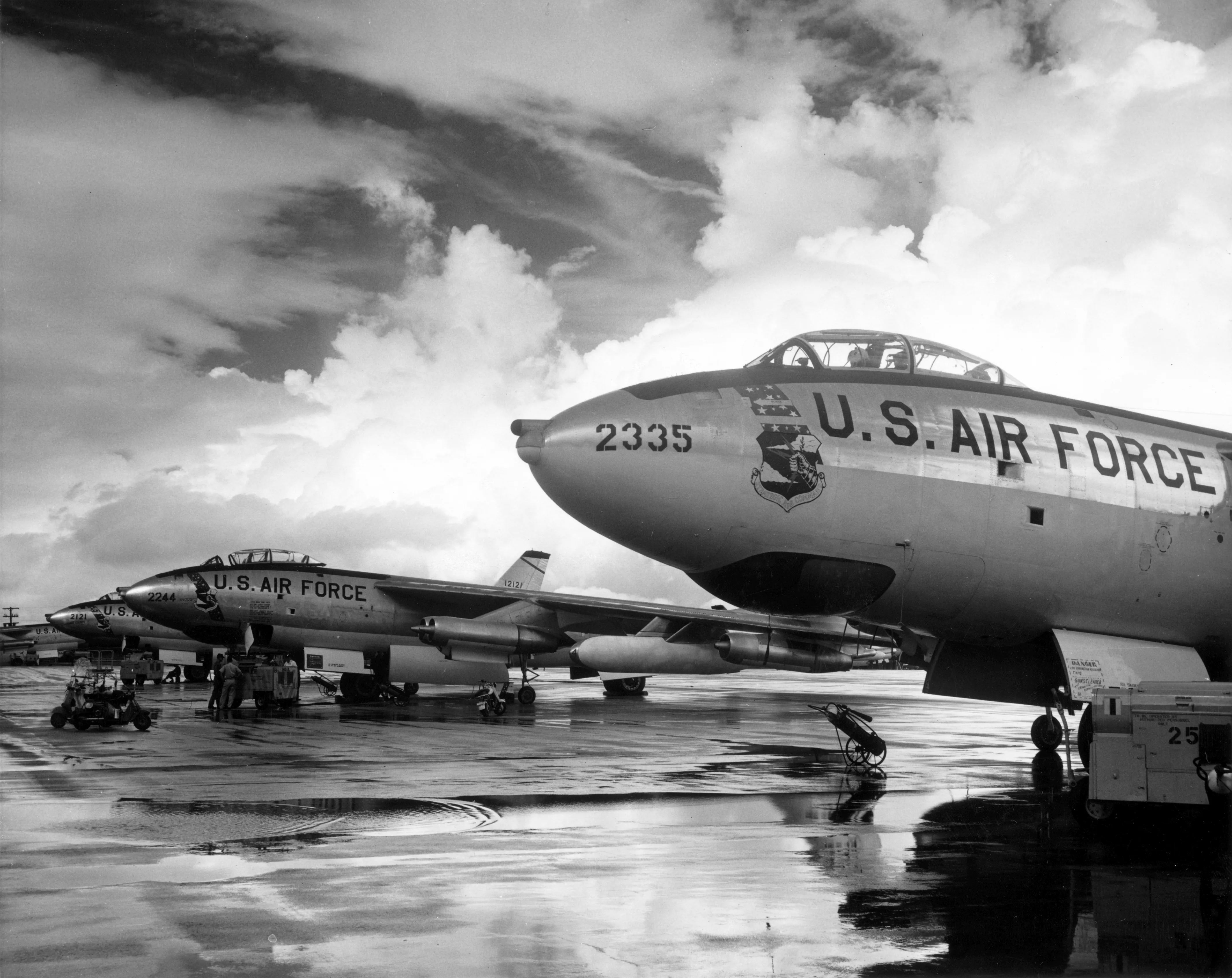
The aircraft was a Boeing RB-47H Stratojet, the electronic-reconnaissance variant of the swept-wing jet bomber, flying out of Forbes Air Force Base in Topeka, Kansas. A standard B-47 carried three crew. This one carried six. Behind the usual flight crew of pilot, copilot, and navigator sat three additional electronic-warfare officers, known in the trade as “Ravens,” riding in a pressurized capsule in the bomb bay and hunched over intercept gear whose entire purpose was to listen for and characterize hostile radar.
Secondary sources attribute the plane to the 55th Strategic Reconnaissance Wing and give a tail number, reportedly 53-4296, though another summary lists 53-4299. Neither the exact serial nor the precise squadron designation could be confirmed from a primary military record, so we leave them aside.
The mission was a composite training flight: gunnery work over the Texas-Gulf area, a navigation leg out over the open Gulf of Mexico, and an electronic-countermeasures exercise on the way home across the south-central states. The route ran in the early-morning hours from over the Gulf near Mississippi, west-northwest across Louisiana and Texas, and up toward Oklahoma.
It began with a signal, not a sighting. Somewhere over the Mississippi area, the No. 2 ECM monitor, Capt. Frank B. McClure, caught something on his scope that behaved wrong. It rose up the display the way a fast-scanning ground radar would. But instead of sweeping past, it seemed to settle in and track along with the aircraft. McClure’s first thought was the natural one: his own equipment was acting up.
Over Louisiana, near Winnsboro, the account moved from the instruments to the windscreen. The pilot, Maj. Lewis D. Chase, and his copilot, Capt. James H. McCoid, reported an intense blue-white light that came up on the aircraft, crossed in front of it at high speed, and then, in the crew’s word, “blink out.”
As the jet pressed on toward the Dallas-Fort Worth area, the two channels began to line up. McClure reset his monitor and again picked up the signal, at the same relative bearing where the light had appeared. The No. 1 monitor, John J. Provenzano, tuned to the same band and found it too, at the same bearing. Here is the detail that has occupied analysts ever since. The signal held a constant bearing relative to the aircraft while that aircraft was moving at roughly 500 miles per hour. A fixed radar on the ground cannot do that. As you fly past a ground emitter, its bearing slides behind you. This one did not slide.
Near Dallas-Fort Worth the picture grew busier. Chase reacquired the light visually, a large luminous source, at one point estimated to be below the aircraft, while the electronic gear held the signal. The crew got on the radio to ground control. The Duncanville, Texas radar site, the 745th Aircraft Control and Warning Squadron, call sign “Utah,” came back with the line that turns this from a story into a case. The Condon Report later recorded it this way:
“Ground Control in the area informed the pilot that both his plane and the other target showed on their radar, the other target holding a range of ten miles from him.”
Now there were three. The crew could see it. The onboard receiver heard it. A radar set on the ground, looking up, painted it ten miles off the RB-47’s flank.
What happened next is the single most-cited moment in the whole episode. Again from the Condon text:
“As the plane got close to it and flew over it, the target disappeared from visual observation, from monitor number two, and from ground radar.”
One instant. Three channels. Gone. Then, the record says, it came back.
With fuel running low, Chase eventually broke off the chase as the aircraft continued toward Oklahoma, and the contact faded out. By the reconstructions, the object had been near the aircraft over a distance of roughly 600 to 700-plus miles, for more than an hour.
The crew, as the names come down to us through the sources: Maj. Lewis D. Chase, pilot; Capt. James H. McCoid, copilot; Capt. Thomas H. Hanley, navigator; and the three Ravens, Provenzano, McClure, and Walter A. Tuchscherer.
What happened to the paperwork afterward is its own small mystery, and it matters. Project Blue Book, the Air Force’s UFO clearinghouse, did not get the case at the time. Air Defense Command forwarded summary information months later. The file points to an October 1957 receipt and a November forwarding date, well after the July event. When investigators finally went looking for the original records, the dates in the file did not line up. A key document, a twelve-page Airborne Observer’s Data Sheet prepared by Maj. Chase, is dated September 10, 1957, and for a time the incident itself was filed under September dates rather than its true date of July 17. The contemporaneous paper trail was both late and internally inconsistent.
Then there is Blue Book’s actual disposition. The file resolved the sighting as a known object, stating that “it was definitely established by the CAA that object observed in the vicinity of Dallas and Ft. Worth was an airliner,” and associating the case with a separate near-miss involving American Airlines Flight 655. That single sentence, case closed, it was an airliner, is the thing every later analyst, skeptic and proponent alike, has had to wrestle with.
The Evidence
The genuinely hard part of this case is multi-channel correlation. It is taken seriously not because the light was bright or the crew was sure, but because the object was reportedly registered on three physically independent detection systems that appeared and disappeared together.
The visual channel. The flight crew described an intensely luminous light, blue-white and at times red, that moved fast, crossed the flight path, paced the aircraft, and blinked out. The Condon abstract calls it “a large ball of light.” That is the whole of it. The record describes a light, and later a ball of light. It says nothing about a shape, a structure, or an origin, and neither will we.
The electronic channel. This is what sets the case apart from the great mass of radar-and-eyewitness reports. By McDonald’s account, the No. 2 monitor’s gear was an ALA-6 direction-finder with spinning antennas feeding an APR-9 receiver and an ALA-5 pulse analyzer, a passive system. It does not transmit. It only listens for radar emissions arriving from outside. So if it registered a signal, that signal had to come from a source out in the world, with the properties of a radar.
Here we reach the discrepancy that sits at the dead center of the entire debate, and that no honest account can paper over. The two most authoritative sources give two different frequencies.
McDonald, the atmospheric physicist who later reconstructed the case in detail, recorded the intercepted signal as “2995 mc to 3000 mc,” about 3,000 MHz, with a pulse width of 2.0 microseconds and a pulse repetition frequency of 600 cycles per second. (“mc,” or megacycles, is simply the period term for what we now call MHz.) Gordon Thayer, the radar specialist who wrote up the case for the Condon Committee, recorded it differently: “about 2,800 mHz.”
That gap of roughly 200 MHz is not a rounding quibble. It is, arguably, the whole case. About 2,800 MHz was a frequency emitted by ground radars of the era, the CPS-6B type used at nearby airfields. If the true frequency was around 2,800, the signal looks suspiciously like something that was always on the ground. If it was nearer 3,000, that explanation gets harder. Thayer wrote his number down knowing exactly what it implied. McDonald wrote his down working from documents Thayer never had. Both fall in the S-band range. Which one is right would go a long way toward settling the case, and we do not get to know.
The diagnostic point that survives either frequency is the geometry. The signal held a roughly constant bearing relative to a 500-mph aircraft, and two separate monitors found it at the same bearing. A stationary emitter on the ground should not behave that way.
The ground-radar channel. Independent of anything aboard the aircraft, the Duncanville site reportedly held a second target near the RB-47 at about ten miles’ range. Ground radar transmits its own pulses and watches for the echo. That is a different physical principle from the passive listening gear in the bomb bay. Two such different systems, plus human eyes, allegedly converged on the same object in the same place. That is the load-bearing fact of the whole case.
What did the people who studied it most carefully conclude? Here we must be precise, because this case is routinely misdescribed.
The Condon Report, the University of Colorado’s federally funded study published in 1968, examined the incident as its Case 5, and Thayer was unable to explain it. It stands among the report’s unexplained cases. But the preserved Case 5 text is far more hedged than the word “unexplained” suggests. Thayer’s conclusion leans heavily on the weaknesses of his own evidence:
“Evaluation of the experience must, therefore, rest entirely on the recollection of crew members ten years after the event. These descriptions are not adequate to allow identification of the phenomenon encountered.”
In the same breath he raised a mundane possibility:
“The fact that the frequency received on number two, about 2,800 mHz., was one of the frequencies emitted from ground radar stations (CPS6B type antennas) at an airport and other airports near by, makes one suspect this possibility.”
So the accurate summary is this. Thayer could not identify the object and left it unexplained. He did so while flagging that his analysis rested on decade-old memories and an incomplete record, and while pointing toward a possible terrestrial mechanism. That is a long way from a ringing endorsement of something extraordinary, and anyone who tells you the Condon Committee certified this as inexplicable is overstating the page.
Thayer is also widely quoted calling the “airliner” explanation “literally ridiculous.” That phrase is genuinely attributed to him in the literature, and it captures the obvious objection: a commercial airliner cannot emit an S-band radar signal or pace a jet the way this object reportedly did. We should be honest, though, that the quote does not appear in the Case 5 chapter itself. It comes to us through secondary sources and likely from Thayer’s other writing.
Then there is James E. McDonald. A University of Arizona atmospheric physicist, he interviewed all six crew members, tracked down official documents the Condon team had not used, corrected the muddled dating to July 17, and published his reconstruction in Flying Saucer Review in 1970. His argument was narrow and, on its own terms, strong. A malfunction can fool one receiver, and a mirage can fool the eyes, but the simultaneous drop of the object from visual, onboard ELINT, and ground radar, all at the same instant, is very hard to pin on any single ordinary cause. McDonald’s interpretation, however, is an interpretation. It is not the consensus, and we will not present it as one.
The Theories
Everything in this section is a hypothesis. None has carried the day.
An airliner, or another aircraft. This was Blue Book’s own disposition. Its fatal weakness is the one Thayer is quoted skewering: an airliner cannot produce the ~3,000 MHz S-band signal on the passive gear, cannot account for the rapid position changes, and cannot vanish simultaneously from three channels. As a complete explanation it does not survive contact with the instrumental record.
Stray ground radar plus a grab-bag of ordinary events. This is the serious skeptical case, made most prominently by Philip J. Klass and developed by Tim Printy. The argument is that no single object was ever there. A bright meteor supplied the first visual flash, an airliner supplied a later visual, equipment behavior and the reception of ground-radar signals supplied the electronic contacts, and the human mind stitched these into one tracking thing. Its strongest support is Thayer’s own number. If the intercept really was near 2,800 MHz, it matches a CPS-6B ground radar, and Printy reasonably asks why a genuine unknown would happen to emit a signal indistinguishable from a US military S-band set. (A specific version pointed to Keesler Air Force Base’s training radar near Biloxi. When Brad Sparks argued that radar was inactive that month, Printy rebutted him with documentation that Keesler was at maximum training capacity in July 1957.) The honest counterweight: even some skeptics concede Klass’s analysis contains errors, and the hypothesis still has to explain the constant relative bearing of the signal as the aircraft moved at 500 mph, and the lockstep correlation and disappearance across visual, ground radar, and onboard ECM all at once. A single stray-radar mechanism does not obviously deliver all three in unison.
Onboard equipment malfunction. This was McClure’s own first instinct. But a malfunction in one receiver does not explain an independent ground radar holding a target at ten miles, nor the naked-eye sighting, nor the cross-channel timing. The fact that a second monitor and a ground station also reported the contact is what weakens a pure-malfunction account.
Atmospheric anomalies: inversion layers, mirage, anomalous propagation. A temperature inversion can bend both light and radar and conjure ghost returns. It is the standard explanation for radar-only or visual-only oddities. It struggles here because it does not naturally produce a coherent S-band signal at a discrete pulse width and PRF, arriving in step with a correlated visual and ground-radar object that then disappears across every channel together. This explanation is invoked often and generically, but it fits this specific instrumental record poorly.
A bright meteor or fireball. This is a plausible source for that first blue-white streak across the windscreen. But a meteor lasts seconds. It cannot pace an aircraft for an extended stretch or correlate with sustained electronic and ground-radar contacts. At most it explains one moment, not the hour.
What Remains Unknown
Set the hypotheses side by side and the same hard kernel survives all of them. Reportedly, three independent systems converged on one object over hundreds of miles: human vision, passive S-band ELINT aboard the aircraft, and ground radar. The electronic signal held a constant bearing against a fast-moving jet. All three channels recorded a shared, simultaneous disappearance and reappearance. No proposed mundane mechanism cleanly accounts for all of that at once. That is precisely why the case is cited, again and again, as one of the better-documented unexplained radar-and-visual encounters on record.
But the strongest skeptical reply is not a rival object. It is evidentiary, and it is the same point Thayer made from the inside. The detailed reconstruction we have leans heavily on crew recollections gathered roughly a decade after the night in question, supported by a contemporaneous paper trail that arrived late and was internally misdated. We are not weighing a clean instrumental dataset. We are weighing memory, partial records, and two respected analysts who could not even agree on the frequency.
So we will not tell you it was a craft, because the record describes a light and a signal and nothing about shape or origin. We will not tell you it was an airliner, because the instruments say otherwise and the man who wrote the official study reportedly called that idea ridiculous. We will not tell you it was covered up, because what the documents actually show is bureaucratic delay, a questionable “airliner” disposition, and reports that went missing or got misdated. That is a more ordinary failure, and in its way a more believable one. We will not tell you the frequency, because the two best sources hand us two different numbers, and the gap between them is the gap between an answer and a mystery.
What we can tell you is that on a July night in 1957, something showed up on three machines at the same time, and then it didn’t. The file is still open.
Sources
Primary / official
- Condon Report, Case 5 (Gordon David Thayer), full text
- Project Blue Book RB-47 file, The Black Vault (casefile)
- Project Blue Book RB-47 file, The Black Vault (scanned documents, PDF)
- James E. McDonald, “The RB-47 Radar-ELINT (ECM) UFO Incident (1957),” Flying Saucer Review, 1970