Disappearances Case file
The Walk in the Cameron Highlands: The Disappearance of Jim Thompson, 1967
A globally famous man walked out of a hill bungalow in Malaysia on Easter Sunday 1967 to take an afternoon stroll and never came back. One of the largest land searches in Malaysian history found no body and no trace, and the cause of his disappearance has never been established.
- Case type
- Disappearance
- Status
- Unexplained
- Event date
- March 26, 1967
- Location
- The Cameron Highlands, Malaysia (a hill-station region where Thompson was on an Easter holiday, staying at a bungalow commonly called Moonlight) - Malaysia
- Evidence
-
- Official record
- Testimonial
The open question What happened to Jim Thompson after he walked out of a Cameron Highlands bungalow on Easter Sunday 1967, and why was no trace of him ever found?
On Easter Sunday, 26 March 1967, Jim Thompson finished lunch at a hill bungalow in the Cameron Highlands of Malaysia and went out for a walk. He was on holiday with friends. He was sixty years old, an American who had built one of Asia’s best-known businesses and was recognized on sight in Bangkok and beyond. Some accounts have him seen by a cook at a nearby bungalow in the late afternoon. By evening he had not come back. The search that followed was among the largest land searches in Malaysian history, drawing in police, soldiers, Orang Asli trackers, dogs, aircraft, and even psychics, and it found no body, no clothing, and no trace. He was declared legally dead seven years later. No one has ever established what happened to him.
That is the documented core of the case, and it is worth holding onto, because Thompson’s vanishing has since collected explanations far more dramatic than the record will bear. His wartime intelligence past has made the disappearance a magnet for spy stories, and a recent documentary claimed, on a single deathbed account its own producer could not corroborate, that he was executed. This is an account of who Thompson was, what the day and the search actually established, and what is only hypothesis. We keep three things separate, as always: what is documented, what the evidence shows, and what is only a hypothesis. There is no ending to dump in the first line, because no one has ever found one.
The documented account
James Harrison Wilson Thompson was born on 21 March 1906 in Greenville, Delaware, into a wealthy textile family. His maternal grandfather was the Union Civil War general James Harrison Wilson, for whom he was named. He attended St. Paul’s School in New Hampshire and graduated from Princeton in 1928, then studied architecture at the University of Pennsylvania without completing the degree, and practiced architecture in New York City through the 1930s.
In 1941 he enlisted in the Delaware National Guard, and he was recruited into the Office of Strategic Services, the wartime United States intelligence agency and the forerunner of the CIA, by its head, William J. Donovan. Thompson served in the OSS in North Africa and Europe, then worked with the Free Thai Movement against the Japanese occupation of Thailand, arriving in the country around the end of the war in August 1945 and organizing the OSS office in Bangkok. In 1946 he was attached to the United States legation there. Reputable accounts agree he held genuine intelligence credentials and was reportedly decorated for his service. The specific rank and the description of him as a de facto American ambassador appear in popular retellings, but neither is firmly established, and they are not stated as fact here. One detail is worth keeping, because it cuts against the later spy theories rather than for them: unlike several OSS colleagues, Thompson did not join the CIA when it was founded in 1947. He left government service, and reporting indicates he came to oppose the return of colonial powers to the region and later disagreed with American foreign policy, keeping contacts among Free Thai and Free Lao figures.
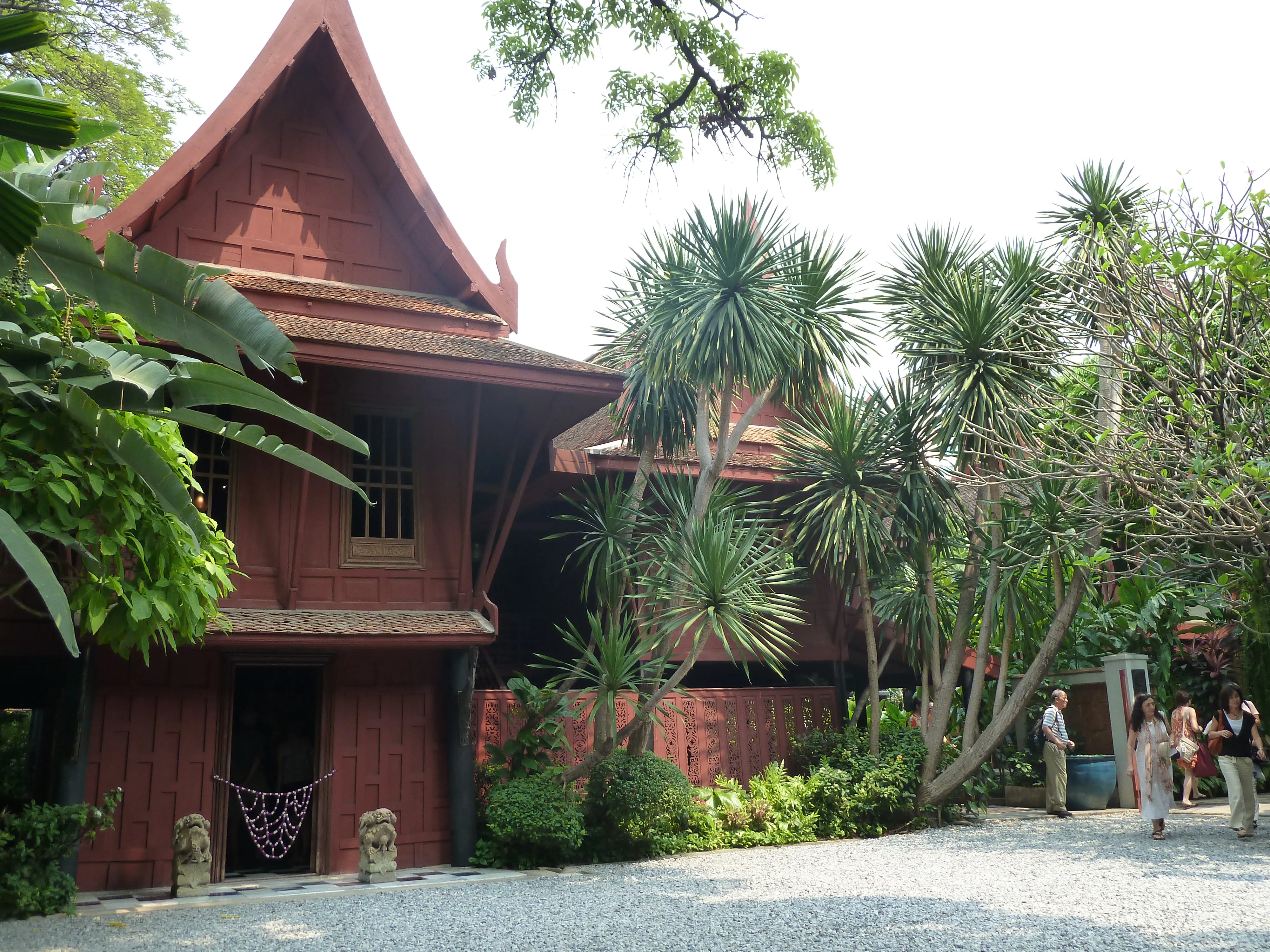
He settled in Bangkok and built a business around hand-woven Thai silk, drawing on the cottage weavers of the Ban Krua community. With a partner, George Barrie, he founded the Thai Silk Company in the late 1940s; the sources differ on the exact year, and the company was incorporated around 1951. The business won international attention when the costume designer Irene Sharaff used Thai silk for the 1951 stage production of The King and I. TIME later credited Thompson with having almost single-handedly saved Thailand’s silk industry from extinction, and that framing is widely repeated, though the exact contemporaneous wording is attributed here rather than quoted as confirmed text. Thailand awarded him the Order of the White Elephant in 1962. Around 1958 and 1959 he reassembled six traditional Thai teak houses on a plot beside a Bangkok canal, creating the home known as the House on the Klong and filling it with a substantial collection of Southeast Asian art. It is preserved today as the Jim Thompson House museum.
In late March 1967 Thompson traveled to the Cameron Highlands, a cool hill-station region of Malaysia, for an Easter holiday. He stayed at a bungalow commonly called Moonlight. The record names his hosts as Ling Tien Gi and his American-born wife, Helen Ling, with a longtime acquaintance, Constance Mangskau, also present. They appear in the account as the friends he was with, and nothing more. On the morning of Easter Sunday the party attended a church service. After lunch, Thompson went out for a walk and did not return. The standard timeline has him leaving in the early afternoon and possibly being seen by a cook at a nearby bungalow later in the day, with his absence noticed by the early evening, though the precise times trace mainly to one detailed secondary reconstruction and should be treated as approximate. He reportedly left behind personal items, including his medication and, by some accounts, his cigarettes, which struck people who knew him as out of character. (The Jim Thompson Foundation gives the date as 27 March; most sources, and the Easter Sunday framing, place it on the 26th, which is the date used here.)
What followed was one of the largest land searches in Malaysian history. Reputable accounts describe several hundred personnel, with a commonly cited core of around 325 Malaysian police and roughly 30 Orang Asli trackers, joined by soldiers, tracker dogs, and aircraft. When volunteers, scouts, and others are counted, the figure rises in some tellings to more than 500. The intensive phase lasted roughly ten or eleven days, with sporadic searching for months afterward, across an area the sources put at anywhere from a few square miles to a much wider radius. Psychics were brought in, most famously the Dutch clairvoyant Peter Hurkos, who declared that Thompson was alive and had been abducted. The search found no body, no clothing, and no trace. Thompson was declared legally dead by a Thai court in 1974, seven years after he vanished, and his estate passed to his nephew, Henry B. Thompson III, who donated the house and collection to the Foundation. In 1985, bone fragments were reportedly found in the area; they were never confirmed to be Thompson’s. No remains of his have ever been produced.
The evidence
Strip away the spy stories and the case rests on very little, and the most important item on the list is not a thing but an absence. The evidence that bears on Thompson’s fate is almost entirely negative.
The decisive absence. After he walked out on the afternoon of 26 March 1967, there is no body, no clothing, no blood, no ransom note, and no confirmed physical trace of Jim Thompson. This is the load-bearing fact of the entire case. Every theory below is built on this void.
The day’s timeline. The reconstruction is consistent across sources: church in the morning, lunch, an afternoon walk, a failure to return. Its limits are real. The precise times, an early-afternoon departure, a late-afternoon sighting by a cook, an early-evening alarm, trace mainly to one detailed secondary account and to the biography it draws on. Whether Thompson said where he was going, and whether the late-afternoon sighting is firm, are not securely established. The timeline fixes the shape of the day better than it fixes his fate.
The items left behind. Multiple reputable sources report that Thompson left personal effects, including his medication and cigarettes. People who knew him read this as evidence against a planned, voluntary departure, on the reasoning that a man intending to vanish would have taken what he needed. That is suggestive, but it is an inference, not proof. It tells us something about how the disappearance looked to those close to him; it does not tell us what became of him.
The tracker dogs. One detailed account reports that dogs found no scent trails down the access road or into the jungle. A negative scent result is weak evidence in either direction, it comes from a single secondary source, and it should not be over-read.
The search itself. The scale of the effort is well attested, even as the exact numbers conflict between sources. What it shows is genuinely notable: a serious, large, sustained search of difficult terrain found nothing. What it does not show is that the body is therefore not in the jungle. The probability analysis below estimates, on the contrary, that a search of that kind could plausibly have missed a body.
The 1985 bone fragments. Bone fragments were reportedly found in the area in 1985. They were never confirmed by any test to be Thompson’s, and their current whereabouts are unclear. This is at best an unconfirmed lead, not an identification. One researcher linked them to a possible road-accident scenario, but that connection is a hypothesis, not a finding.
A search-and-rescue probability analysis. A modern search-and-rescue analysis, circulated in recent years, reportedly concludes that the probability, not the certainty, is that Thompson’s remains lie undiscovered in the Cameron Highlands, and estimates that the 1967 search had only a modest chance of detecting a body in that terrain. This is a modeling exercise that favors the most mundane outcome; it is not physical evidence, and the full report was not reviewed for this account. It is the closest thing the case has to an analytic answer, and even it is framed as probability rather than proof.
The contemporaneous reporting. TIME covered the disappearance in 1967 and Thompson’s silk career earlier, and these are the closest contemporaneous reputable sources. The archive pages are subscriber-gated, so the specific quotations attributed to TIME, including the silk-industry line and the statements credited to Peter Hurkos, are presented here as attributed rather than as confirmed verbatim text.
The honest summary of the evidence is short. A man walked into the jungle and did not come out, and a very large search of that jungle found no sign of him. Everything beyond that is an attempt to fill the space the missing body leaves.
The theories
Everything in this section is a hypothesis. None of it is proven. Several of these theories touch sensitive ground, the most charged of them naming an organization and long-dead individuals in a killing that was never established, and they are handled here as attributed, contested speculation and nothing more. The ordering reflects what the evidence will and will not bear, not certainty.
An accident, getting lost, or an animal. The lowest-drama explanation is that Thompson lost his way, fell, suffered a sudden health event, or was killed by a wild animal in difficult terrain, with no other party involved. The case for it is that the country is genuinely dangerous, that it requires no culprit, and that the search-and-rescue analysis favors the conclusion that his remains are still somewhere in the Highlands. A popular-history account, drawing on that analysis, has put the point as the most straightforward answer being the most probable: that Thompson got lost, had an accident, and died. That assessment belongs to that secondary source and is recorded here as its view, not as a conclusion of this publication. The case against it is the case against all of them: a search of unusual scale, with trackers and dogs, found no body. This is the most parsimonious explanation, the one the evidence leans toward, and it is still unproven.
A voluntary disappearance. That Thompson chose to vanish, for personal or financial reasons. One biographical strand reportedly suggests he was under financial strain and might have walked away to avoid difficulty. That claim is thinly and inconsistently sourced; other accounts treat the business as substantial. It also runs against the items he left behind, including his medication, and against the absence of any sign that he ever resurfaced. It is attributed speculation, and the financial-motive version in particular rests on weak ground.
Murder by business rivals. That competitors in the silk trade had him killed. He was a dominant figure in a lucrative industry, but there is no body, no ransom, and no named perpetrator, and this is among the thinnest theories in the file. Attributed speculation, unsupported.
Something tied to his intelligence past. Because of his OSS background and his political contacts in the region, some accounts speculate that Thompson was abducted or killed in connection with Cold War intelligence work, during the years of the Vietnam War. The psychic Peter Hurkos’s 1967 claim that Thompson was alive and held by communist forces belongs to this cluster as period color, not as evidence. The case for it is his genuine intelligence pedigree. The case against it is that no agency, no operation, and no named person has ever been shown to be involved, and that this is the cluster most prone to conspiracy inflation. This publication names no agency and no living person, because the record supports none. Attributed speculation.
An execution by the Communist Party of Malaya. The most recent claimed solution was advanced in a 2017 documentary by the producer Barry Broman. As reported, the chain ran from a Thai friend of Thompson’s, to a man named Teo Pin, to a deathbed account by Teo Pin’s uncle, said to have been a senior CPM figure, that the party had killed Thompson and ensured no remains were found. The stated motive was that Thompson had reportedly asked to be put in contact with the CPM’s leader, drawing suspicion in a region that was a real CPM stronghold. The theory is internally coherent, and the area’s history is genuine. But it rests on a single, third-hand, unverifiable deathbed account, and the producer himself said so on the record: by his own account, he told his informant that the information needed corroboration, asked whether anyone could confirm the uncle’s story, and was told that no one could. The theory is presented here strictly as the documentary’s own explicitly uncorroborated claim. It is not established that the CPM killed Jim Thompson.
A road accident with a concealed body. That Thompson was struck by a vehicle near the road and the body hidden, which would explain why jungle searchers found nothing. This is the scenario one researcher tied to the unconfirmed 1985 bone fragments. The bones were never confirmed to be his, and the connection remains conjecture. Attributed speculation.
None of the six is proven. Each is a way of filling a space that the evidence leaves empty.
What remains unknown
The honest residue of the Thompson case is narrow, and decades of theory have not closed it.
A celebrated man finished lunch at a hill bungalow on Easter Sunday 1967, went out for an afternoon walk, and did not come back. One of the largest land searches in Malaysian history, with hundreds of personnel, trackers, dogs, and aircraft, found no body, no clothing, and no trace. He was declared legally dead in 1974. The cause of his disappearance has never been established. The most likely explanation, that the terrain itself killed him, fits the danger of the country and the absence of any culprit, but it is an inference unconfirmed by any remains.
Several plain questions sit at the center of it and none has a documented answer. Did Thompson say where he was going? Was the late-afternoon sighting real? Why did he leave his medication behind? Where, if anywhere, are his remains? The record is silent on all four.
There is one further sorrow attached to the year, and it is set down here only with care. A few months after Thompson vanished, his sister, Katherine Thompson Wood, was murdered at her home in the United States, and that killing was also never solved. The sources conflict on where she died, so no specific place is stated here. The two events have invited the suggestion that they were connected, but an analysis of the case found no provable link between them, and it should be read as attributed speculation rather than fact. It is recorded because it is part of the documented public history of the family, and for no other reason.
So we will not tell you that the CIA or any other agency took him, because no agency and no person has ever been shown to have. We will not tell you the Communist Party of Malaya executed him, because the only account that says so could not be corroborated, by the admission of the man who reported it. We will not tell you he walked away on purpose, because the things he left behind argue against it and no trace of him ever surfaced. We will not tell you the bones were his, because they were never confirmed. What we can tell you is that on Easter Sunday 1967, a famous man went for a walk in the Cameron Highlands and was never seen again, and that the most honest reading of the evidence is also the quietest one: that the country most likely took him, and that even this is not proven. The file is still open.
Sources
Primary / near-primary
- TIME magazine archive, “Thailand: Air of Intrigue” (1967)
- TIME magazine archive, contemporaneous silk-king coverage
- James H.W. Thompson Foundation / Jim Thompson House, “Foundation”
The TIME archive pages are subscriber-gated and were read in summary, not in full text; the quotations attributed to TIME above are presented as attributed rather than as confirmed verbatim wording. William Warren’s biography of Thompson, first published in 1970 as The Legendary American and later reissued as Jim Thompson: The Unsolved Mystery, is the primary source behind most of the disappearance-day detail and is named here for the reader who wants the original account.
Secondary / contextual
- Wikipedia, “Disappearance of Jim Thompson”
- Wikipedia, “Jim Thompson (designer)”
- Penn Museum, Expedition magazine, Alessandro Pezzati, “Jim Thompson, the Thai Silk King” (2011)
- TIME, “Jim Thompson: Thai Silk and a Mysterious Disappearance” (2016)
- Asia Times, “Solving the mystery of Jim Thompson’s murder” (2017)
- Free Malaysia Today, “Gone in Cameron Highlands: the mystery of Jim Thompson” (2022)
- Khaosod English, “Jim Thompson Disappearance: Case Solved?” (2017)
- Historic Mysteries, “The Disappearance of Jim Thompson, the Man Who Saved Silk”
- Business Destinations, “Jim Thompson: the legacy of the Thai silk king”