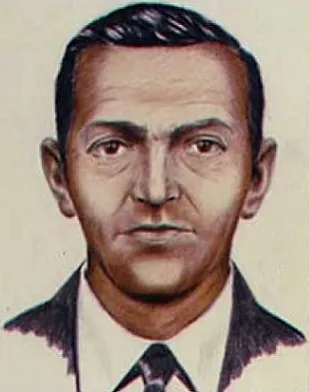
Cold Cases Case file
The Man Who Jumped: The Unsolved Hijacking of Flight 305, 1971
On the night before Thanksgiving 1971, a man in a dark suit hijacked a Northwest Orient jet, took $200,000 and four parachutes, and jumped into the dark over southwest Washington. After one of the largest manhunts in FBI history, the only unsolved air-piracy case in United States history was closed without a name. Who he was, and whether he survived the jump, are both still open.
- Case type
- Cold case
- Status
- Unexplained
- Event date
- November 24, 1971
- Location
- Southwest Washington / the Pacific Northwest (Northwest Orient Flight 305 ran Portland, Oregon to Seattle, Washington; the hijacker parachuted over southwest Washington, with the estimated drop zone near Ariel and Lake Merwin) - United States
- Evidence
-
- Official record
- Testimonial
- Physical
The open question Who was the man who hijacked Flight 305 and parachuted into the night, and did he survive the jump?
On the afternoon before Thanksgiving in 1971, a man bought a one-way ticket in Portland under the name Dan Cooper, boarded a short Northwest Orient flight to Seattle, ordered a bourbon and soda, and handed a flight attendant a note. The note told her he had a bomb. Some hours later, on the leg south out of Seattle, that man lowered the rear stairway of a Boeing 727 in flight, stepped off into the November dark over southwest Washington with $200,000 strapped to him, and was never seen again.
The case is often told as a caper, a polite man in a dark suit who beat the FBI and vanished into legend. That telling is the thing rigor has to correct. What the record actually holds is a documented federal air-piracy investigation, codenamed NORJAK, that ran for forty-five years, processed somewhere between hundreds and more than a thousand serious suspects, filled sixty-six volumes, and was formally suspended in 2016 with no one identified. It is described as the only unsolved act of air piracy in United States history. Two questions sit at the center of it, and after one of the largest manhunts the Bureau ever mounted, neither is answered: who the man was, and whether he survived the jump. This is an account of what the record holds, what the evidence can and cannot establish, and where the theories begin. We keep three things separate, as always: what is documented, what the evidence shows, and what is still only a hypothesis.
The documented account
Start with the name, because the famous one is wrong. The hijacker bought his ticket as “Dan Cooper.” The version that stuck to the case, “D.B. Cooper,” was a news-wire error: in the rush of early reporting the alias was garbled, and the mistake was compounded by police having briefly questioned and cleared an unrelated local man who happened to be named D.B. Cooper. The wrong name propagated across the wires and became permanent. It was never the hijacker’s chosen alias.
The flight was Northwest Orient Airlines Flight 305, a Boeing 727, running the short hop from Portland International Airport in Oregon to Seattle-Tacoma International Airport in Washington on 24 November 1971. There were 36 passengers aboard and a crew of six: two pilots, a flight engineer, and three flight attendants, among them Florence Schaffner and Tina Mucklow.
Shortly after takeoff, Cooper passed Schaffner a note indicating he had a bomb. The original note was, by the dominant account, later handed back to him at his demand and never recovered by the FBI, so its exact wording is not on the record; the lines often quoted are a reconstruction, not a preserved document. What is documented is that when Schaffner sat beside him, he opened a briefcase to show her what appeared to be a bomb, described as cylinders and wires. His demands were specific: $200,000 in cash and four parachutes, two main and two reserve, to be delivered when the plane reached Seattle. Witnesses described him as a man in roughly his mid-40s, in a dark business suit, white shirt, and narrow dark tie, calm and unhurried throughout.
On the ground at Seattle, the money and the parachutes were brought aboard. The ransom was $200,000 in $20 bills, ten thousand notes; the FBI had recorded the serial numbers before delivery, so the bills were traceable, though not physically marked. With the demands met, Cooper released all 36 passengers and part of the crew, including Schaffner, keeping a small crew aboard to fly him onward. Tina Mucklow was the flight attendant who remained.
He directed the crew to fly toward Mexico City, slow and low, with the cabin unpressurized and the 727’s rear airstair, a ventral stairway under the tail that could be opened in flight, lowered. The aircraft flew a deliberately slow, low-altitude profile through the night. Somewhere over southwest Washington, around 8:00 p.m. by the conservative account (some reconstructions place a tail-section pressure change slightly later, near 8:13 p.m.), Cooper went down the open stairway and jumped. The crew felt a brief pressure change consistent with the stairway and the jump. The plane flew on and landed at Reno, Nevada, with the airstair still down and the cabin empty. He was never seen again, never identified, and never found.
Where he came down is not known. An early estimate placed the jump near Ariel, Washington, and Lake Merwin; a later, wind-corrected recalculation pointed instead toward the Washougal River watershed. Both are estimates. A large multi-agency ground and air search of the estimated zone turned up no parachute, no body, and no money. The FBI later noted that physical evidence in parts of the area may have been disturbed by the 1980 eruption of Mount St. Helens.
One fragment of the ransom did surface. On 10 February 1980, an eight-year-old boy named Brian Ingram found bundles of decayed $20 bills while on a family outing at Tina Bar, a beach on the Columbia River downstream of Vancouver, Washington. The amount was about $5,800, in three deteriorated packets still bound by rubber bands, and the serial numbers matched the recorded ransom list. It is the only confirmed recovery of any of the money. It deepened the case rather than closing it.
The investigation that ran underneath all of this was codenamed NORJAK, for the Northwest hijacking. By the Bureau’s account it processed a very large number of serious suspects, with figures reported from roughly 800 up to more than a thousand, and the case file grew to sixty-six volumes. On 8 July 2016, the FBI suspended its active investigation. As reported in the coverage of that announcement, the Bureau said it had exhausted its credible leads over the forty-five-year investigation and was redirecting resources to other priorities, while noting that field offices would still accept physical evidence specifically tied to the parachutes or the money. No one had been identified. It stands as the only unsolved act of air piracy in United States history.
The evidence
The physical record in this case is unusually solid. It establishes, beyond reasonable doubt, that the crime happened essentially as described. What it does not do, in any single instance, is name the man. That is the pattern worth holding onto: every artifact is real, every artifact yields a suggestive lead, and not one of them closes the gap to an identity.
The composite sketches. Drawn from the crew’s descriptions, the sketches give a consistent likeness of a middle-aged man in a dark suit and thin tie, reproduced for decades. They establish a witness-derived image. They do not establish identity. A sketch is a reconstruction, not a forensic match, and over the years the same sketches have been used both to argue for and to argue against various candidates. They have no probative weight for any specific name.
The clip-on tie. Cooper left a black clip-on necktie and a tie clip aboard the aircraft. The tie is genuine, in evidence, and preserved, which makes it the case’s marquee artifact. An independent citizen-science group, the Cooper Research Team led by Tom Kaye, examined it under an electron microscope and reported finding large numbers of particles on it, including unalloyed (pure) titanium, rare-earth elements, and other industrial traces. Their interpretation evolved over time: an early reading suggested a connection to aerospace or to Boeing, where pure titanium was in industrial use in 1971, and a later revision moved away from that toward a metals or electronics-manufacturing environment. This is a lead, not a name. The researchers themselves have stressed that the particle work is suggestive and circumstantial, not proof, and it is an independent technical effort, not an FBI forensic conclusion. It does not establish where the man worked, let alone who he was.
The parachutes. Four chutes were supplied. One of the reserves was a non-functional training chute with its canopy sewn shut, meant only for classroom demonstration, and it was not found aboard afterward. From the apparent mishandling of the equipment, including the selection of a dummy reserve, the FBI inferred that Cooper was probably not a highly experienced parachutist, which cuts against the “expert paratrooper” profiles built around some suspects. The inference is reasonable but it is an inference. It does not establish his skill level conclusively, what he ultimately jumped with, or whether he lived.
The fingerprints and cigarette butts. The FBI lifted dozens of latent fingerprints from the cabin and recovered cigarette butts the man had left. These are real physical traces. They are also of limited value: the prints were never matched to any named individual, and a public airliner cabin makes it impossible to attribute every print to Cooper alone. The cigarette butts were reportedly lost before modern DNA techniques became available, and any DNA profile associated with the case is of uncertain provenance. It has been used, where at all, to exclude candidates rather than to identify one, and the chain of custody is uncertain enough that no such exclusion should be treated as definitive.
The flight path and the drop zone. The reconstructed flight corridor over southwest Washington and the estimated jump window are documented. The landing point is not. Two competing estimates, the Ariel and Lake Merwin area and the wind-corrected Washougal watershed, and the complete absence of any recovered parachute or remains, mean that where he came down is genuinely unknown. The search of the estimated zone found nothing.
The Tina Bar money. About $5,800 of the ransom, with serial numbers matching the recorded list, on a Columbia River beach in 1980. This is the one hard forensic tie between the physical money and the crime, and it is real. But it complicates as much as it confirms. Geological and sediment analysis of the find has been reported to suggest the money arrived at the beach later than 1971, with later river dredging and a study of diatoms in the bundles pointing toward a deposit some time after the night of the jump. Those findings are reported and should be weighed as such, not as settled fact, but they sit awkwardly with any simple picture of the cash floating straight down the river that night. The money tells us a fraction of the ransom reached Tina Bar. It does not tell us by what route, where the man landed, or whether he survived.
The NORJAK file itself. The scale of the investigation is documented: forty-five years, a very large suspect pool, sixty-six volumes, multi-agency searches, and a formal suspension in 2016. What it establishes is the seriousness and the thoroughness of the effort. What it does not establish is a solution. The single most important fact in the entire file is the negative one. After one of the largest manhunts in FBI history, no identification was ever confirmed.
The theories
Everything in this section is hypothesis. The FBI confirmed none of it. The case has attracted a long roster of named candidates over the decades, advanced by authors, relatives, and documentary makers, and the discipline here is the one the publication always applies to suspects who were never charged: each is an attributed, unproven claim, and none is asserted as the answer.
Did he survive the jump? This is the first open question, and the honest answer is that no one knows. The argument for survival rests largely on the Tina Bar money: at least some of the cash left the plane and reached the ground, and some researchers contend that a capable jumper could have come through a night, low-altitude jump. The argument against is the circumstance of the jump itself. He went out at night, in reported poor weather, at low altitude over rugged forested terrain, in business clothes and street shoes, probably without expert skill if the dummy-chute inference holds, and he was never seen, identified, or found, with no body, no parachute, and no logical pattern of recovered money. The FBI’s working assumption leaned toward non-survival. But no remains were ever found, and he was never identified alive either. Both sides are real; neither is conclusive. The position the record supports is that it is unknown.
The named candidates, all unconfirmed. A few illustrate how the question has been worked, and each comes with the same caveat: the FBI did not confirm any of them. Richard Floyd McCoy Jr. (1942-1974), an Army veteran and pilot, carried out a strikingly similar hijacking-and-parachute extortion in April 1972, for which he was convicted, and he died in a 1974 shootout after a prison escape; the similarity kept him in the conversation for decades, but the FBI is reported to have eliminated him on description and timing grounds. In a recent development, a parachute rig linked to the late McCoy resurfaced, and the FBI examined it and returned it in late 2025 without tying it to the hijacking and without ruling it out. Kenneth Christiansen (1926-1994), a former paratrooper and Northwest Orient employee, was advanced in a 2010 book and a television episode, and the FBI rejected him as a prime suspect on a poor physical match. Robert Wesley Rackstraw (1943-2019), a Vietnam-era pilot promoted heavily in a 2016 book and documentary, was eliminated by the FBI in 1979 for lack of direct evidence and was, at 28, younger than the witness descriptions. Lynn Doyle “L.D.” Cooper (1931-1999) was named by a relative in 2011 and ruled out. Sheridan Peterson (1926-2021), a former Boeing technical editor, was floated and then reportedly excluded after a relative provided a DNA sample said not to match, though the uncertain handling of any “Cooper DNA” means that exclusion cannot be treated as definitive either. The pattern across the whole roster is the same. Names are proposed; the Bureau confirms none.
The “industrial worker” hypothesis. The tie-particle work generated a theory about occupation rather than identity: that Cooper may have worked in a metals or electronics-manufacturing environment, an early reading pointing toward aerospace or Boeing and a revised reading toward general industrial or electronics work. As in Layer 2, the researchers themselves frame this as a suggestive lead, not proof, and it should be read as a clue about a possible kind of work, never as an established fact that “Cooper worked at Boeing.”
What remains unknown
The case never closed, and the residue is the cleanest summary of it. No one knows who the man was. No one knows whether he lived or died after he stepped off the stairway. A short evening hop, a polite passenger in a dark suit, a note no one kept, $200,000 in recorded twenties exchanged for the safe release of 36 people, four parachutes including one useless sewn-shut dummy, a slow flight toward Mexico City with the tail stairs down, a jump into a Pacific Northwest November night, and, nine years later, about $5,800 surfacing on a riverbank with matching serial numbers and a deposit date that does not fit the simple story.
We will not tell you he died, because no body, no remains, and no parachute were ever found. We will not tell you he survived, because he was never identified alive and the circumstances of the jump argue against it. We will not tell you he was McCoy, or Christiansen, or Rackstraw, or any of the others, because the FBI confirmed none of them and a great deal of the case against each runs into mismatched descriptions, contested timing, or uncertain forensics. What we can tell you is the documented shape of the thing, and the negative fact that towers over it. After forty-five years, sixty-six volumes, and one of the largest manhunts in FBI history, the United States closed the only unsolved air-piracy case in its history without a name.
Sources
Primary
Secondary
- Britannica, “D.B. Cooper”
- Christian Science Monitor, “D.B. Cooper: FBI closes notorious unsolved skyjacking case” (13 July 2016)
- TIME, “D.B. Cooper Case No Longer Being Investigated by FBI” (2016)
- HISTORY, “Who Was the Mysterious Hijacker D.B. Cooper?”
- Rolling Stone, “D.B. Cooper: Flight Attendant Tina Mucklow Opens Up”
- NBC News, “Clip-On Tie Holds New Clues About Hijacker D.B. Cooper for Amateur Sleuths”
- The Seattle Times, “Did D.B. Cooper work at Boeing? Citizen Sleuths say maybe…”
- The Seattle Times, “Does that evidence truly tie D.B. Cooper to Boeing? Plot thickens”
- Citizen Sleuths / The Cooper Research Team, tie particle analysis
- Wikipedia, “D. B. Cooper”