Maritime Mysteries Case file
Holding Our Own: The Sinking of the Edmund Fitzgerald, 1975
The largest ship on the Great Lakes vanished from a companion vessel's radar in under ten minutes, with no distress call, on a November night in 1975. The storm sank her. Which failure delivered the killing blow is the part three official investigations could never agree on.
- Case type
- Maritime
- Status
- Unexplained
- Event date
- November 10, 1975
- Location
- Eastern Lake Superior, about 17 miles northwest of Whitefish Point, Michigan; the wreck lies in Canadian waters - Lake Superior - Canada (wreck site); the loss occurred on the US/Canada waters of Lake Superior
- Evidence
-
- Official record
- Testimonial
- Physical
The open question What sent the Edmund Fitzgerald to the bottom of Lake Superior in minutes, with no distress call, and why could the official investigations never agree on which failure caused it.
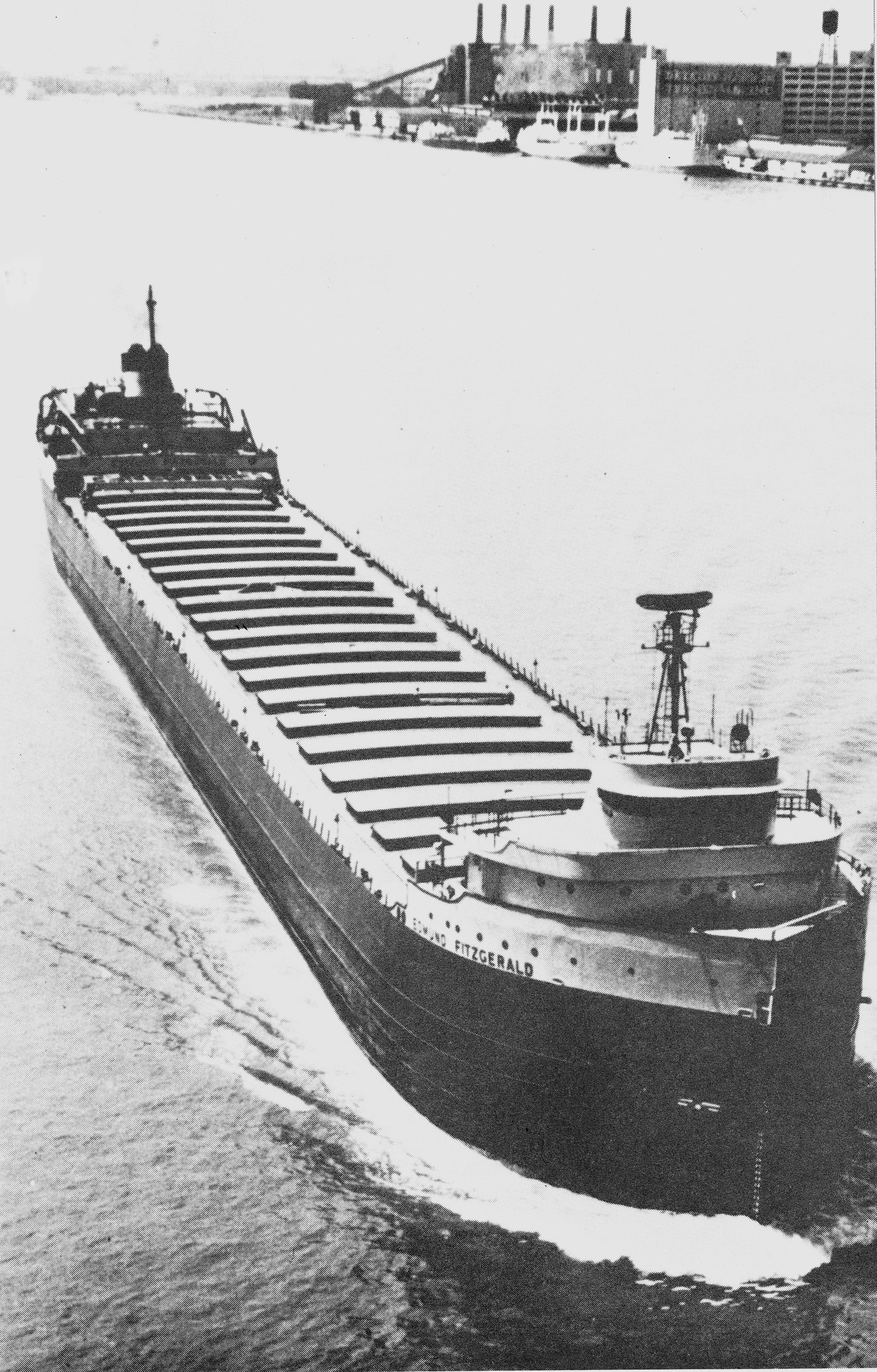
At about ten minutes past seven on the evening of 10 November 1975, the freighter Arthur M. Anderson radioed the ship ahead of her in a Lake Superior gale to ask how she was doing. The other ship was the Edmund Fitzgerald, the largest vessel on the Great Lakes, and her master, Captain Ernest M. McSorley, answered: “We are holding our own.” That was the last anyone heard from her. Within roughly ten minutes the Fitzgerald had vanished from the Anderson’s radar. No distress call was ever sent. The ship that had been steaming a few miles ahead was simply gone, and with her all twenty-nine men aboard.
It is important to be exact about what is and is not the mystery here, because the popular memory gets it backward. That a ship was lost in one of the worst storms Lake Superior produces is not strange and was never strange. November gales on the Lakes are killers, and the Fitzgerald was steaming through a severe one. The genuine open question is narrower and harder: why a 729-foot ore carrier, sound enough to report herself stable minutes earlier, went to the bottom in under ten minutes with no warning and no call for help, and which specific failure did it. On that question the official record is split three ways. A United States Coast Guard Marine Board, the National Transportation Safety Board, and the Lake Carriers’ Association reached three materially different conclusions, a member of the NTSB dissented from his own board, and the cause has never been settled in the fifty years since. We keep three things separate, as always: what is documented, what the evidence shows, and what is still only a hypothesis.
The documented account
The Edmund Fitzgerald was a Great Lakes bulk ore carrier, a “laker.” She was built by the Great Lakes Engineering Works at River Rouge, Michigan, and launched in June 1958. (She was not built by Northwestern Mutual; that company owned her. Some accounts conflate the two, and they should not be.) At 729 feet long she was the largest ship on the Great Lakes at her launch and held that distinction for about thirteen years, into the early 1970s. She was owned by the Northwestern Mutual Life Insurance Company of Milwaukee and operated under charter, running iron ore from the western Lake Superior ports down to the steel mills of the lower Lakes.
On 9 November 1975 the Fitzgerald loaded 26,116 long tons of taconite, iron-ore pellets, at Superior, Wisconsin, and departed in the early afternoon, bound for a steel mill near Detroit. She was under Captain McSorley, a veteran master, with a crew of twenty-nine. A second laker, the Arthur M. Anderson under Captain Jesse B. Cooper, was on a similar course. The two ships were in radio contact and rode out the storm together, the Fitzgerald ahead and the Anderson trailing some ten to fifteen miles behind. As the weather worsened, both captains altered course northward, toward the Canadian shore, seeking the shelter of the higher ground.
The storm itself was a major early-winter low crossing the Lakes on 9 and 10 November. The recorded conditions and the later testimony do not all agree, and the difference matters. The measured afternoon values, from the University of Wisconsin meteorological summary and the Anderson’s own observations, give northwest winds sustained in the low-to-mid 40s of knots and waves of about 12 to 16 feet. Higher figures circulate widely: gusts near 70 miles per hour and seas of 25 to 35 feet later in the evening, and Captain Cooper’s testimony that waves washed as high as 35 feet over the Anderson’s pilothouse. The lower numbers are the measured afternoon readings; the higher ones are later-evening peaks and personal estimate, not instrument data. A storm severe enough to overwhelm a laker is firmly established. The exact sea state at the moment the Fitzgerald was lost is not.
Through the afternoon the Fitzgerald reported trouble. McSorley radioed that the ship had developed a list, had lost some vent covers and a section of fence railing, and had both of her radars out, and he asked the Anderson to help him navigate. He told another vessel that he was in one of the worst seas he had ever seen. Then came the 7:10 p.m. exchange and “We are holding our own,” a reply about coping with the seas, not a report on the ship’s condition. Within about ten minutes the Anderson could neither raise the Fitzgerald by radio nor find her on radar. After a snow squall cleared, the ship ahead of them was no longer there. Captain Cooper reported his concern to the Coast Guard that evening, and a search began in the storm.
The wreck was located on 14 November 1975 by a US Navy aircraft using a magnetic anomaly detector, about 17 miles northwest of Whitefish Point in the Canadian waters of eastern Lake Superior, in roughly 530 feet of water. A US Navy unmanned submersible, CURV-III, surveyed the site the following May, in 1976. The survey showed the Fitzgerald lying in two large sections: the bow upright, the stern inverted, with a debris field between them. (The 1975 detection and the 1976 survey are separate events; the ship was found in 1975 and examined in detail in 1976.)
None of the twenty-nine crew were recovered. The standard explanation is Lake Superior’s cold fresh water, which stays cold enough year-round to inhibit the decomposition that would normally bring a body to the surface, so the dead remained with the wreck. The site is now treated as the crew’s grave. Out of respect for that, Ontario later restricted diving on the wreck, establishing a protected radius around it with licensing and heavy fines. In July 1995 an expedition organized by the Great Lakes Shipwreck Historical Society, the explorer Joseph MacInnis, and the National Geographic Society, supported by a Canadian navy vessel, recovered the ship’s bronze bell as a memorial and left in its place a replica engraved with the names of the twenty-nine crew. The recovery was carried out with the families’ consent, with relatives present, and the bell was rung once for each of the lost men. The restored bell is now the centerpiece of a memorial at Whitefish Point.
The evidence
For a sudden, all-hands loss, the Fitzgerald’s evidentiary record is unusually rich. There are two full federal investigations with hatch-cover modeling, the Anderson’s contemporaneous radio log and Captain Cooper’s testimony, weather-service and onboard storm data, and decades of underwater survey imagery. The central weakness is the one every such loss shares: there was no survivor, no recovered remains, no recovered log, and no recovered data from the ship herself. Every proposed cause is inferred from the wreck’s posture and the surrounding record, not observed. With that stated, here is what each channel shows and where it stops.
The Anderson’s radio log and Cooper’s testimony. The Anderson tracked the Fitzgerald by radar and radio through the storm, recorded the 7:10 p.m. exchange, and lost her shortly after. This is the single best contemporaneous account, and it fixes two things firmly: the time of the loss and its suddenness. The ship reported herself coping minutes before she vanished, and no distress call was sent. The limit is that it shows nothing about the mechanism. “Holding our own” described how she was managing the seas, not the state of her hull, and the gap between that message and the disappearance is exactly the unexplained interval. Cooper’s later figure of 35-foot waves over his pilothouse is testimony and estimate, not an instrument reading, and it conflicts with the measured afternoon values.
The reported topside damage. During the afternoon the Fitzgerald reported a list, lost vent covers and railing, and both radars out. This shows that the ship was already taking damage, and probably water, before she sank, consistent with a progressive loss of freeboard. The limit is that the precise nature and source of the damage is exactly what the investigations dispute. A list could come from flooding through the hatches, from the topside damage, or from a holed hull, and the radio reports cannot distinguish between them.
The storm data. Weather-service forecasts and onboard observations document a severe gale that worsened overnight: the warnings were upgraded, the Anderson logged afternoon winds in the low 40s of knots and waves of 12 to 16 feet, and conditions deteriorated into the evening. This establishes that the environment was unquestionably capable of overwhelming a laker. The limit, again, is the conflict in the wave figures, 12 to 16 feet measured against 25 to 35 feet estimated or testified later. The storm is established. The exact sea state at the moment of loss is not, and the most dramatic single wave height should not be treated as a measured fact.
The wreck itself. The Fitzgerald lies in two main pieces, bow upright and stern inverted, in about 530 feet of water, with a debris field between. This is the central physical datum and the battleground of the theories. A break could have happened at or near the surface, which points toward a structural failure, or on impact with the bottom after the ship sank intact and plunged, which points toward flooding. The CURV-III imagery and the later dives have been read both ways. The limit is decisive: the imagery is genuinely ambiguous on the sequence, which is why a 1989 review panel drew no firm conclusions and why naval-architecture re-analyses have continued. The wreck cannot, by itself, time the break.
The hatch covers. Both the Coast Guard and the NTSB examined the Fitzgerald’s hatch covers and clamps. The Coast Guard found many of the visible covers not secured to the coamings and most of the clamps undamaged, and both bodies modeled how much water the hatch design would admit. This makes the hatches physically central to the two flooding theories. The dispute is whether water came in gradually, through ineffective and loosely fastened closures, or suddenly, when covers collapsed under boarding seas. The limit is that the same physical findings support both readings: the undamaged clamps are read by the Coast Guard as evidence the covers were not properly fastened, and by the NTSB modeling as consistent with a sudden collapse. The Lake Carriers’ Association disputes the hatch mechanism altogether.
The Six Fathom Shoal data. Captain Cooper, and later the Lake Carriers’ Association, argued that the Fitzgerald passed dangerously close to the Six Fathom Shoal off Caribou Island while navigation aids in the area were out, and that a 1976 Canadian hydrographic survey found a shoal extending farther east than the charts of the day had shown. This offers a plausible mechanism for early hull damage that the charts would have hidden. The limit is that there is no agreed physical confirmation that the Fitzgerald struck the shoal. The bottom damage to the wreck is equally explained by the sinking and the impact, and whether the shoal claim is corroborated by hull damage is contested.
The thread running through all of it is the same. The record can establish that the ship was in a severe storm, that she was already damaged and listing, that she reported herself coping, and that she was gone ten minutes later, broken in two on the bottom. It cannot, on its own, establish which failure ended her.
The theories
Everything in this section is a hypothesis, and the most important fact about it is that the people who investigated the loss most closely did not agree. Three official bodies reached three different conclusions, and a member of one of them dissented. None of what follows was ever established as the answer, and none should be read as the answer here. They are set out as the documented disagreement they are.
The Coast Guard: gradual flooding through ineffective hatch closures. The Coast Guard Marine Board concluded, in summary, that the most probable cause was a loss of buoyancy and stability resulting from massive flooding of the cargo hold, with water entering through ineffective hatch closures as boarding seas swept the deck, accumulating gradually through the final day until the ship lost buoyancy and plunged without warning. (The exact wording of the report’s conclusion is paraphrased here and attributed as reported; it should be read in the Marine Casualty Report itself, which is the primary record.) The reading has been taken to imply that the hatch clamps were not properly fastened or maintained. In support: many visible covers found unsecured, the undamaged clamps, and the reported gradual list. Against it: the Lake Carriers’ Association and many mariners noted that the same hatch design had a long safe service record, and a gradual mechanism fits the near-instant final disappearance less well than a sudden one.
The NTSB: sudden flooding from the collapse of hatch covers. According to accounts of the NTSB report, the Board found a different probable cause: the sudden, massive flooding of the cargo hold caused by the collapse of one or more hatch covers under the weight of giant boarding seas, preceded by a loss of freeboard and a list from flooding through the topside damage and non-weathertight hatches. (Again, this is paraphrase attributed as reported, pending the primary report MAR-78-3.) The NTSB explicitly differed from the Coast Guard on sudden collapse versus gradual leakage, and supported its conclusion with computer modeling of the forces required to collapse the covers. In support: that force modeling, and a better fit to the speed of the loss. Against it: the Lake Carriers’ Association and the dissenting member rejected the hatch mechanism entirely. The hatch theory is disputed, not disproven; it was, after all, the official conclusion of both federal bodies in one form or another.
The NTSB dissent: shoaling. At least one member of the NTSB Board formally dissented from its finding. (We do not name the member; the attribution was not reliably confirmed.) The dissent held that the Fitzgerald sank suddenly from shoaling, a grounding or raking on the uncharted eastward extension of the Six Fathom Shoal, rather than from hatch failure. A formal dissent recorded within the federal report itself is, on its own, strong evidence that the cause was not settled even on the board that issued the finding.
The Lake Carriers’ Association: grounding on the Six Fathom Shoal. The Lake Carriers’ Association, an industry body, formally objected to the hatch finding, arguing that the one-piece covers had a long unblemished record and that the more probable cause was the ship grounding on the Six Fathom Shoal northwest of Caribou Island while key navigation aids were down, raking the hull and flooding her. Captain Cooper of the Anderson held a similar view. In support: the Anderson’s observation that the Fitzgerald ran close to the shoal, and the 1976 Canadian survey finding an uncharted shoal extension. Against it: no agreed physical confirmation of a shoal strike on the hull, and both the Coast Guard and the NTSB rejected grounding as the primary cause.
Structural failure at the surface. A separate expert hypothesis, not an official finding, holds that the Fitzgerald suffered a hull-girder failure and broke in two at or near the surface, rather than sinking intact and breaking on impact with the bottom. It is cited in support that the wreck lies in two pieces, and comparison is drawn to other Great Lakes hull-failure losses; the 1980 Cousteau dive speculated a surface breakup. The status is unresolved: the surface-versus-bottom timing of the break cannot be settled from the wreck imagery, which is the same ambiguity that defeats the other readings.
The “Three Sisters.” Mariners describe a Great Lakes phenomenon they call the “Three Sisters,” a series of three exceptionally large waves in quick succession, and the Anderson reportedly took such a sequence shortly before the Fitzgerald vanished. This is a proposed trigger rather than a standalone cause. A giant boarding sea is, in the NTSB account, exactly what collapses a hatch cover, so the rogue-wave idea can be folded into the flooding or breakup theories. It is plausible and unproven, and it should be treated as a possible trigger, not an established fact.
What remains unknown
The honest residue is this. A 729-foot ore carrier, the largest ship on the Lakes, loaded with iron-ore pellets and reporting herself stable, vanished from a companion ship’s radar in under ten minutes in a November gale, with no distress call, and came to rest in two pieces 530 feet down with all twenty-nine of her crew. The storm sank her. That much is not in dispute and never was. Which failure delivered the killing blow has never been agreed.
The Coast Guard concluded she flooded gradually through poorly secured hatches. The NTSB concluded she flooded suddenly when hatch covers collapsed. A member of the NTSB Board dissented for shoaling. The Lake Carriers’ Association blamed a grounding on an uncharted shoal. Independent experts have argued for a structural break-up at the surface, perhaps triggered by a sequence of rogue waves. Two federal bodies that examined the same wreck contradicted each other, and one of them split internally. That is the shape of this case: not a riddle nobody studied, but a documented disaster that the people who investigated it hardest could not resolve among themselves.
So we will not tell you the case is solved, because the official bodies that looked at it could not solve it and did not agree. We will not tell you any single mechanism is the answer, because the evidence that would distinguish among them, the timing of the break and the source of the flooding, was never recoverable. What we can tell you is that on a storm night in 1975 the largest ship on the Great Lakes reported that she was holding her own, and ten minutes later she was on the bottom of Lake Superior, and the question of exactly why remains officially undetermined fifty years on. The wreck is a grave, the bell rings for the crew at Whitefish Point, and the file is still open.
The loss is also the most famous shipwreck in the history of the Lakes, and the reason most people know it at all is Gordon Lightfoot’s 1976 song “The Wreck of the Edmund Fitzgerald.” The song is why the case endures in public memory. It is not a source, and none of its imagery is evidence about what happened.
Sources
Primary / official
- U.S. Coast Guard, Marine Casualty Report: SS Edmund Fitzgerald, Sinking in Lake Superior on 10 November 1975 with Loss of Life (Marine Board of Investigation; Commandant’s Action 26 July 1977)
- National Transportation Safety Board, Marine Accident Report MAR-78-3: SS Edmund Fitzgerald Sinking (adopted 4 May 1978)
The exact wording of the Coast Guard and NTSB conclusions is paraphrased and attributed as reported throughout this article rather than quoted verbatim; the two reports above are the primary records and should be consulted directly for their precise language.
Secondary / contextual
- Great Lakes Shipwreck Historical Society / Great Lakes Shipwreck Museum, “Edmund Fitzgerald”
- National Museum of the Great Lakes, “The Bell of the Fitzgerald, Fall 1995”
- University of Wisconsin CIMSS/SSEC, “The sinking of the SS Edmund Fitzgerald”
- Encyclopaedia Britannica, “Edmund Fitzgerald”
- Wisconsin Public Radio, “We Are Holding Our Own”
- Lake Superior Magazine, “Edmund Fitzgerald: Decades of Speculation, Fascination and Grieving”
- NOAA Office of National Marine Sanctuaries, “Edmund Fitzgerald”
- Smithsonian Magazine, “Nobody Knows What Sank the ‘Edmund Fitzgerald’”
- Wikipedia, “SS Edmund Fitzgerald”